



Community hub
Recent from talks
Knowledge base stats:
Talk channels stats:
Members stats:
483rd Tactical Airlift Wing
The 483rd Tactical Airlift Wing was a tactical airlift and composite wing assigned to Pacific Air Forces during the Vietnam War. It was the host organization at Cam Ranh Bay Air Base South Vietnam from 1970 to 1972.
The Wing was first organized as the 483rd Troop Carrier Wing during the Korean War, as an airlift organization assigned to Far East Air Forces (later Pacific Air Forces).
The wing was activated at Ashiya Air Base, Japan as the 483rd Troop Carrier Wing on 1 January 1953 and replaced the 403rd Troop Carrier Wing, Medium and absorbed the 403rd's mission, personnel and equipment. It was assigned to the 315th Air Division of Far East Air Forces for duty in the Korean War.
The wing was equipped with Fairchild C-119 Flying Boxcars and performed troop carrier and air transport operations in the Far East, including landing of troops and cargo in forward areas of the combat zone, air transportation of airborne troops and equipment, and air evacuation of casualties. In June 1953, as the Korean war neared an armistice, all wing C-119s airlifted the entire 187th Regimental Combat Team (Airborne) from Kyushu, Japan to Seoul and Chunch'on, South Korea, to preclude enemy breakthroughs. This was the largest mass movement of personnel in the history of combat cargo to that time. For is actions in the Korean War, the wing received the Korean Presidential Unit Citation.
Between April 1953 and September 1954, the wing aided the French Air Force in Indochina by training aircrews, evacuating wounded, and maintaining aircraft. For these actions, the wing became one of the first units in the Air Force to receive the Air Force Outstanding Unit Award. In 1958, the wing began to reequip with Lockheed C-130 Hercules aircraft. Its transition was complete by 1959. It performed theater transport duties and participated in joint exercises with Army units until inactivated in Japan on 23 June 1960. Its squadrons were transferred to the direct control of the 315th Air Division and relocated to Naha Air Base and Tachikawa Air Base, Japan as Ashiya closed.
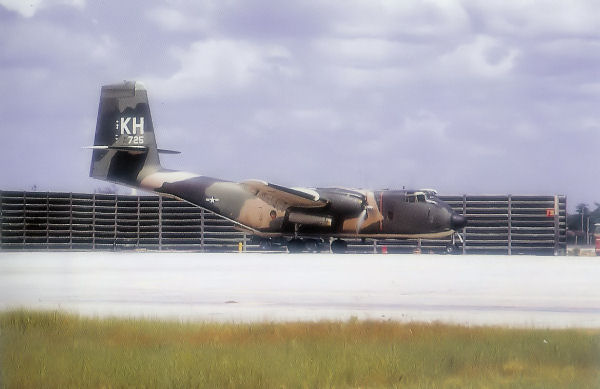
In August 1966, the Air Force and the Army began implementing Project Red Leaf, which would transfer responsibility for the de Havilland Canada C-7 Caribou from the Army to the Air Force following the Johnson-McConnell agreement of 1966. Air Force personnel began being assigned to the Army aviation companies flying the Caribou. Starting in late October personnel to form the cadre for the 483rd Troop Carrier Wing began to arrive at Cam Ranh Bay Air Base, South Viet Nam. The cadre began planning to move squadron level operations from the small Army camps they were operating from to permanent sites when the Air Force units were activated. Although removal of Caribous from the Mekong Delta and An Khe was particularly controversial, the Department of Defense ordered that the wing's squadrons be located on Air Force installations, not Army posts. On 1 January 1967, the wing was organized and took over Caribou operations. Two squadrons each were located at Cam Ranh Bay, Vung Tau Air Base, and Phu Cat Air Base, although detachments were maintained at an additional six locations. In December 1967, a Viet Cong mortar attack on Can Tho Airfield damaged two wing C-7s. As a result wing planes were no longer stationed at Can Tho, Nha Trang Air Base, or Pleiku Air Base.
The 483rd was assigned the mission of providing intra-theater airlift in support of United States military civic actions, combat support and civic assistance throughout the Republic of Vietnam. The wing's Caribou proved especially valuable in resupplying special forces camps, and largely supplanted the Fairchild C-123 Providers in performing this mission. Initially, the wing's 537th Troop Carrier Squadron was dedicated to supporting the 1st Cavalry Division. This arrangement continued until late 1968, when the division moved to the southern provinces and was more efficiently supported by the squadrons at Cam Ranh Bay and Vung Tau.
The C-7s provided the light load-short haul transport to rough landing strips in South Vietnam. The unique capabilities of the C-7 for short landing and takeoff made Caribou transports vital to the war effort. On many occasions the C-7A's flew emergency airlift missions to airstrips and combat areas that no other aircraft could reach. Most notable were those in support of special forces camps in the Central Highlands.
Hub AI
483rd Tactical Airlift Wing AI simulator
(@483rd Tactical Airlift Wing_simulator)
483rd Tactical Airlift Wing
The 483rd Tactical Airlift Wing was a tactical airlift and composite wing assigned to Pacific Air Forces during the Vietnam War. It was the host organization at Cam Ranh Bay Air Base South Vietnam from 1970 to 1972.
The Wing was first organized as the 483rd Troop Carrier Wing during the Korean War, as an airlift organization assigned to Far East Air Forces (later Pacific Air Forces).
The wing was activated at Ashiya Air Base, Japan as the 483rd Troop Carrier Wing on 1 January 1953 and replaced the 403rd Troop Carrier Wing, Medium and absorbed the 403rd's mission, personnel and equipment. It was assigned to the 315th Air Division of Far East Air Forces for duty in the Korean War.
The wing was equipped with Fairchild C-119 Flying Boxcars and performed troop carrier and air transport operations in the Far East, including landing of troops and cargo in forward areas of the combat zone, air transportation of airborne troops and equipment, and air evacuation of casualties. In June 1953, as the Korean war neared an armistice, all wing C-119s airlifted the entire 187th Regimental Combat Team (Airborne) from Kyushu, Japan to Seoul and Chunch'on, South Korea, to preclude enemy breakthroughs. This was the largest mass movement of personnel in the history of combat cargo to that time. For is actions in the Korean War, the wing received the Korean Presidential Unit Citation.
Between April 1953 and September 1954, the wing aided the French Air Force in Indochina by training aircrews, evacuating wounded, and maintaining aircraft. For these actions, the wing became one of the first units in the Air Force to receive the Air Force Outstanding Unit Award. In 1958, the wing began to reequip with Lockheed C-130 Hercules aircraft. Its transition was complete by 1959. It performed theater transport duties and participated in joint exercises with Army units until inactivated in Japan on 23 June 1960. Its squadrons were transferred to the direct control of the 315th Air Division and relocated to Naha Air Base and Tachikawa Air Base, Japan as Ashiya closed.
In August 1966, the Air Force and the Army began implementing Project Red Leaf, which would transfer responsibility for the de Havilland Canada C-7 Caribou from the Army to the Air Force following the Johnson-McConnell agreement of 1966. Air Force personnel began being assigned to the Army aviation companies flying the Caribou. Starting in late October personnel to form the cadre for the 483rd Troop Carrier Wing began to arrive at Cam Ranh Bay Air Base, South Viet Nam. The cadre began planning to move squadron level operations from the small Army camps they were operating from to permanent sites when the Air Force units were activated. Although removal of Caribous from the Mekong Delta and An Khe was particularly controversial, the Department of Defense ordered that the wing's squadrons be located on Air Force installations, not Army posts. On 1 January 1967, the wing was organized and took over Caribou operations. Two squadrons each were located at Cam Ranh Bay, Vung Tau Air Base, and Phu Cat Air Base, although detachments were maintained at an additional six locations. In December 1967, a Viet Cong mortar attack on Can Tho Airfield damaged two wing C-7s. As a result wing planes were no longer stationed at Can Tho, Nha Trang Air Base, or Pleiku Air Base.
The 483rd was assigned the mission of providing intra-theater airlift in support of United States military civic actions, combat support and civic assistance throughout the Republic of Vietnam. The wing's Caribou proved especially valuable in resupplying special forces camps, and largely supplanted the Fairchild C-123 Providers in performing this mission. Initially, the wing's 537th Troop Carrier Squadron was dedicated to supporting the 1st Cavalry Division. This arrangement continued until late 1968, when the division moved to the southern provinces and was more efficiently supported by the squadrons at Cam Ranh Bay and Vung Tau.
The C-7s provided the light load-short haul transport to rough landing strips in South Vietnam. The unique capabilities of the C-7 for short landing and takeoff made Caribou transports vital to the war effort. On many occasions the C-7A's flew emergency airlift missions to airstrips and combat areas that no other aircraft could reach. Most notable were those in support of special forces camps in the Central Highlands.