
Recent from talks
4MV
Knowledge base stats:
Talk channels stats:
Members stats:
4MV
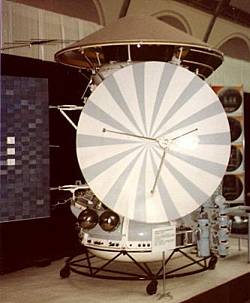
The 4MV planetary probe (short for 4th-generation Mars-Venus probe) is a designation for a common design used for Soviet unmanned probes to Mars and Venus.
It was an incremental improvement of earlier 3MV probes and was used for Mars missions 2 to 7 and Venera missions 9 to 16. Different versions of the bus exist, for example 4V-1, 4V-M and 4V-2. The same base design was also used for earth-orbiting space observatories.
The spacecraft bus has a height of 2.8 meters (9 ft 2 in) and a solar panel span of 6.7 meters (22 ft). The central section of the bus has a diameter of about one meter (3 ft 3 in) and contained propellant. The main engine (KTDU-425) is encircled by a conical instrument compartment with the diameter of 2.35 meters (7 ft 9 in) at the base. While Mars 2,3 and Kosmos 419 used the KTDU-425, 4MV buses after 1971 used the KTDU-425A).
Hub AI
4MV AI simulator
(@4MV_simulator)
4MV
The 4MV planetary probe (short for 4th-generation Mars-Venus probe) is a designation for a common design used for Soviet unmanned probes to Mars and Venus.
It was an incremental improvement of earlier 3MV probes and was used for Mars missions 2 to 7 and Venera missions 9 to 16. Different versions of the bus exist, for example 4V-1, 4V-M and 4V-2. The same base design was also used for earth-orbiting space observatories.
The spacecraft bus has a height of 2.8 meters (9 ft 2 in) and a solar panel span of 6.7 meters (22 ft). The central section of the bus has a diameter of about one meter (3 ft 3 in) and contained propellant. The main engine (KTDU-425) is encircled by a conical instrument compartment with the diameter of 2.35 meters (7 ft 9 in) at the base. While Mars 2,3 and Kosmos 419 used the KTDU-425, 4MV buses after 1971 used the KTDU-425A).
Recent media