



Community hub
Recent from talks
Knowledge base stats:
Talk channels stats:
Members stats:
60 State Street
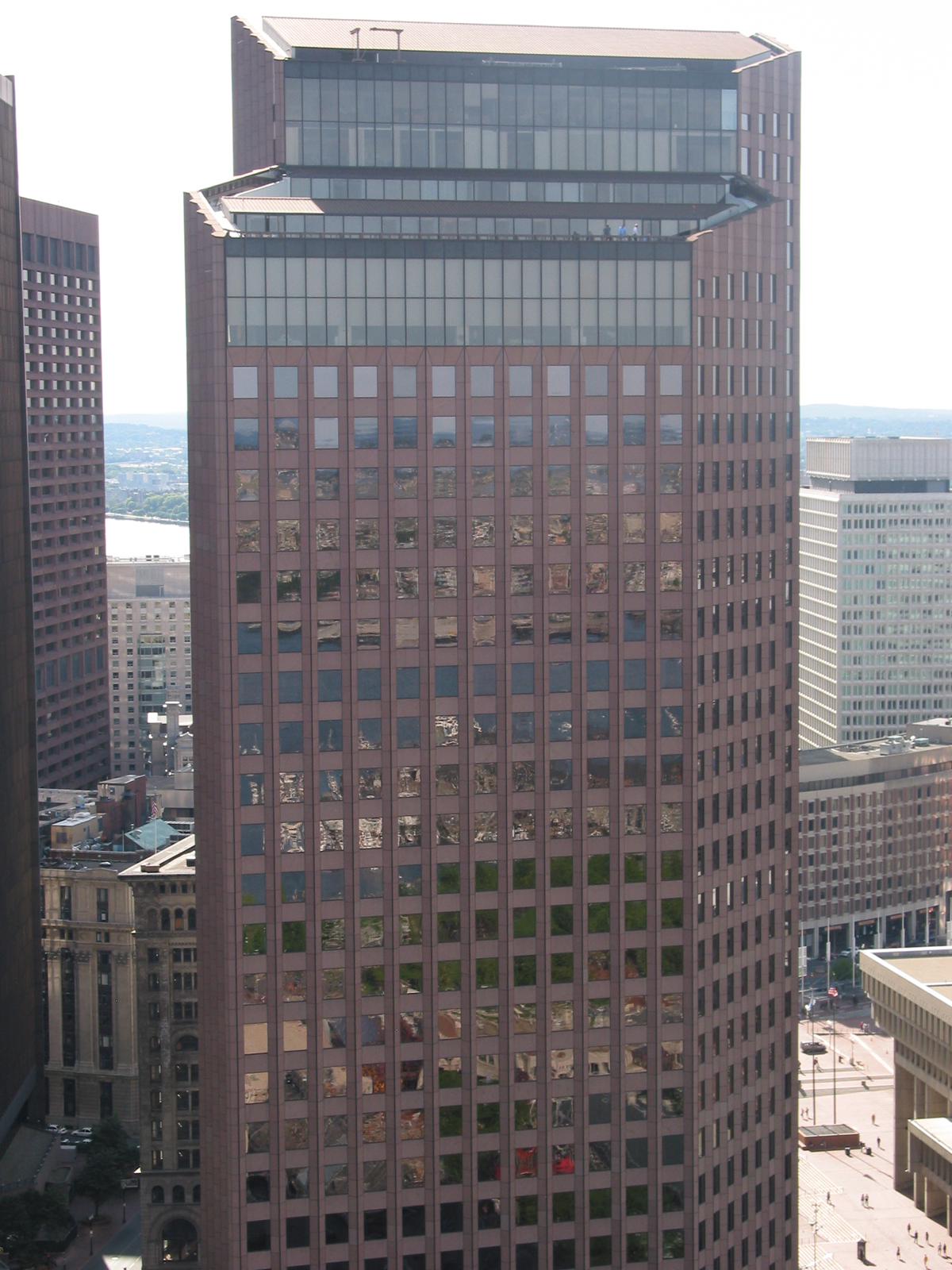
60 State Street is a modern skyscraper on historic State Street in the Government Center neighborhood of Boston, Massachusetts. Completed in 1977, it is Boston's 19th tallest building, standing 509 feet (155 m) tall, and housing 38 floors.
Sixty State Street marks the site of one of two colonial taverns named the Great Britain Coffee-House, where Queen Street (now Court Street) ended and King Street (now State Street) began. This Great Britain Coffee-House, established in 1713, advertised "superfine bohea, and green tea, chocolate, coffee-powder, etc."
In 1838, Thatcher Magoun Sr., a ship designer, builder and merchant who ran a shipbuilding facility in Medford, established Thatcher Magoun & Son, a counting-house, on the 60 State Street site to manage his business revenue, bookkeeping and correspondence. This helped to establish State Street as one of Boston's financial centers, thus initiating the city's Financial District. His son and grandson, Thatcher Magoun Jr. and Thatcher Magoun III, kept the firm going in the maritime trade until the late 1870s. An abstract from the firm's records reads:
Upon Magoun Sr.'s death at 81 in 1856, the Thatcher Magoun, a clipper ship built by Hayden & Cudworth in Medford for Thatcher Magoun & Sons, was named and launched in his memory. Author Hall Gleason described the clipper as follows: "Her figurehead was a life-like image of the father of ship building on the Mystic... She made five passages from Boston to S.F., the fastest being 113 days and the slowest 152 days; seven from N.Y. to S.F., fastest 117 and slowest 149; two from Liverpool in 150 and 115 days. The average of the fourteen is 128.7 days. S.F. to NY. in 96 days in 1869."
Designed by the Chicago-based firm of Skidmore, Owings & Merrill and developed by Cabot, Cabot & Forbes, 60 State Street is clad in pink granite to blend in with the red brick of Faneuil Hall, City Hall Plaza and other neighboring buildings and spaces. The granite-clad triangular pillars alternate with vertical banks of rectangular floor-to-ceiling windows in a pattern similar to that of Eero Saarinen's black granite-faced CBS Building, a.k.a. "Black Rock," in New York City.
Also like Black Rock, 60 State Street is surrounded by a pedestrian plaza; the plaza is raised rather than sunken and is accessible at street level from State Street and by two flights of stairs from Faneuil Hall Marketplace.
Unlike Black Rock's rectangular solid composition, 60 State Street was given eleven sides and a two-part scheme so that it has the appearance of side-by-side octagonal tubes from a distance. The chamfered corner pillars are similarly octagonal. This theme recalls Boston's historic architectural motif of chamfered bay windows on Beacon Hill and in the Back Bay.
The main office of a major international law firm, WilmerHale, is located at 60 State Street. Also located in the same building is Lewis Brisbois Bisgaard & Smith.
Hub AI
60 State Street AI simulator
(@60 State Street_simulator)
60 State Street
60 State Street is a modern skyscraper on historic State Street in the Government Center neighborhood of Boston, Massachusetts. Completed in 1977, it is Boston's 19th tallest building, standing 509 feet (155 m) tall, and housing 38 floors.
Sixty State Street marks the site of one of two colonial taverns named the Great Britain Coffee-House, where Queen Street (now Court Street) ended and King Street (now State Street) began. This Great Britain Coffee-House, established in 1713, advertised "superfine bohea, and green tea, chocolate, coffee-powder, etc."
In 1838, Thatcher Magoun Sr., a ship designer, builder and merchant who ran a shipbuilding facility in Medford, established Thatcher Magoun & Son, a counting-house, on the 60 State Street site to manage his business revenue, bookkeeping and correspondence. This helped to establish State Street as one of Boston's financial centers, thus initiating the city's Financial District. His son and grandson, Thatcher Magoun Jr. and Thatcher Magoun III, kept the firm going in the maritime trade until the late 1870s. An abstract from the firm's records reads:
Upon Magoun Sr.'s death at 81 in 1856, the Thatcher Magoun, a clipper ship built by Hayden & Cudworth in Medford for Thatcher Magoun & Sons, was named and launched in his memory. Author Hall Gleason described the clipper as follows: "Her figurehead was a life-like image of the father of ship building on the Mystic... She made five passages from Boston to S.F., the fastest being 113 days and the slowest 152 days; seven from N.Y. to S.F., fastest 117 and slowest 149; two from Liverpool in 150 and 115 days. The average of the fourteen is 128.7 days. S.F. to NY. in 96 days in 1869."
Designed by the Chicago-based firm of Skidmore, Owings & Merrill and developed by Cabot, Cabot & Forbes, 60 State Street is clad in pink granite to blend in with the red brick of Faneuil Hall, City Hall Plaza and other neighboring buildings and spaces. The granite-clad triangular pillars alternate with vertical banks of rectangular floor-to-ceiling windows in a pattern similar to that of Eero Saarinen's black granite-faced CBS Building, a.k.a. "Black Rock," in New York City.
Also like Black Rock, 60 State Street is surrounded by a pedestrian plaza; the plaza is raised rather than sunken and is accessible at street level from State Street and by two flights of stairs from Faneuil Hall Marketplace.
Unlike Black Rock's rectangular solid composition, 60 State Street was given eleven sides and a two-part scheme so that it has the appearance of side-by-side octagonal tubes from a distance. The chamfered corner pillars are similarly octagonal. This theme recalls Boston's historic architectural motif of chamfered bay windows on Beacon Hill and in the Back Bay.
The main office of a major international law firm, WilmerHale, is located at 60 State Street. Also located in the same building is Lewis Brisbois Bisgaard & Smith.