Hubbry Logo
65,53665,536Main
Open search
65,536
Community hub
65,536
logo
8 pages, 0 posts
0 subscribers
Be the first to start a discussion here.
65,536
65,536
from Wikipedia
← 65535 65536 65537 →
Cardinalsixty-five thousand five hundred thirty-six
Ordinal65536th
(sixty-five thousand five hundred thirty-sixth)
Factorization216
Divisors1, 2, 4, 8, 16, 32, 64, 128, 256, 512, 1024, 2048, 4096, 8192, 16384, 32768, 65536
Greek numeral͵εφλϚ´
Roman numeralLXVDXXXVI, lxvdxxxvi
Binary100000000000000002
Ternary100222200213
Senary12232246
Octal2000008
Duodecimal31B1412
Hexadecimal1000016

65536 is the natural number following 65535 and preceding 65537.

65536 is a power of two: (2 to the 16th power).

65536 is the smallest number with exactly 17 divisors (but there are smaller numbers with more than 17 divisors; e.g., 180 has 18 divisors) (sequence A005179 in the OEIS).

256×256 grid with 65536 squares

In mathematics

[edit]

65536 is , so in tetration notation 65536 is 42.

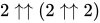
When expressed using Knuth's up-arrow notation, 65536 is , which is equal to , which is equivalent to or .

As is also equal to 4, or ,

can thus be written as , or , or as the pentation (hyperoperation notation).

65536 is a superperfect number – a number such that σ(σ(n)) = 2n.[1]

A 16-bit number can distinguish 65536 different possibilities. For example, unsigned binary notation exhausts all possible 16-bit codes in uniquely identifying the numbers 0 to 65535. In this scheme, 65536 is the least natural number that can not be represented with 16 bits. Conversely, it is the "first" or smallest positive integer that requires 17 bits.

65536 is the only power of 2 less than 231000 that does not contain the digits 1, 2, 4, or 8 in its decimal representation.[2]

The sum of the unitary divisors of 65536 is prime (1 + 65536 = 65537, which is prime).[3]

65536 is an untouchable number.

In computing

[edit]

65,536 (216) is the number of different values representable in a number of 16 binary digits (or bits), also known as an unsigned short integer in many computer programming systems.

  • A 65,536-bit integer can represent up to 265,536 (2.00352993...×1019,728) values.
  • 65,536 is the number of characters in the original Unicode, and currently in a Unicode plane.

This number is a limit in many common hardware and software implementations, some examples of which are:

  • The Motorola 68000 family, x86 architecture, and other computing platforms have a word size of 16 bits, representing 65536 possible values. (32- or 64-bit operations are supported equally or better in modern microprocessors.)
  • Many modern CPUs allow a memory page size of 64KiB (65536 bytes) to be configured in their memory-management hardware.[4]
  • The default buffer size of a Unix pipeline is 64KiB (65536 bytes).
  • 65536 is the maximum number of spreadsheet rows supported by Excel 97, Excel 2000, Excel 2002 and Excel 2003. Text files that are larger than 65536 rows cannot be imported to these versions of Excel.[5] (Excel 2007, 2010 and 2013 support 1,048,576 rows (220)).
  • A 16-bit microprocessor chip can directly access 65536 memory addresses, and the 16-bit highcolor graphics standard supports a color palette of 65536 different colors.
  • The maximum number of methods allowed in a single dex file Android application is 65536.[6]
  • The limit for the amount of code in bytes for a non-native, non-abstract method in Java.
  • The number of available ports to combine with a network address to create a network socket.
  • The maximum character limit for one message in WhatsApp is 65536.

References

[edit]
Revisions and contributorsEdit on WikipediaRead on Wikipedia
from Grokipedia
65,536 is the natural number equal to 2162^{16}, which represents the total count of distinct values—from 0 to —that can be encoded using 16 binary bits, making it a foundational in digital computing. In , 65,536 denotes the maximum number of unique addresses accessible by a pure 16-bit addressing system, corresponding to 64 kilobytes (64 KiB) of addressable byte storage, a limitation that defined early microprocessors like the and Z80. This 16-bit addressing scheme enabled efficient handling of data in the and but spurred advancements to 32-bit and beyond to support larger requirements. The number also plays a key role in and : in 16-bit (high ), it provides a total of 65,536 distinct colors, often implemented as 5 bits for , 6 for , and 5 for blue (5-6-5 format). Similarly, in , 16-bit sampling provides 65,536 amplitude levels, enabling a of about 96 decibels in formats like CD-quality sound. Beyond hardware, 65,536 structures various software and protocol limits. The Basic Multilingual Plane encompasses the first 65,536 code points (U+0000 to U+FFFF), covering most commonly used characters from major world writing systems. In networking, TCP and UDP port numbers range from 0 to 65,535, providing 65,536 possible endpoints for connections in IPv4 and protocols. Additionally, it appears in operating system constraints, such as historical limits on open file descriptors in systems rooted in 16-bit integer limits. Mathematically, 65,536 is a perfect square (2562256^2), with exactly 17 positive divisors (, 16, 32, 64, 128, 256, 512, , 2048, 4096, 8192, 16384, 32768, 65536), and the smallest number with that divisor count. Its binary representation is a simple 1 followed by 16 zeros (10000000000000000), underscoring its purity as a .

As a power of two

Binary and decimal representation

65,536 is exactly 2162^{16}, the sixteenth power of two, obtained by multiplying 2 by itself sixteen times. In binary notation, 65,536 is represented as 10000000000000000210000000000000000_2, consisting of a single '1' bit followed by sixteen '0' bits, reflecting its position as the 17th bit in a binary sequence starting from the zeroth power. In decimal form, 65,536 is written as the five-digit 65536, with no leading zeros, making it a straightforward positive in base-10. This value can be derived through basic : since 210=[1024](/page/1024)2^{10} = [1024](/page/1024), it follows that 216=210×26=[1024](/page/1024)×64=655362^{16} = 2^{10} \times 2^6 = [1024](/page/1024) \times 64 = 65536. Powers of two, including 2162^{16}, have played a central role in historical counting systems, particularly in binary representations where every positive is expressed as a unique sum of distinct powers of 2, a concept rooted in ancient methods for efficient enumeration and calculation.

Exponentiation and tetration

65,536 can be expressed as a power tower of 2's with height 4, specifically 22222^{2^{2^{2}}}, where exponentiation is evaluated from the top down (right-associatively). This representation highlights its role in iterated exponentiation, a foundational concept in hyperoperations. Building progressively, the tetration with height 2 yields 22=22=4^{2}2 = 2^{2} = 4, height 3 gives 32=222=24=16^{3}2 = 2^{2^{2}} = 2^{4} = 16, and height 4 results in 42=2222=216=65,536^{4}2 = 2^{2^{2^{2}}} = 2^{16} = 65{,}536. In notation, 65,536 is denoted as 42^{4}2, emphasizing repeated of the base 2 four times. Equivalently, using , it is 242 \uparrow\uparrow 4, where the double arrow signifies tetration as a power tower of four 2's. This notation, introduced by , formalizes hyperoperations beyond simple and underscores 65,536's position as the smallest tetration value that reaches five digits. As part of exponential sequences, 65,536 relates to Fermat numbers, which are defined as Fn=22n+1F_n = 2^{2^n} + 1; specifically, it equals F41=65,5371F_4 - 1 = 65{,}537 - 1, where F4F_4 is the fourth Fermat number and the largest known Fermat prime. This connection positions 65,536 within the sequence of powers of 2 that neighbor these historically significant primes, though it itself is a pure power rather than a Fermat number.

Number theory properties

Divisor structure

The prime of 65,536 is 2162^{16}.
As a result, its positive s are precisely the powers of 2 from 202^0 to 2162^{16}, namely 1, , , 8, 16, 32, 64, 128, 256, 512, , 2,048, 4,096, , 16,384, 32,768, and 65,536.
This yields exactly 17 divisors, and 65,536 is the smallest power of 2 with this number of divisors, since the divisor for 2k2^k is k+1k+1.
The sum of the divisors of 65,536, denoted σ(65,536)\sigma(65{,}536), is 2171=131,0712^{17} - 1 = 131{,}071. The unitary divisors of 65,536 are 1 and 65,536 itself, as these are the only divisors coprime to their complementary factors for a .
Their sum is , which is a .

Special classifications

65,536 is classified as a superperfect number in number theory, satisfying the condition σ(σ(n))=2n\sigma(\sigma(n)) = 2n, where σ\sigma denotes the sum-of-divisors function. For n=65,536=216n = 65,536 = 2^{16}, σ(n)=2171=131,071\sigma(n) = 2^{17} - 1 = 131,071, and since 131,071 is prime, σ(131,071)=131,072=2×65,536\sigma(131,071) = 131,072 = 2 \times 65,536. Another distinctive property is its decimal digit composition: 65,536 is the only power of 2 below 231,0002^{31,000} that avoids the digits 1, 2, 4, and 8 entirely, consisting solely of the digits 6, 5, 5, 3, and 6. Moreover, 65,536 is the largest known number whose sum of unitary divisors is prime.

Applications in

16-bit representation

In 16-bit binary systems, 65,536 represents the total number of distinct values that can be encoded using 16 bits, corresponding to the unsigned integer range from 0 to 65,535. This range arises because each of the 16 bits can be either 0 or 1, yielding 216=65,5362^{16} = 65,536 possible combinations. For signed 16-bit integers, typically using representation, the range spans from -32,768 to 32,767, maintaining the same total of 65,536 values by allocating one bit for the and the remaining 15 bits for magnitude. Values up to fit exactly within 16 bits in binary, but 65,536 itself requires 17 bits, as its binary form is 1 followed by 16 zeros (10000000000000000 in binary). Early microprocessors exemplified 16-bit data handling, with the using a 16-bit word size for registers and arithmetic operations, enabling efficient processing of data in this range. Similarly, the supported 16-bit words alongside byte and longword operations, facilitating 16-bit data transfers on its external 16-bit bus while performing internal 32-bit computations. Multiplying two 16-bit numbers produces a result that can span up to 32 bits to avoid overflow, as the maximum product (65,535 × 65,535) equals 4,294,836,225, exceeding the 16-bit capacity. This necessitates wider registers or careful handling in 16-bit architectures to capture the full precision.

System limits and standards

In 16-bit computing architectures, such as those based on the Intel 8086 microprocessor, the maximum directly addressable memory per segment is 65,536 bytes (64 KiB), as the 16-bit registers and offsets allow for 2^{16} unique locations within each 64 KiB segment of the overall 1 MiB address space. This limitation influenced early personal computer designs, where the IBM PC and compatibles reserved portions of the 1 MiB total addressable memory for system hardware, resulting in a practical 640 KiB limit for conventional memory available to MS-DOS applications and user programs. Techniques like bank switching and expanded memory specifications were later developed to circumvent these barriers and access additional RAM beyond 640 KiB. The standard organizes its code space into 17 planes, each comprising exactly 65,536 code points (2^{16}), providing a structured framework for encoding over 1.1 million characters across scripts and symbols. The Basic Multilingual Plane (Plane 0) originally served as the primary limit of 65,536 code points for the most commonly used characters in modern languages, with supplementary planes extending support for rarer scripts while maintaining the per-plane slot count. File systems like FAT16, a 16-bit variant of the , support a maximum of 65,524 clusters to avoid exhausting the 16-bit entries reserved for cluster identification, which constrains partition sizes typically to 2 GiB or less depending on cluster size. In graphics and display standards, 16-bit () enables 65,536 unique colors per , commonly distributed as 5 bits for red, 6 for green, and 5 for blue (RGB 565 format), balancing visual fidelity with memory efficiency in early multimedia applications. Software applications from the era often inherited these 16-bit constraints; for instance, versions 97–2003 (.xls format) restricted worksheets to 65,536 rows and 256 columns to align with the underlying structure. In , particularly RSA implementations, a 65,536-bit theoretically permits a modulus supporting up to 2^{65536} distinct values, offering immense security but rendering operations impractically slow, with alone requiring hours or more on standard hardware.

References

Add your contribution
Related Hubs
User Avatar
No comments yet.