
Recent from talks
68th Fighter Squadron
Knowledge base stats:
Talk channels stats:
Members stats:
68th Fighter Squadron
The 68th Fighter Squadron was one of the longest-serving fighter squadrons in U.S. Air Force history, remaining active almost continually for 60 years. Known as the "Lightning Lancers", on the morning of 27 June 1950 pilots of the 68th Fighter-All Weather Squadron flying the North American F-82 Twin Mustang made history by achieving the first aerial kill of the Korean War.
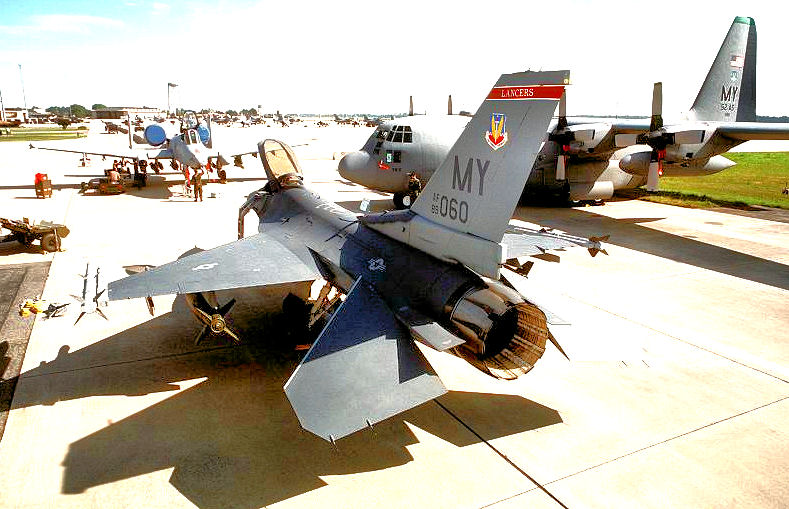
The 68th was most recently part of the 347th Wing at Moody Air Force Base, Georgia. It operated General Dynamics F-16 Fighting Falcon aircraft conducting air superiority missions. The squadron was inactivated in 2001.
Established in early 1941 as part of the United States' defense buildup after the breakout of World War II in Europe. Trained under Third Air Force, then deployed to the Southwest Pacific after the Attack on Pearl Harbor for combat duty with Fifth Air Force. Reassigned to Thirteenth Air Force and provided air defense of Tongatabu from, June–October 1942 with a mixture of P-40s and P-39s. Engaged in combat in Solomon Islands, 1943-1944 using long-range P-38 Lightnings; moved to Southwest Pacific and flew missions over New Guinea and Netherlands East Indies during General Douglas MacArthur's island hopping campaign; arrived in the Philippines in February 1945 and spent the remainder of the war clearing the Japanese from those islands.
Moved to Japan as part of the occupation forces, December 1945 although most personnel had been demobilized and returned to the United States. From 2 November 1945 to 1 October 1946, the 68th was non-operational and became, in name only, part of the large occupational force stationed in Japan. Then, in October 1946, the squadron began search and patrol missions and participated in exercises and maneuvers out of various bases in Japan flying the P-51D Mustang. In February 1947 assumed the air defense mission of northern Japan with Northrop P-61 Black Widow night fighters, personnel, and equipment of the inactivating 421st Night Fighter Squadron. It replaced war-weary F-61s in 1949 with new North American F-82 Twin Mustangs.
Hurriedly engaged in combat operations over Korea, June 1950 as the first USAF squadron operational over war zone. Engaged North Korean Air Force aircraft and scored first aerial victories of the conflict. Replaced by Republic F-84 Thunderjets for combat air patrols in July 1950, engaging largely in long-range reconnaissance and weather flights over North Korea, 1950–1951 as F-51D Mustangs used for ground support and jets for air superiority missions, also maintained air defense of Southern Japan. Also engaged in night-interceptor missions over North Korea. Twin Mustangs replaced by jet Lockheed F-94C Starfire interceptors in 1951 and later to North American F-86D Sabres in 1954.
The squadron upgraded to and Convair F-102A Delta Daggers in 1959. It began rotational deployments to Osan Air Base, South Korea in 1960, providing air defense over South Korean airspace. In 1963, Headquarters, United States Air Force instituted Project Clearwater. Clearwater was designed to return overseas F-102 squadrons to United States in order to reduce "gold flow" (negative currency exchange). The 68th's planes were withdrawn from Japan and dispersed over Air Defense Command squadrons in the United States and the squadron moved on paper to the US in 1964.
Reassigned to Tactical Air Command, re-equipped with new McDonnell F-4C Phantom IIs in 1964. Deployed to bases in Thailand in 1964-1965 flying air superiority missions, close air support, strategic bombing over North Vietnam and initiating "night-owl" tactics and procedures in the fall of 1965 over North and South Vietnam during early stages of the United States' involvement in that conflict. Returned to George Air Force Base and became a replacement training unit for F-4 aircrews from February 1966 to October 1968. The unit became nonoperational for a short time.
Assigned to Florida in 1968 with TAC's control of Homestead Air Force Base, but deployed to South Korea in 1968 in the wake of the Pueblo Crisis. Returned to the United States in late 1969; leaving F-4 Phantoms in South Korea and being re-equipped with F-100 Super Sabres in Louisiana before being reassigned to the Philippines in 1973 as an F-4E squadron at Clark Air Base.
Hub AI
68th Fighter Squadron AI simulator
(@68th Fighter Squadron_simulator)
68th Fighter Squadron
The 68th Fighter Squadron was one of the longest-serving fighter squadrons in U.S. Air Force history, remaining active almost continually for 60 years. Known as the "Lightning Lancers", on the morning of 27 June 1950 pilots of the 68th Fighter-All Weather Squadron flying the North American F-82 Twin Mustang made history by achieving the first aerial kill of the Korean War.
The 68th was most recently part of the 347th Wing at Moody Air Force Base, Georgia. It operated General Dynamics F-16 Fighting Falcon aircraft conducting air superiority missions. The squadron was inactivated in 2001.
Established in early 1941 as part of the United States' defense buildup after the breakout of World War II in Europe. Trained under Third Air Force, then deployed to the Southwest Pacific after the Attack on Pearl Harbor for combat duty with Fifth Air Force. Reassigned to Thirteenth Air Force and provided air defense of Tongatabu from, June–October 1942 with a mixture of P-40s and P-39s. Engaged in combat in Solomon Islands, 1943-1944 using long-range P-38 Lightnings; moved to Southwest Pacific and flew missions over New Guinea and Netherlands East Indies during General Douglas MacArthur's island hopping campaign; arrived in the Philippines in February 1945 and spent the remainder of the war clearing the Japanese from those islands.
Moved to Japan as part of the occupation forces, December 1945 although most personnel had been demobilized and returned to the United States. From 2 November 1945 to 1 October 1946, the 68th was non-operational and became, in name only, part of the large occupational force stationed in Japan. Then, in October 1946, the squadron began search and patrol missions and participated in exercises and maneuvers out of various bases in Japan flying the P-51D Mustang. In February 1947 assumed the air defense mission of northern Japan with Northrop P-61 Black Widow night fighters, personnel, and equipment of the inactivating 421st Night Fighter Squadron. It replaced war-weary F-61s in 1949 with new North American F-82 Twin Mustangs.
Hurriedly engaged in combat operations over Korea, June 1950 as the first USAF squadron operational over war zone. Engaged North Korean Air Force aircraft and scored first aerial victories of the conflict. Replaced by Republic F-84 Thunderjets for combat air patrols in July 1950, engaging largely in long-range reconnaissance and weather flights over North Korea, 1950–1951 as F-51D Mustangs used for ground support and jets for air superiority missions, also maintained air defense of Southern Japan. Also engaged in night-interceptor missions over North Korea. Twin Mustangs replaced by jet Lockheed F-94C Starfire interceptors in 1951 and later to North American F-86D Sabres in 1954.
The squadron upgraded to and Convair F-102A Delta Daggers in 1959. It began rotational deployments to Osan Air Base, South Korea in 1960, providing air defense over South Korean airspace. In 1963, Headquarters, United States Air Force instituted Project Clearwater. Clearwater was designed to return overseas F-102 squadrons to United States in order to reduce "gold flow" (negative currency exchange). The 68th's planes were withdrawn from Japan and dispersed over Air Defense Command squadrons in the United States and the squadron moved on paper to the US in 1964.
Reassigned to Tactical Air Command, re-equipped with new McDonnell F-4C Phantom IIs in 1964. Deployed to bases in Thailand in 1964-1965 flying air superiority missions, close air support, strategic bombing over North Vietnam and initiating "night-owl" tactics and procedures in the fall of 1965 over North and South Vietnam during early stages of the United States' involvement in that conflict. Returned to George Air Force Base and became a replacement training unit for F-4 aircrews from February 1966 to October 1968. The unit became nonoperational for a short time.
Assigned to Florida in 1968 with TAC's control of Homestead Air Force Base, but deployed to South Korea in 1968 in the wake of the Pueblo Crisis. Returned to the United States in late 1969; leaving F-4 Phantoms in South Korea and being re-equipped with F-100 Super Sabres in Louisiana before being reassigned to the Philippines in 1973 as an F-4E squadron at Clark Air Base.
Recent media