



Community hub
Recent from talks
Knowledge base stats:
Talk channels stats:
Members stats:
6V6
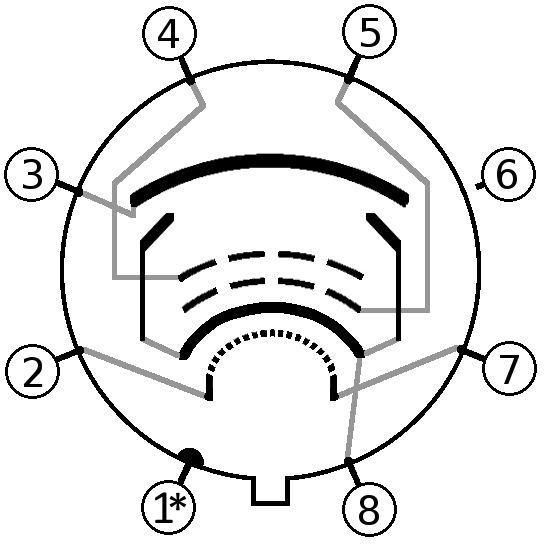
The 6V6 is a beam-power tetrode vacuum tube. The first of this family of tubes to be introduced was the 6V6G by Ken-Rad Tube & Lamp Corporation in late 1936, with the availability by December of both Ken-Rad and Raytheon 6V6G tubes announced. It is still in use in audio applications, especially electric guitar amplifiers.
Following the introduction in July 1936 of the 6L6, the potential of the scaled down version that became the 6V6 was soon realized. The lower-powered 6V6 was better-suited for average home use, and became common in the audio-output-stages of "farmhouse" table-top radios, where power pentodes such as the 6F6 had previously been used. The 6V6 required less heater power and produced less distortion than the 6F6, while yielding higher output in both single-ended and push-pull configurations.
Although the 6V6 was originally designed especially for use in automobile radios, the clip-in Loctal base 7C5, from early 1939, or the lower heater current 12V6GT, both with the identical characteristics to the 6V6, but with the smaller T-9 glass envelope, soon became the tubes of choice for many automotive radios manufacturers. Additionally, the 6V6 had applications in portable battery-operated radios.
The data sheet information supplied by the tube manufacturers' design-centers list the typical operation of an audio output stage for a single 6V6 as producing about 5W of continuous power, and a push-pull-pair about 14W. Amplifier manufacturers soon realized that the tube was capable of being used at ratings above the recommended maximums, and guitar amplifiers with 400V on the plates of a pair of 6V6GTA claim to produce an output power of 20W RMS at 5%THD with 40W Peak Music Power, and with 490V on the plates, as much as 30 W RMS.
Following the 6V6G, RMA Release #96 - 09 Nov. 1936, sponsored by Ken-Rad Tube & Lamp Corporation, with the ST 14 shouldered glass envelope, the 6V6 was announced with a metal mantel in January 1937 by Hygrade Sylvania Corporation. The RMA Release #125 – 03 Jan.1938, Sponsored by RCA. for the 6V6 tube has led to some confusion as to the origins of the 6V6. The 6V6G but not the 6V6 is in the RCA manual RC-13 from July 1937, but the 6V6 is to be found in the 1937 tube manuals of other manufacturers, such as Raytheon.
Tube manufacturers were keen to promote the superiority of the metal tube construction that was introduced on April 1, 1935. Large quantities of the 6V6 tube were produced in the following decade, many as military supply JAN tubes. The price of the metal and glass versions were held to closely the same retail price level for the first few years of their production. The introduction of the 6V6GT, RMA Release #201 – 10 July 1939, was sponsored by Hytron Corporation. By 1940, the 6V6G production was largely superseded by this smaller "GT" T-9 glass envelope. On April 17, 1942, the War Production Board ordered radio tube manufacturers to discontinue within seven days the production for civilian use of 349 of the 710 types of radio tubes on the market, amongst these were the 6V6G and 6V6GX. By 1943, the price of the metal version was almost twice that of the GT version, and this proportional difference in price seems to have remained constant, right through to the end of the 1970s. The 6V6GTA – RMA Release #1681 – 2 July 1956, sponsored by Hygrade Sylvania Corporation, has a controlled warm-up period.
The various different NOS (new old stock) tubes of the 6V6 family, depending on manufacturer, model, series, strength and condition, will vary enormously in scarcity and therefore usually in price. The metal NOS 6V6 tube, once costing almost twice the price of its now highly valued glass enveloped counterparts, is now considered to be fairly common, and is usually the cheapest NOS tube available, with many current production tubes costing more than its 60 to 80 year older classic predecessor. In the final years of U.S. production, several of the major manufacturers switched to using the so-called "coin" based GT bulb.
Now, over eighty-six years after its introduction, and still retaining its original characteristics, the 6V6 has one of the longest active lifetimes of any electronic component, having never been out of production in all this long period of time. Although historically widely used in all manner of electronic goods, many of which are still in service, it is in guitar amplifiers where its use has become archetypal. Not only are there very many existing amplifiers in regular use that rely on the 6V6, with contemporary reproductions of the more iconic models still being made, modern designers are still keen to develop new creations that rely on its use. Generally speaking, 6V6 tubes are sturdy and can be operated beyond their published specifications (the Soviet made 6P6S, and early Chinese 6V6 versions were not as permissive of exceeding design limits, although current production has improved). Because of this, the 6V6 soon proved itself to be suitable for use in consumer-market musical instrument amplifiers, particularly combo-style guitar amps such as the Gibson GA-40, and the Fender Amplifiers; Champ, Princeton, and Deluxe, some of which drive their 6V6s well in excess of the datasheet specified maximum rating. This ongoing demand encourages Chinese, Slovakian and Russian tube factories not only to keep the 6V6 in production to this day, but to further develop the supply.
Hub AI
6V6 AI simulator
(@6V6_simulator)
6V6
The 6V6 is a beam-power tetrode vacuum tube. The first of this family of tubes to be introduced was the 6V6G by Ken-Rad Tube & Lamp Corporation in late 1936, with the availability by December of both Ken-Rad and Raytheon 6V6G tubes announced. It is still in use in audio applications, especially electric guitar amplifiers.
Following the introduction in July 1936 of the 6L6, the potential of the scaled down version that became the 6V6 was soon realized. The lower-powered 6V6 was better-suited for average home use, and became common in the audio-output-stages of "farmhouse" table-top radios, where power pentodes such as the 6F6 had previously been used. The 6V6 required less heater power and produced less distortion than the 6F6, while yielding higher output in both single-ended and push-pull configurations.
Although the 6V6 was originally designed especially for use in automobile radios, the clip-in Loctal base 7C5, from early 1939, or the lower heater current 12V6GT, both with the identical characteristics to the 6V6, but with the smaller T-9 glass envelope, soon became the tubes of choice for many automotive radios manufacturers. Additionally, the 6V6 had applications in portable battery-operated radios.
The data sheet information supplied by the tube manufacturers' design-centers list the typical operation of an audio output stage for a single 6V6 as producing about 5W of continuous power, and a push-pull-pair about 14W. Amplifier manufacturers soon realized that the tube was capable of being used at ratings above the recommended maximums, and guitar amplifiers with 400V on the plates of a pair of 6V6GTA claim to produce an output power of 20W RMS at 5%THD with 40W Peak Music Power, and with 490V on the plates, as much as 30 W RMS.
Following the 6V6G, RMA Release #96 - 09 Nov. 1936, sponsored by Ken-Rad Tube & Lamp Corporation, with the ST 14 shouldered glass envelope, the 6V6 was announced with a metal mantel in January 1937 by Hygrade Sylvania Corporation. The RMA Release #125 – 03 Jan.1938, Sponsored by RCA. for the 6V6 tube has led to some confusion as to the origins of the 6V6. The 6V6G but not the 6V6 is in the RCA manual RC-13 from July 1937, but the 6V6 is to be found in the 1937 tube manuals of other manufacturers, such as Raytheon.
Tube manufacturers were keen to promote the superiority of the metal tube construction that was introduced on April 1, 1935. Large quantities of the 6V6 tube were produced in the following decade, many as military supply JAN tubes. The price of the metal and glass versions were held to closely the same retail price level for the first few years of their production. The introduction of the 6V6GT, RMA Release #201 – 10 July 1939, was sponsored by Hytron Corporation. By 1940, the 6V6G production was largely superseded by this smaller "GT" T-9 glass envelope. On April 17, 1942, the War Production Board ordered radio tube manufacturers to discontinue within seven days the production for civilian use of 349 of the 710 types of radio tubes on the market, amongst these were the 6V6G and 6V6GX. By 1943, the price of the metal version was almost twice that of the GT version, and this proportional difference in price seems to have remained constant, right through to the end of the 1970s. The 6V6GTA – RMA Release #1681 – 2 July 1956, sponsored by Hygrade Sylvania Corporation, has a controlled warm-up period.
The various different NOS (new old stock) tubes of the 6V6 family, depending on manufacturer, model, series, strength and condition, will vary enormously in scarcity and therefore usually in price. The metal NOS 6V6 tube, once costing almost twice the price of its now highly valued glass enveloped counterparts, is now considered to be fairly common, and is usually the cheapest NOS tube available, with many current production tubes costing more than its 60 to 80 year older classic predecessor. In the final years of U.S. production, several of the major manufacturers switched to using the so-called "coin" based GT bulb.
Now, over eighty-six years after its introduction, and still retaining its original characteristics, the 6V6 has one of the longest active lifetimes of any electronic component, having never been out of production in all this long period of time. Although historically widely used in all manner of electronic goods, many of which are still in service, it is in guitar amplifiers where its use has become archetypal. Not only are there very many existing amplifiers in regular use that rely on the 6V6, with contemporary reproductions of the more iconic models still being made, modern designers are still keen to develop new creations that rely on its use. Generally speaking, 6V6 tubes are sturdy and can be operated beyond their published specifications (the Soviet made 6P6S, and early Chinese 6V6 versions were not as permissive of exceeding design limits, although current production has improved). Because of this, the 6V6 soon proved itself to be suitable for use in consumer-market musical instrument amplifiers, particularly combo-style guitar amps such as the Gibson GA-40, and the Fender Amplifiers; Champ, Princeton, and Deluxe, some of which drive their 6V6s well in excess of the datasheet specified maximum rating. This ongoing demand encourages Chinese, Slovakian and Russian tube factories not only to keep the 6V6 in production to this day, but to further develop the supply.