
Recent from talks
88th Aero Squadron
Knowledge base stats:
Talk channels stats:
Members stats:
88th Aero Squadron
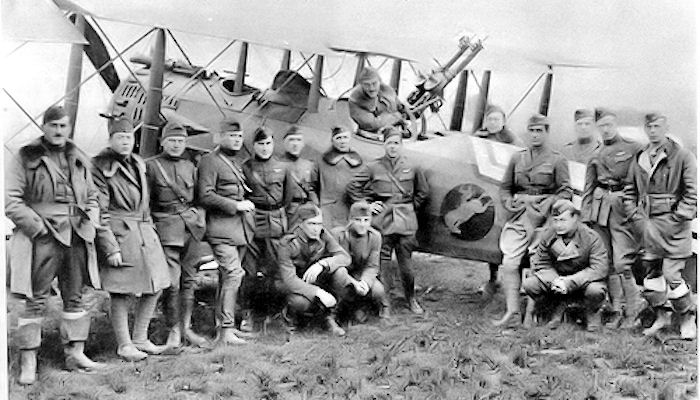
The 88th Aero Squadron was an Air Service, United States Army unit that fought on the Western Front during World War I.
The squadron was assigned as a Corps Observation Squadron, performing short-range, tactical reconnaissance over the III Corps, United States First Army sector of the Western Front in France, providing battlefield intelligence. After the 1918 Armistice with Germany, the squadron was assigned to the United States Third Army as part of the Occupation of the Rhineland in Germany. It returned to the United States in June 1919 and became part of the permanent United States Army Air Service in 1921, being re-designated as the 88th Squadron.
The current United States Air Force unit which holds its lineage and history is the 436th Training Squadron, assigned to the 7th Operations Group, Dyess Air Force Base, Texas.
The 88th Aero Squadron history begins on 9 August 1917 at Fort Logan, Colorado when the men of both the 88th and 89th Aero Squadrons were inducted into the Army, received numerous vaccinations and began basic indoctrination into the military. On 16 August, the men boarded a troop train and were moved to Kelly Field No. 1, Texas. It was again moved to Kelly Field No. 2 on 24 September. After training and instruction on assembling new aircraft, the 88th Aero Squadron was ordered to move to the Aviation Concentration Center, Camp Mills, Garden City, New York on 6 October.
After several weeks at Camp Mills, awaiting transportation for overseas movement to Europe, the squadron was moved to Hoboken, New Jersey on 27 October where it boarded the British Cunard Liner RMS Orduna for the trans-Atlantic move to England. On the 27th the Orduna formed with a convoy at Halifax, Nova Scotia, arriving at Liverpool, England on 9 November. Taking a train to the south coast at Southampton, the squadron crossed the English Channel and arrived at Le Havre, France on the 11th. After some rest at Le Havre, the squadron then was boarded on a train on 13 November, eventually arriving at the 1st Air Depot, AEF, Colombey-les-Belles Airdrome on 16 November.
Upon arrival at the camp, a billeting officer met the squadron and informed them that they would be assigned to civilian quarters in the town until the squadron could erect some wooden barracks on the station compound. On 5 December, the men had returned to their billets in the town when German Gotha bombers attacked the town, and the squadron received its first taste of war. Fortunately, no one was injured and all that was lost was some sleep.
On 1 February 1918, the 88th Squadron was classified as a Corps Observation squadron and was moved to the 1st Observation Group School at Amanty Airdrome. Here the squadron remained for over two months and was whipped into fighting condition. After a few weeks of training and also performing construction on the Airdrome, on 22d February, the squadron's pilots and observers arrived from training at Issoudun Aerodrome. Embryo observers were sent to the squadron and were trained by being taken up on various "missions", photographic, reconnaissance, liaison. etc. Pilots learned how to work with the observers and to make the plane a fighting unit. The school at Amanty was equipped with some obsolete French Dorand AR-1 aircraft, which were met with almost universal disapproval from the aviators that had trained on Nieuport 28s at Issoudun. Training at the school consisted of taking the observers up on missions over Allied-controlled territory.
In May 1918 the 88th was assigned to the I Corps Observation Group. Its mission was primarily to keep the command informed by visual and photographic reconnaissance of the general situation within and behind enemy lines. To accomplish this task, a routine schedule of operations was prescribed for each day consisting of several close-range reconnaissance missions in the sector and, toward dusk, a reconnaissance for active hostile batteries in action. Special missions were flown as required in addition to the daily routine work.
Hub AI
88th Aero Squadron AI simulator
(@88th Aero Squadron_simulator)
88th Aero Squadron
The 88th Aero Squadron was an Air Service, United States Army unit that fought on the Western Front during World War I.
The squadron was assigned as a Corps Observation Squadron, performing short-range, tactical reconnaissance over the III Corps, United States First Army sector of the Western Front in France, providing battlefield intelligence. After the 1918 Armistice with Germany, the squadron was assigned to the United States Third Army as part of the Occupation of the Rhineland in Germany. It returned to the United States in June 1919 and became part of the permanent United States Army Air Service in 1921, being re-designated as the 88th Squadron.
The current United States Air Force unit which holds its lineage and history is the 436th Training Squadron, assigned to the 7th Operations Group, Dyess Air Force Base, Texas.
The 88th Aero Squadron history begins on 9 August 1917 at Fort Logan, Colorado when the men of both the 88th and 89th Aero Squadrons were inducted into the Army, received numerous vaccinations and began basic indoctrination into the military. On 16 August, the men boarded a troop train and were moved to Kelly Field No. 1, Texas. It was again moved to Kelly Field No. 2 on 24 September. After training and instruction on assembling new aircraft, the 88th Aero Squadron was ordered to move to the Aviation Concentration Center, Camp Mills, Garden City, New York on 6 October.
After several weeks at Camp Mills, awaiting transportation for overseas movement to Europe, the squadron was moved to Hoboken, New Jersey on 27 October where it boarded the British Cunard Liner RMS Orduna for the trans-Atlantic move to England. On the 27th the Orduna formed with a convoy at Halifax, Nova Scotia, arriving at Liverpool, England on 9 November. Taking a train to the south coast at Southampton, the squadron crossed the English Channel and arrived at Le Havre, France on the 11th. After some rest at Le Havre, the squadron then was boarded on a train on 13 November, eventually arriving at the 1st Air Depot, AEF, Colombey-les-Belles Airdrome on 16 November.
Upon arrival at the camp, a billeting officer met the squadron and informed them that they would be assigned to civilian quarters in the town until the squadron could erect some wooden barracks on the station compound. On 5 December, the men had returned to their billets in the town when German Gotha bombers attacked the town, and the squadron received its first taste of war. Fortunately, no one was injured and all that was lost was some sleep.
On 1 February 1918, the 88th Squadron was classified as a Corps Observation squadron and was moved to the 1st Observation Group School at Amanty Airdrome. Here the squadron remained for over two months and was whipped into fighting condition. After a few weeks of training and also performing construction on the Airdrome, on 22d February, the squadron's pilots and observers arrived from training at Issoudun Aerodrome. Embryo observers were sent to the squadron and were trained by being taken up on various "missions", photographic, reconnaissance, liaison. etc. Pilots learned how to work with the observers and to make the plane a fighting unit. The school at Amanty was equipped with some obsolete French Dorand AR-1 aircraft, which were met with almost universal disapproval from the aviators that had trained on Nieuport 28s at Issoudun. Training at the school consisted of taking the observers up on missions over Allied-controlled territory.
In May 1918 the 88th was assigned to the I Corps Observation Group. Its mission was primarily to keep the command informed by visual and photographic reconnaissance of the general situation within and behind enemy lines. To accomplish this task, a routine schedule of operations was prescribed for each day consisting of several close-range reconnaissance missions in the sector and, toward dusk, a reconnaissance for active hostile batteries in action. Special missions were flown as required in addition to the daily routine work.
Recent media