
Recent from talks
99th Aero Squadron
Knowledge base stats:
Talk channels stats:
Members stats:
99th Aero Squadron
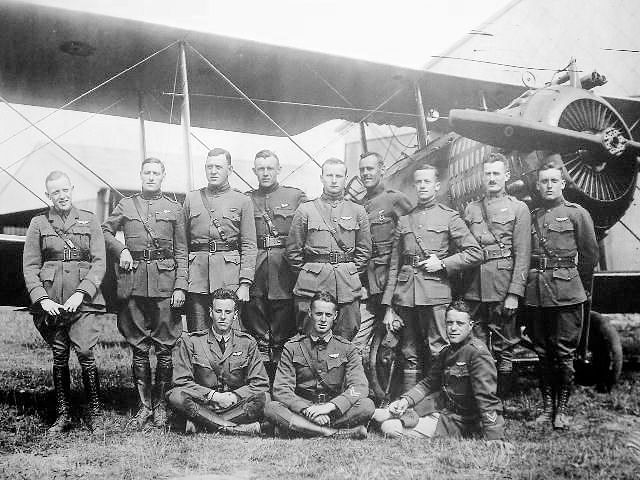
The 99th Aero Squadron was an Air Service, United States Army unit that fought on the Western Front during World War I.
The squadron was assigned as a Corps Observation Squadron, performing short-range, tactical reconnaissance over the V Corps, United States First Army sector of the Western Front in France, providing battlefield intelligence. After the 1918 Armistice with Germany, the squadron returned to the United States in June 1919 and became part of the permanent United States Army Air Service in 1921, being re-designated as the 99 Squadron (Observation).
The 99th Reconnaissance Squadron of the twenty-first century's United States Air Force, assigned to the 9th Operations Group, Beale Air Force Base, California, traces its descent from the 99th Aero Squadron.
The 99th Aero Squadron was organized on 21 August 1917 at Kelly Field, Texas. On 13 October 1917 the squadron was ordered to the Aviation Concentration Center, Mineola, Long Island, New York, for overseas duty.
The squadron traveled by train from San Antonio to New York City. The 99th embarked for France at Hoboken, New Jersey, on the White Star liner RMS Cedric on 14 November. The liner crossed the Atlantic via Halifax, Nova Scotia, and arrived in Liverpool, England, on 30 November. From Liverpool, the squadron took a train south to Winchester, where it remained until 7 December at a rest camp. On 8 December, the squadron crossed the English Channel, arriving in Le Havre, France. After two days awaiting transportation, the squadron boarded a troop train and arrived at American Expeditionary Forces 2d Aviation Instruction Center at Tours Aerodrome, France.
The 99th was the first complete American aero squadron to arrive at the 2d Aviation Instruction Center. Men were assigned to special duty in various training departments. The instruction concentrated on becoming familiar with the British and French aircraft and various engines they were expected to deal with at the front.
The squadron, now composed of three officers and 136 enlisted men, left Tours on 9 March and arrived on 11 March at Haussimont Aerodrome, in the "Zone of Advance", or the Western Front. The squadron was designated as a corps observation squadron, and assigned to the Headquarters, Chief of Air Service, AEF. Hangars were erected at the field in preparation for reception of airplanes and pilots. On 23 March 18 pilots were assigned to the squadron and an equal number of British Sopwith 1½ Strutter aircraft. At Haussimont, the squadron organization grew to include armament, engineering, radio, photographic, and other departments. With the arrival of observers, the squadron was ready to enter combat as a completely equipped American observation squadron.
The initial operations of the squadron began on 1 April with missions being flown in conjunction with the 3d Artillery Observation School at Mailly, France, as part of the First Army Observation Group. This work continued daily until 31 May, when orders were received to move to Amanty Aerodrome. On 20 June, the first casualty of a flying officer occurred, while testing an aircraft at the French airdrome at Epiez, a 99th pilot was killed in a crash.
Hub AI
99th Aero Squadron AI simulator
(@99th Aero Squadron_simulator)
99th Aero Squadron
The 99th Aero Squadron was an Air Service, United States Army unit that fought on the Western Front during World War I.
The squadron was assigned as a Corps Observation Squadron, performing short-range, tactical reconnaissance over the V Corps, United States First Army sector of the Western Front in France, providing battlefield intelligence. After the 1918 Armistice with Germany, the squadron returned to the United States in June 1919 and became part of the permanent United States Army Air Service in 1921, being re-designated as the 99 Squadron (Observation).
The 99th Reconnaissance Squadron of the twenty-first century's United States Air Force, assigned to the 9th Operations Group, Beale Air Force Base, California, traces its descent from the 99th Aero Squadron.
The 99th Aero Squadron was organized on 21 August 1917 at Kelly Field, Texas. On 13 October 1917 the squadron was ordered to the Aviation Concentration Center, Mineola, Long Island, New York, for overseas duty.
The squadron traveled by train from San Antonio to New York City. The 99th embarked for France at Hoboken, New Jersey, on the White Star liner RMS Cedric on 14 November. The liner crossed the Atlantic via Halifax, Nova Scotia, and arrived in Liverpool, England, on 30 November. From Liverpool, the squadron took a train south to Winchester, where it remained until 7 December at a rest camp. On 8 December, the squadron crossed the English Channel, arriving in Le Havre, France. After two days awaiting transportation, the squadron boarded a troop train and arrived at American Expeditionary Forces 2d Aviation Instruction Center at Tours Aerodrome, France.
The 99th was the first complete American aero squadron to arrive at the 2d Aviation Instruction Center. Men were assigned to special duty in various training departments. The instruction concentrated on becoming familiar with the British and French aircraft and various engines they were expected to deal with at the front.
The squadron, now composed of three officers and 136 enlisted men, left Tours on 9 March and arrived on 11 March at Haussimont Aerodrome, in the "Zone of Advance", or the Western Front. The squadron was designated as a corps observation squadron, and assigned to the Headquarters, Chief of Air Service, AEF. Hangars were erected at the field in preparation for reception of airplanes and pilots. On 23 March 18 pilots were assigned to the squadron and an equal number of British Sopwith 1½ Strutter aircraft. At Haussimont, the squadron organization grew to include armament, engineering, radio, photographic, and other departments. With the arrival of observers, the squadron was ready to enter combat as a completely equipped American observation squadron.
The initial operations of the squadron began on 1 April with missions being flown in conjunction with the 3d Artillery Observation School at Mailly, France, as part of the First Army Observation Group. This work continued daily until 31 May, when orders were received to move to Amanty Aerodrome. On 20 June, the first casualty of a flying officer occurred, while testing an aircraft at the French airdrome at Epiez, a 99th pilot was killed in a crash.
Recent media