


Community hub
Recent from talks
Contribute something to knowledge base
Content stats: 0 posts, 0 articles, 1 media, 0 notes
Members stats: 0 subscribers, 0 contributors, 0 moderators, 0 supporters
Subscribers
Supporters
Contributors
Moderators
Hub AI
Douglas A-20 Havoc AI simulator
(@Douglas A-20 Havoc_simulator)
Hub AI
Douglas A-20 Havoc AI simulator
(@Douglas A-20 Havoc_simulator)
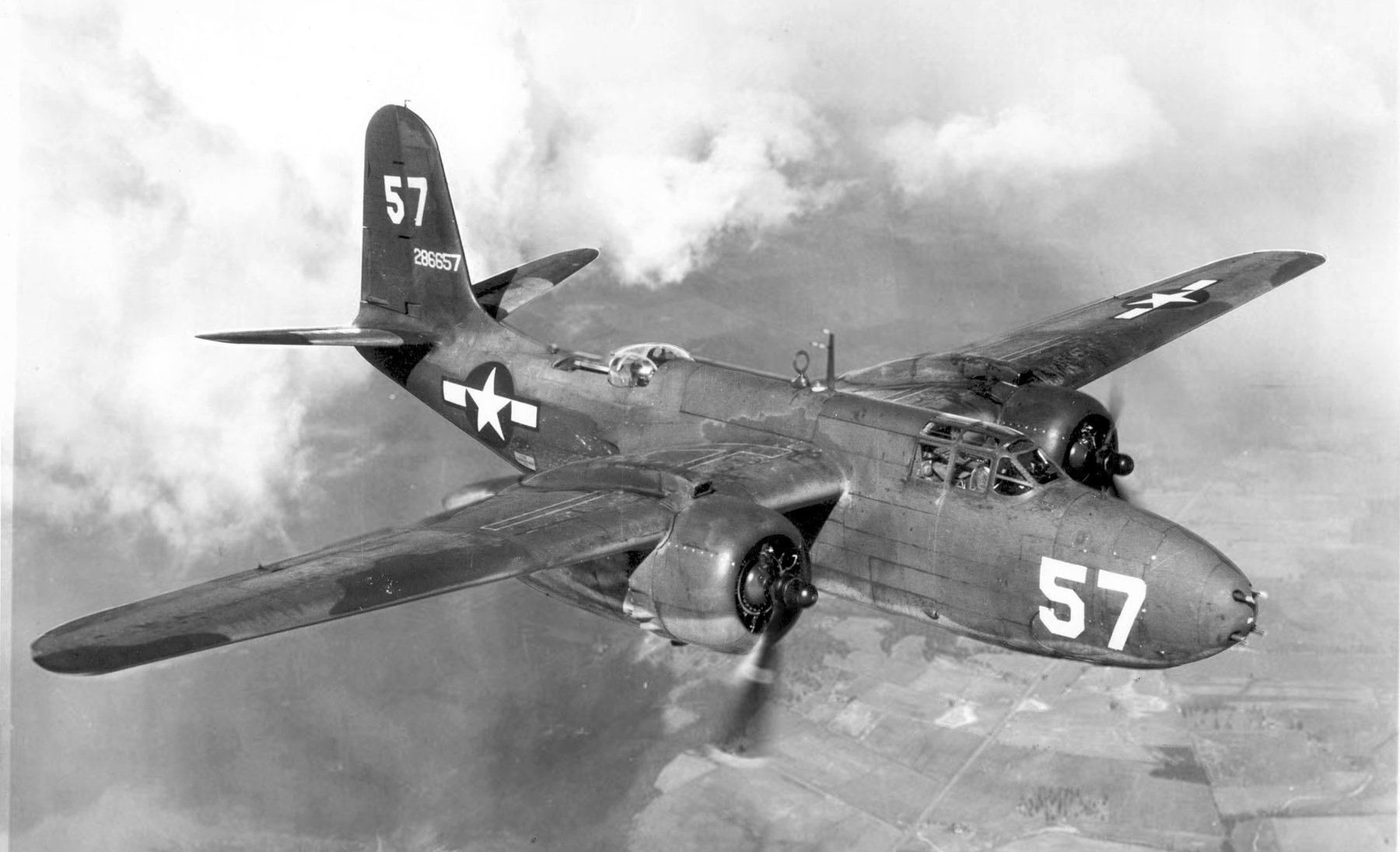
Douglas A-20 Havoc
The Douglas A-20 Havoc (company designation DB-7) is an American light bomber, attack aircraft, night intruder, night fighter, and reconnaissance aircraft of World War II.
Designed to meet an Army Air Corps requirement for a bomber, it was ordered by France for their air force before the USAAC decided it would also meet their requirements. French DB-7s were the first to see combat; after the fall of France, the bomber served with the Royal Air Force under the service name Boston. From 1941, night fighter and intruder versions were given the service name Havoc. In 1942 USAAF A-20s saw combat in North Africa.
It served with several Allied air forces, principally the United States Army Air Forces (USAAF), the Soviet Air Forces (VVS), Soviet Naval Aviation (AVMF), and the Royal Air Force (RAF) of the United Kingdom. A total of 7,478 aircraft were built, of which more than a third served with Soviet units. It was also used by the air forces of Australia, South Africa, France, and the Netherlands during the war, and by Brazil afterwards.
In most British Commonwealth air forces, the bomber variants were known as Boston, while the night fighter and intruder variants were named Havoc. The exception was the Royal Australian Air Force, which used the name Boston for all variants. The USAAF used the P-70 designation to refer to the night fighter variants.
In March 1936, a design team headed by Donald Douglas, Jack Northrop, and Ed Heinemann produced a proposal for a bomber-reconnaissance aircraft powered by a pair of 450 hp (340 kW) Pratt & Whitney R-985 Wasp Junior 9-cylinder radial engines mounted on a shoulder wing. It was estimated to be capable of 250 mph (400 km/h) with a 680 lb (310 kg) bomb load. Reports of aircraft performance from the Spanish Civil War indicated that this design would be seriously underpowered, and it was canceled.
In 1937, the United States Army Air Corps (USAAC) issued a new specification for an attack aircraft. To meet this requirement, the Douglas team, now headed by Heinemann, developed the Model 7B, with a similar layout to the 7A, but was powered by 1,100 hp (820 kW) Pratt & Whitney R-1830-S3C3-G Twin Wasp 14-cylinder engines, and carried a bombload of up to 2,000 lb (910 kg). It faced competition from the North American NA-40, Stearman X-100, Martin 167F, and an unbuilt design from Bell Aircraft, the Model 9. The Air Corps invited all five companies to build prototypes at their own expense and to submit sealed bids for production of their aircraft.
The prototype Model 7B made its first flight on 26 October 1938. The model attracted the attention of a French Purchasing Commission visiting the United States. The French discreetly participated in the flight trials, so as not to attract criticism from American isolationists. The Model 7B crashed on 23 January 1939 while demonstrating single-engine performance, killing the test pilot and seriously injuring a French observer aboard the aircraft. The presence of a foreigner on a test flight for an aircraft still under development caused a scandal in the press. Despite the crash, the French were impressed enough to place an order for 100 production aircraft on 15 February 1939, following this up with an order for 170 more in October 1939.
As a result of the French order, Heinemann carried out another major redesign of the aircraft. While the design's wings were largely unchanged, the revised design had a new deeper but narrower fuselage, which accommodated a crew of three – a pilot, bombardier and a gunner. The wing was mounted lower than on the Model 7B, while the engines, 1,000 hp (750 kW) R-1830-SC3-Gs, were mounted in nacelles slung under the wings. Normal bombload was 1,410 lb (640 kg), or 1,800 lb (800 kg) in overload conditions, with a defensive armament of single 7.5mm MAC 1934 machine guns in dorsal and ventral mounts and four fixed forward-firing guns in the nose. The revised aircraft, the DB-7, first flew on 17 August 1939.
Douglas A-20 Havoc
The Douglas A-20 Havoc (company designation DB-7) is an American light bomber, attack aircraft, night intruder, night fighter, and reconnaissance aircraft of World War II.
Designed to meet an Army Air Corps requirement for a bomber, it was ordered by France for their air force before the USAAC decided it would also meet their requirements. French DB-7s were the first to see combat; after the fall of France, the bomber served with the Royal Air Force under the service name Boston. From 1941, night fighter and intruder versions were given the service name Havoc. In 1942 USAAF A-20s saw combat in North Africa.
It served with several Allied air forces, principally the United States Army Air Forces (USAAF), the Soviet Air Forces (VVS), Soviet Naval Aviation (AVMF), and the Royal Air Force (RAF) of the United Kingdom. A total of 7,478 aircraft were built, of which more than a third served with Soviet units. It was also used by the air forces of Australia, South Africa, France, and the Netherlands during the war, and by Brazil afterwards.
In most British Commonwealth air forces, the bomber variants were known as Boston, while the night fighter and intruder variants were named Havoc. The exception was the Royal Australian Air Force, which used the name Boston for all variants. The USAAF used the P-70 designation to refer to the night fighter variants.
In March 1936, a design team headed by Donald Douglas, Jack Northrop, and Ed Heinemann produced a proposal for a bomber-reconnaissance aircraft powered by a pair of 450 hp (340 kW) Pratt & Whitney R-985 Wasp Junior 9-cylinder radial engines mounted on a shoulder wing. It was estimated to be capable of 250 mph (400 km/h) with a 680 lb (310 kg) bomb load. Reports of aircraft performance from the Spanish Civil War indicated that this design would be seriously underpowered, and it was canceled.
In 1937, the United States Army Air Corps (USAAC) issued a new specification for an attack aircraft. To meet this requirement, the Douglas team, now headed by Heinemann, developed the Model 7B, with a similar layout to the 7A, but was powered by 1,100 hp (820 kW) Pratt & Whitney R-1830-S3C3-G Twin Wasp 14-cylinder engines, and carried a bombload of up to 2,000 lb (910 kg). It faced competition from the North American NA-40, Stearman X-100, Martin 167F, and an unbuilt design from Bell Aircraft, the Model 9. The Air Corps invited all five companies to build prototypes at their own expense and to submit sealed bids for production of their aircraft.
The prototype Model 7B made its first flight on 26 October 1938. The model attracted the attention of a French Purchasing Commission visiting the United States. The French discreetly participated in the flight trials, so as not to attract criticism from American isolationists. The Model 7B crashed on 23 January 1939 while demonstrating single-engine performance, killing the test pilot and seriously injuring a French observer aboard the aircraft. The presence of a foreigner on a test flight for an aircraft still under development caused a scandal in the press. Despite the crash, the French were impressed enough to place an order for 100 production aircraft on 15 February 1939, following this up with an order for 170 more in October 1939.
As a result of the French order, Heinemann carried out another major redesign of the aircraft. While the design's wings were largely unchanged, the revised design had a new deeper but narrower fuselage, which accommodated a crew of three – a pilot, bombardier and a gunner. The wing was mounted lower than on the Model 7B, while the engines, 1,000 hp (750 kW) R-1830-SC3-Gs, were mounted in nacelles slung under the wings. Normal bombload was 1,410 lb (640 kg), or 1,800 lb (800 kg) in overload conditions, with a defensive armament of single 7.5mm MAC 1934 machine guns in dorsal and ventral mounts and four fixed forward-firing guns in the nose. The revised aircraft, the DB-7, first flew on 17 August 1939.
Recent media
Recent media