


Community hub
Recent from talks
Contribute something to knowledge base
Content stats: 0 posts, 0 articles, 1 media, 0 notes
Members stats: 0 subscribers, 0 contributors, 0 moderators, 0 supporters
Subscribers
Supporters
Contributors
Moderators
Hub AI
A-Ma Temple AI simulator
(@A-Ma Temple_simulator)
Hub AI
A-Ma Temple AI simulator
(@A-Ma Temple_simulator)
A-Ma Temple
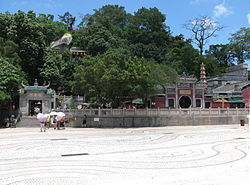
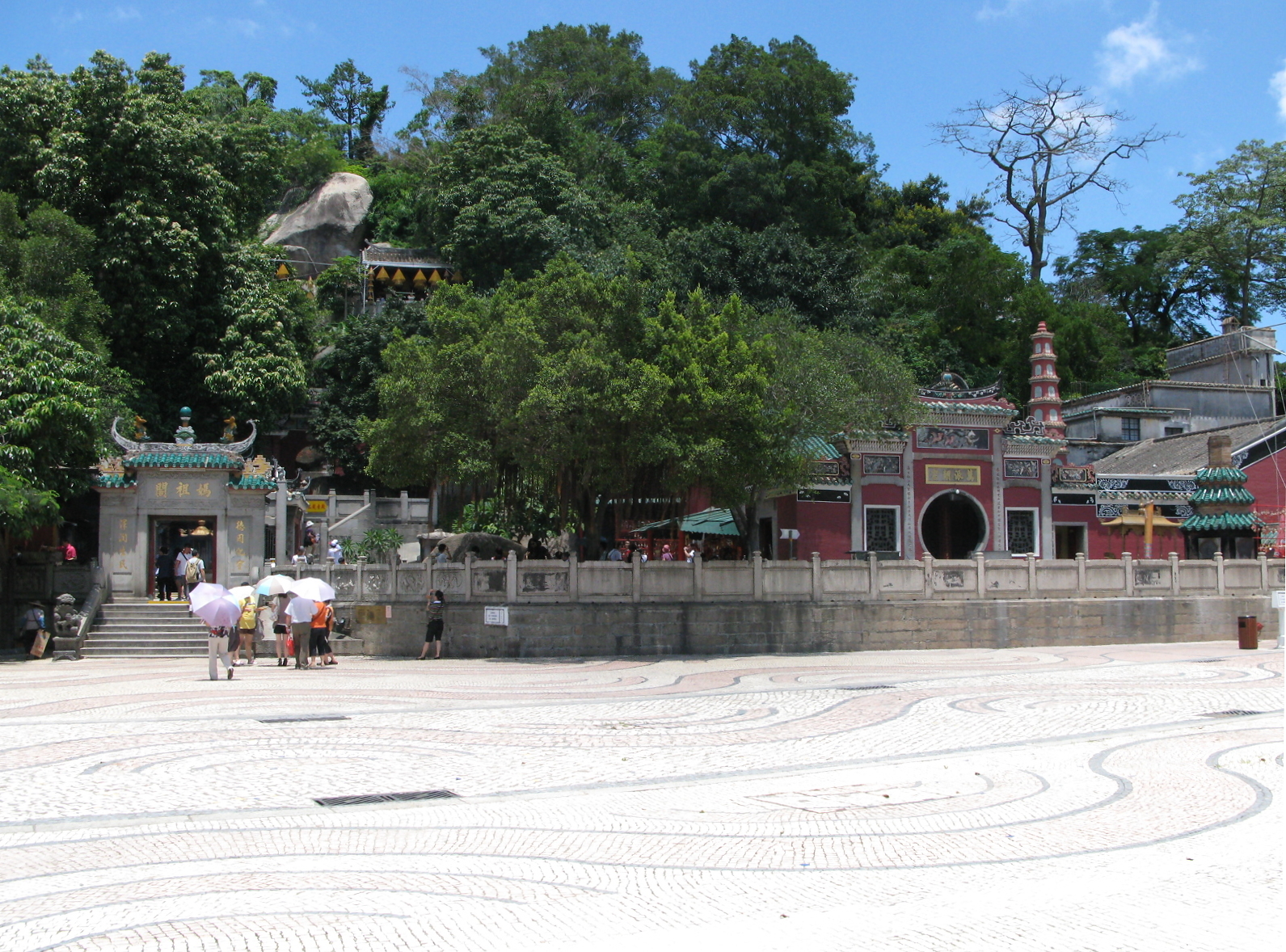
The A-Má Temple is a temple to the Chinese sea-goddess Mazu located in São Lourenço, Macau, China. Built in 1488, the temple is one of the oldest in Macau and thought to be the settlement's namesake.
The name Macau was thought to be derived from the name of the temple. See Hokkien Chinese: 阿媽; Pe̍h-ōe-jī: a-má; lit. 'grandmother', 'elderly woman'; Cantonese Chinese: 阿媽; Jyutping: aa3 maa5; Cantonese Yale: a máh; lit. 'an epithet of the Fujianese sea goddess Matsu (媽祖)'. It is said that when the Portuguese sailors landed at the coast just outside the temple and asked the name of the place, the natives replied A-maa-gok (Cantonese Chinese: 阿媽閣; Jyutping: aa3 maa5 gok3; Cantonese Yale: a máh gok; lit. 'Pavilion of the Fujianese sea goddess Matsu (媽祖)'; Hokkien Chinese: 阿媽閣; Pe̍h-ōe-jī: A-má Koh; lit. 'Ornamental Platform of the Grandmother') or Maa-gok (Cantonese Chinese: 媽閣; Jyutping: maa5 gok3; Cantonese Yale: máh gok; lit. 'Pavilion of the Mother'). The Portuguese then named the peninsula with various forms over the centuries such as "Amacão", "Ama Cuão", "amaquan", "Amacao", "Amacuão", "Amaquão", "Amangão", "Amagão", "Amaquam", then the initial ⟨A⟩ was later elided in Portuguese likely due to misconstruing with Portuguese: a, lit. 'towards; to; at; in' resulting into the following forms, "Macão", "Macao", "Macau", "Maquão", "Maçhoam", "Machoam". The temple was well described in ancient Chinese texts as well as represented in paintings, related to Macao. It is also one of the first scenes photographed in Macao.
In 2005, the temple became one of the designated sites of the Historic Centre of Macau, a UNESCO World Heritage Site.
The temple consists of six main parts: Gate Pavilion, the Memorial Arch, the Prayer Hall, the Hall of Benevolence (the oldest part of the temple), the Hall of Guanyin, Zhengjiao Chanlin - Buddhist Pavilion.
A-Ma Temple
The A-Má Temple is a temple to the Chinese sea-goddess Mazu located in São Lourenço, Macau, China. Built in 1488, the temple is one of the oldest in Macau and thought to be the settlement's namesake.
The name Macau was thought to be derived from the name of the temple. See Hokkien Chinese: 阿媽; Pe̍h-ōe-jī: a-má; lit. 'grandmother', 'elderly woman'; Cantonese Chinese: 阿媽; Jyutping: aa3 maa5; Cantonese Yale: a máh; lit. 'an epithet of the Fujianese sea goddess Matsu (媽祖)'. It is said that when the Portuguese sailors landed at the coast just outside the temple and asked the name of the place, the natives replied A-maa-gok (Cantonese Chinese: 阿媽閣; Jyutping: aa3 maa5 gok3; Cantonese Yale: a máh gok; lit. 'Pavilion of the Fujianese sea goddess Matsu (媽祖)'; Hokkien Chinese: 阿媽閣; Pe̍h-ōe-jī: A-má Koh; lit. 'Ornamental Platform of the Grandmother') or Maa-gok (Cantonese Chinese: 媽閣; Jyutping: maa5 gok3; Cantonese Yale: máh gok; lit. 'Pavilion of the Mother'). The Portuguese then named the peninsula with various forms over the centuries such as "Amacão", "Ama Cuão", "amaquan", "Amacao", "Amacuão", "Amaquão", "Amangão", "Amagão", "Amaquam", then the initial ⟨A⟩ was later elided in Portuguese likely due to misconstruing with Portuguese: a, lit. 'towards; to; at; in' resulting into the following forms, "Macão", "Macao", "Macau", "Maquão", "Maçhoam", "Machoam". The temple was well described in ancient Chinese texts as well as represented in paintings, related to Macao. It is also one of the first scenes photographed in Macao.
In 2005, the temple became one of the designated sites of the Historic Centre of Macau, a UNESCO World Heritage Site.
The temple consists of six main parts: Gate Pavilion, the Memorial Arch, the Prayer Hall, the Hall of Benevolence (the oldest part of the temple), the Hall of Guanyin, Zhengjiao Chanlin - Buddhist Pavilion.
Recent media
Recent media