


Community hub
Recent from talks
Contribute something to knowledge base
Content stats: 0 posts, 0 articles, 1 media, 0 notes
Members stats: 0 subscribers, 0 contributors, 0 moderators, 0 supporters
Subscribers
Supporters
Contributors
Moderators
Hub AI
AHQ Malta AI simulator
(@AHQ Malta_simulator)
Hub AI
AHQ Malta AI simulator
(@AHQ Malta_simulator)
AHQ Malta
Air Headquarters Malta (AHQ Malta or Air H.Q. Malta) was an overseas command of the Royal Air Force (RAF) during the Second World War. It was established on 28 December 1941 by renaming RAF Mediterranean under Air Vice Marshal Hugh Lloyd. Lloyd was named Air Officer Commanding in Malta on 1 June 1941.
AHQ Malta played a key defensive role during the war when Malta was under siege by Axis forces between 11 June 1940 to 20 November 1942. In 1943 it then became a major sub-command centre for the Allies under the Mediterranean Air Command (MAC) when the Allies began their attack on Sicily, Italy.
AHQ Malta remained in operation under British command until 1968 when it was disbanded. The British withdrew from Malta in 1979.
No. 267 Squadron RAF and No. 268 Squadron RAF, both with seaplanes, were formed at RAF Kalafrana in August 1918.
RAF Mediterranean had been based in Malta under one designation or another throughout the interwar period, spending some time known as 'Mediterranean Group'.
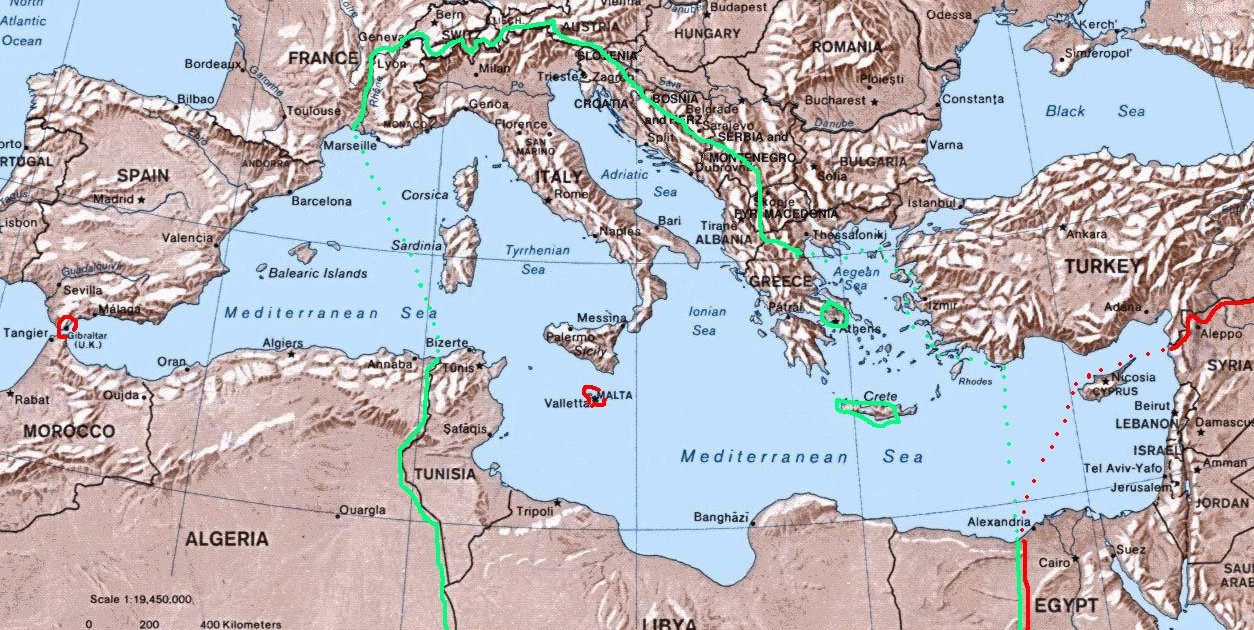
Despite concerns that the island, far from Britain and close to Italy, could not be defended, the British decided in July 1939 to increase the number of anti-aircraft guns and fighter aircraft on Malta. During 1940 Malta's air defence force had been built up from Faith, Hope, and Charity, the three famous Sea Gladiators of the Hal Far Fighter Flight.
During the early stage of the Siege of Malta (11 June 1940 to 20 November 1942), which was also early in the wider North African Campaign, Axis powers did not consider Malta much of an offensive threat. However it was considered an essential Allied stronghold. This was exemplified by Operation Pedestal and the other, often very costly, efforts to resupply the island.
On 20 April 1942, the USS Wasp delivered 47 Spitfires to Malta. Although the German Luftwaffe promptly destroyed 30 of them on the same day, the defensive and offensive capabilities of AHQ Malta grew as a result of these and other aircraft reaching the island in the summer of 1942. On 1 July 1942, AHQ Malta had approximately 200 aircraft, about half of which were Spitfires.
AHQ Malta
Air Headquarters Malta (AHQ Malta or Air H.Q. Malta) was an overseas command of the Royal Air Force (RAF) during the Second World War. It was established on 28 December 1941 by renaming RAF Mediterranean under Air Vice Marshal Hugh Lloyd. Lloyd was named Air Officer Commanding in Malta on 1 June 1941.
AHQ Malta played a key defensive role during the war when Malta was under siege by Axis forces between 11 June 1940 to 20 November 1942. In 1943 it then became a major sub-command centre for the Allies under the Mediterranean Air Command (MAC) when the Allies began their attack on Sicily, Italy.
AHQ Malta remained in operation under British command until 1968 when it was disbanded. The British withdrew from Malta in 1979.
No. 267 Squadron RAF and No. 268 Squadron RAF, both with seaplanes, were formed at RAF Kalafrana in August 1918.
RAF Mediterranean had been based in Malta under one designation or another throughout the interwar period, spending some time known as 'Mediterranean Group'.
Despite concerns that the island, far from Britain and close to Italy, could not be defended, the British decided in July 1939 to increase the number of anti-aircraft guns and fighter aircraft on Malta. During 1940 Malta's air defence force had been built up from Faith, Hope, and Charity, the three famous Sea Gladiators of the Hal Far Fighter Flight.
During the early stage of the Siege of Malta (11 June 1940 to 20 November 1942), which was also early in the wider North African Campaign, Axis powers did not consider Malta much of an offensive threat. However it was considered an essential Allied stronghold. This was exemplified by Operation Pedestal and the other, often very costly, efforts to resupply the island.
On 20 April 1942, the USS Wasp delivered 47 Spitfires to Malta. Although the German Luftwaffe promptly destroyed 30 of them on the same day, the defensive and offensive capabilities of AHQ Malta grew as a result of these and other aircraft reaching the island in the summer of 1942. On 1 July 1942, AHQ Malta had approximately 200 aircraft, about half of which were Spitfires.
Recent media
Recent media