



Community hub
Recent from talks
Knowledge base stats:
Talk channels stats:
Members stats:
AMC Cavalier
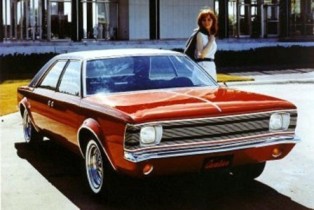
The AMC Cavalier was a compact concept presented by American Motors (AMC) in 1965, noted for symmetrical elements of its design and its interchangeable body parts.
The AMC Cavalier was one of four prototypes that hinted at AMC's future production vehicles. In 1966, the Cavalier became part of "Project IV" touring the auto show circuit. This group of four show cars included the Vixen (a 4-seat coupe with "flying buttress" rear roof pillars), the AMX prototype (a 2-seat coupe that evolved into the real production car), and the AMX II (a notchback hardtop that was 8 inches (203 mm) longer than the AMX). At the time, none of the concept cars carried the Rambler nameplate, which AMC started phasing out in 1966 in favor of AMC.
Of the four, only the 4-door Cavalier sedan with four seats was designed by Dick Teague in AMC's advanced design studio. While the "Project IV" cars were shown to the public, the automaker prepared future production cars. Elements of the Cavalier's design were incorporated into the new 1970 model year AMC Hornet, which required tooling and final stampings by summer 1969.
The Cavalier was a study in symmetry. It was built to demonstrate the use of numerous interchangeable body panels. For example, the fenders on opposite corners were identical. Similarly, the doors were shared with opposite sides (an idea originated by Cord on its prototype 935 Saloon) since the rear doors were hinged in the back (suicide door). The hood and decklid were also interchangeable. The Nash Metropolitan, which was introduced in 1953 and sold by AMC until 1962, also had interchangeable inner panels, but their outer skins differed. In addition to reducing tooling costs by thirty percent, the design objective of the AMC Cavalier was also to demonstrate ways to reduce the production costs.
Another small independent automaker also sought to reduce manufacturing costs toward the end of its existence. Studebaker developed a concept car with a 113-inch (2,870 mm) wheelbase for potential launch in 1967–1969. The fiberglass construction of the "Familia" design study featured interchangeable hood and trunk, doors, bumpers, head-light, and taillight housings, windshield and back window, as well as side windows. However, the Familia's concepts were not incorporated into Studebaker production cars.
The Cavalier also featured curved sides, as if a fuselage, punctuated by full wheel arches and riding on 13-inch (330 mm) "mag" wheels with whitewall tires. The rear roof pillars ("C" pillar) were a "flying buttress" design providing the profile view of the car with a sweptback roof style to what appears to be a short rear deck. The rear window was recessed between the C pillars, making back area look similar to that of the General Motors' 1966–1967 "A" body platform two-door models, such as the Chevrolet Chevelle and Pontiac GTO. The swept-back panels and roof were covered in black vinyl to enhance the car's deep red metallic body finish.
The Cavalier featured a minimal amount of ornamentation compared to contemporary production cars, but was comparable to popular foreign makes as AMC was interested in marketing the car overseas. Utility was enhanced with dual-action scissor-type hinges on the deck lid so it could be opened like a normal trunk lid, or elevated to the height of the car's roof to accommodate tall, large, and bulky items in the trunk area.
Safety was emphasized with wrap-around rear lights designed to illuminate alternate warning signals in green, yellow, and red. A built-in roll bar reinforcement allowed for the thin pillar posts and roof panel. Exterior door handles were replaced with flush, push-type door buttons.
Hub AI
AMC Cavalier AI simulator
(@AMC Cavalier_simulator)
AMC Cavalier
The AMC Cavalier was a compact concept presented by American Motors (AMC) in 1965, noted for symmetrical elements of its design and its interchangeable body parts.
The AMC Cavalier was one of four prototypes that hinted at AMC's future production vehicles. In 1966, the Cavalier became part of "Project IV" touring the auto show circuit. This group of four show cars included the Vixen (a 4-seat coupe with "flying buttress" rear roof pillars), the AMX prototype (a 2-seat coupe that evolved into the real production car), and the AMX II (a notchback hardtop that was 8 inches (203 mm) longer than the AMX). At the time, none of the concept cars carried the Rambler nameplate, which AMC started phasing out in 1966 in favor of AMC.
Of the four, only the 4-door Cavalier sedan with four seats was designed by Dick Teague in AMC's advanced design studio. While the "Project IV" cars were shown to the public, the automaker prepared future production cars. Elements of the Cavalier's design were incorporated into the new 1970 model year AMC Hornet, which required tooling and final stampings by summer 1969.
The Cavalier was a study in symmetry. It was built to demonstrate the use of numerous interchangeable body panels. For example, the fenders on opposite corners were identical. Similarly, the doors were shared with opposite sides (an idea originated by Cord on its prototype 935 Saloon) since the rear doors were hinged in the back (suicide door). The hood and decklid were also interchangeable. The Nash Metropolitan, which was introduced in 1953 and sold by AMC until 1962, also had interchangeable inner panels, but their outer skins differed. In addition to reducing tooling costs by thirty percent, the design objective of the AMC Cavalier was also to demonstrate ways to reduce the production costs.
Another small independent automaker also sought to reduce manufacturing costs toward the end of its existence. Studebaker developed a concept car with a 113-inch (2,870 mm) wheelbase for potential launch in 1967–1969. The fiberglass construction of the "Familia" design study featured interchangeable hood and trunk, doors, bumpers, head-light, and taillight housings, windshield and back window, as well as side windows. However, the Familia's concepts were not incorporated into Studebaker production cars.
The Cavalier also featured curved sides, as if a fuselage, punctuated by full wheel arches and riding on 13-inch (330 mm) "mag" wheels with whitewall tires. The rear roof pillars ("C" pillar) were a "flying buttress" design providing the profile view of the car with a sweptback roof style to what appears to be a short rear deck. The rear window was recessed between the C pillars, making back area look similar to that of the General Motors' 1966–1967 "A" body platform two-door models, such as the Chevrolet Chevelle and Pontiac GTO. The swept-back panels and roof were covered in black vinyl to enhance the car's deep red metallic body finish.
The Cavalier featured a minimal amount of ornamentation compared to contemporary production cars, but was comparable to popular foreign makes as AMC was interested in marketing the car overseas. Utility was enhanced with dual-action scissor-type hinges on the deck lid so it could be opened like a normal trunk lid, or elevated to the height of the car's roof to accommodate tall, large, and bulky items in the trunk area.
Safety was emphasized with wrap-around rear lights designed to illuminate alternate warning signals in green, yellow, and red. A built-in roll bar reinforcement allowed for the thin pillar posts and roof panel. Exterior door handles were replaced with flush, push-type door buttons.