
Recent from talks
AMR 33
Knowledge base stats:
Talk channels stats:
Members stats:
AMR 33
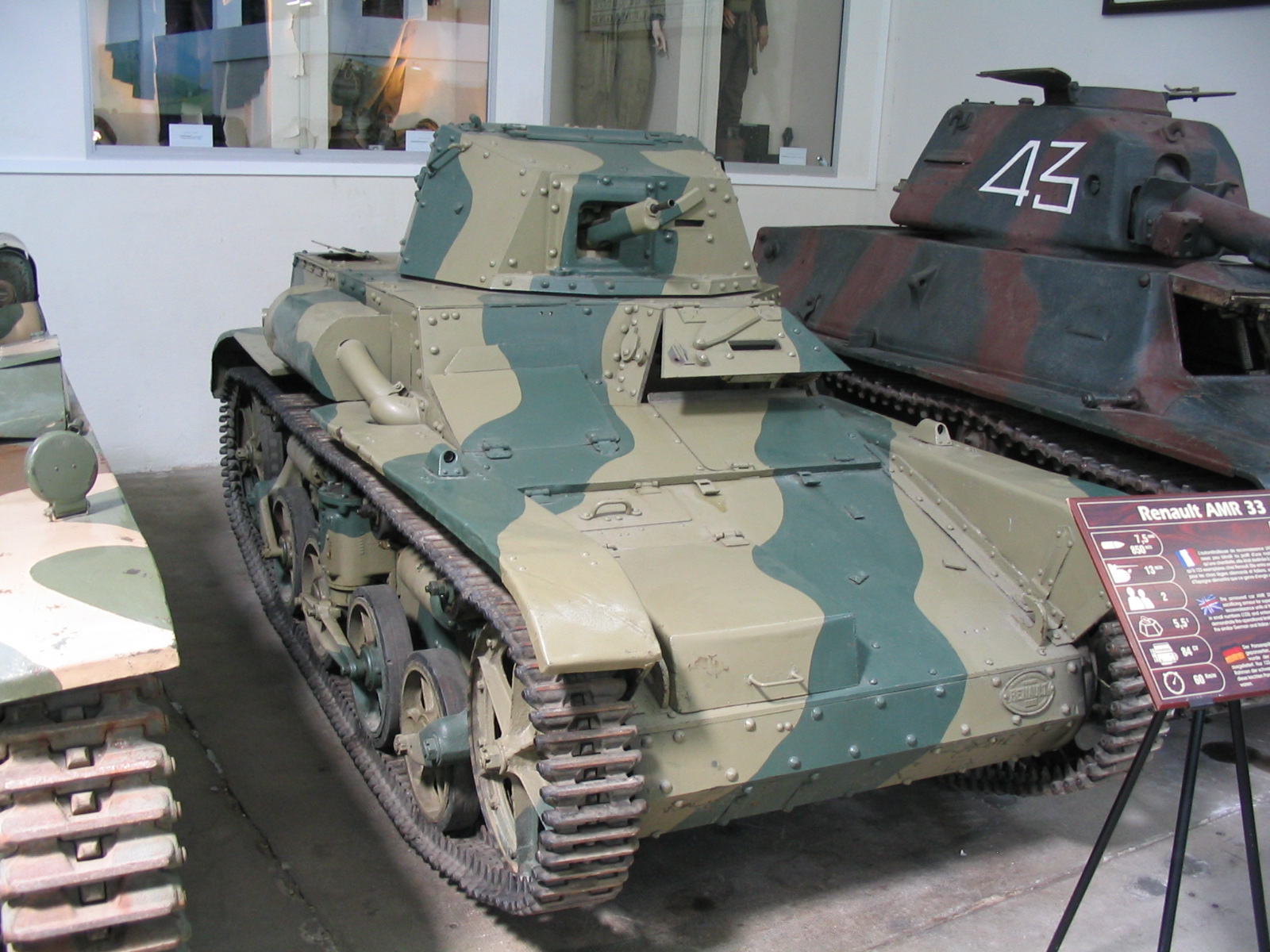
The Automitrailleuse de Reconnaissance Renault Modèle 1933 (AMR 33 or Renault VM) was a French light cavalry tank developed during the Interbellum and used in the Second World War.
Developed by Renault from 1932, the type was ordered by the French Cavalry in 1933; a total of 123 would be built until 1935. The AMR 33 was lightly armed and armoured; though it was very fast for its day, it proved to be a mechanically unreliable vehicle, especially its suspension elements being too weak. It was therefore succeeded by an improved type, the AMR 35.
Though its name might suggest otherwise, the AMR 33 was not a scout vehicle and mostly was not equipped with a radio set. The AMR 33s were intended to form a large mass of light tanks, preceding the medium types into battle. In reality, they never served as such; by the time enough medium tanks were produced to form armoured divisions, the AMR 33 had already been replaced by the AMR 35 and was limited to the Cavalry Divisions and in 1940 to the Cavalry Light Divisions to provide fire support to motorised infantry and dismounted cavalry. In the 1940 Battle of France, the AMR 33s were quickly lost. Some captured vehicles were used by Germany for the duration of the war.
To counter the threat posed by the massive Soviet arms build-up since 1928, the year Joseph Stalin took power, on 4 July 1930, the French government conceived the plan to form a projection force capable of assisting its allies in the Cordon sanitaire. This force would have to consist of five motorised infantry divisions and the five existing cavalry divisions, one brigade of each would have to be motorised. The plan called for the introduction of many specialised vehicles, among which was an Automitrailleuse de Cavalerie type Reconnaissance (AMR), specified on 16 January 1932 as a vehicle of three tons, armed with a light 7.5 mm machine gun and having a range of 200 kilometres. It should have a crew of two, have an average terrain speed of 35 km/h and an armour base of 9 mm. Automitrailleuse was then the generalised term for any light armoured fighting vehicle armed with a machine gun. At the time, the Cavalry only used wheeled vehicles as tanks were too slow but the designation remained when tracked vehicles entered service, as the official policy was to allocate tanks (Chars) to the Infantry. Although the name might suggest otherwise, an AMR was not a specialised reconnaissance vehicle but a skirmisher without a radio. The gathering and reporting of information was the task of an AMD (Automitrailleuse de Découverte).
In anticipation, in early November 1931, Louis Renault had already begun to design a tracteur léger de cavalerie type VM based on his Renault UE tractor. On 12 November, the first drawings were examined and rejected because the vehicle in its proposed form was much too cramped. A larger hull was clearly necessary but Renault was hesitant to invest in it without the prospect of a possible order. On 21 November, he was asked by the Section Technique de la Cavalerie to provide a tankette version of his Renault UE to test the feasibility of a tracked AMR-concept. Being hereby informed of the general outlines of the specifications, on 22 December, he sent a representative to supreme commander Maxime Weygand to lobby for a Renault AMR. Weygand informed him that it had informally been decided to procure the AMR Citroën Kégresse P 28, a half-track made by Renault's competitor Citroën. However, after much deliberation, the General that very day committed himself to take a Renault tank into consideration.[citation needed]
That commitment being secured, Renault hastily designed a larger model, a wooden mock-up of which was presented in March 1932. Based on it, an order was made on 20 April for five prototypes for a price of 171,250 FF per vehicle, to be delivered in September before the start of the autumn Champagne manoeuvres. The Cavalry saw this as a pre-series to obtain a platoon to be used for its very first trials with a mechanised unit. However, Renault decided to provide each with a different suspension type, to lower the risk that his design would be found wanting. All were generally based on the Carden Loyd type that Renault had simply copied for his Renault UE – without paying any licence rights – and used the standard Renault Reinastella engine. As there simply wasn't time to fully develop all types before the autumn, in July the five vehicles, with military registration numbers 79756 to 79760, were delivered with the simplest one: two leaf springs on each side didn't spring the suspension units, they were the suspension units. In September, the tanks were united in the first French Cavalry mechanised unit ever: the experimental Détachement Mécanique de Sûreté. The experience showed that they were very agile, but also noisy, poorly balanced and lacking sufficient range; unsurprisingly, the crew was always in for a bumpy ride.
After the exercise, they were sent back to Renault, who shortly afterwards submitted three types for evaluation to the Commission d'Expériences du Matériel Automobile at Vincennes: prototype 79758, still with the original suspension, 79759 with added internal hydraulic dampers and 79760 with a fully new suspension consisting of a central bogie with a leaf spring and wheels at the front and the back connected to two horizontal helical springs. In November and December 1932, the "Commission de Vincennes" tested them, using as reference changed specifications determined on 10 June 1932. They were found to have a sufficient speed (56.25 – 60 km/h), but an insufficient range of 166 - 188 kilometres and to be too heavy with a weight of 4.8 tons. On 8 December, it was decided to abandon the unrealistic three ton weight limit and install larger fuel tanks and heavier armour, 13 mm thick; the vehicles were again sent back. In April 1933, Renault submitted two types, fitted with 0.5 ton weights simulating an up-armouring from nine to thirteen millimetres maximum: 79758 was rebuilt with a horizontal rubber spring suspension and 79757 was fitted with a suspension derived from that of 79760, but now with a central vertical spring and the casings of the horizontal springs filled with oil to make them act as dampers. They were tested until June 1933 and, against the strong advice of Renault favouring the rubber springs, on 6 June a production was ordered for prototype 79757 as the AMR Renault modèle 1933 or AMR 33.
On 8 March 1933, the Cavalry had already made a preliminary order of 45 for whatever type would be chosen. This was confirmed on 22 June together with a second order of 20 vehicles and deliveries were to start no later than 1 July. A third order of 50 was made in the autumn. However, due to financial difficulties, the first vehicle was only delivered on 1 June 1934; the last of the 115 was delivered in September. The production of the Citroën half-track was limited to 50. It was decided to rebuild the original prototypes into standard vehicles; however, two were ultimately used to develop the AMR 35, an improved model that was necessary because the too-fragile suspension of the AMR 33 was prone to break down (or even simply to break off) and engine noise was excessive. Prototype 79758 was used to test several other improved configurations. To compensate, three more AMR 33's were built in the spring of 1935 for a total of 123, including all prototypes. The chassis that was used for the development of the Engin P, a project for a 37 mm gun equipped tank destroyer, is not included in this number.
Hub AI
AMR 33 AI simulator
(@AMR 33_simulator)
AMR 33
The Automitrailleuse de Reconnaissance Renault Modèle 1933 (AMR 33 or Renault VM) was a French light cavalry tank developed during the Interbellum and used in the Second World War.
Developed by Renault from 1932, the type was ordered by the French Cavalry in 1933; a total of 123 would be built until 1935. The AMR 33 was lightly armed and armoured; though it was very fast for its day, it proved to be a mechanically unreliable vehicle, especially its suspension elements being too weak. It was therefore succeeded by an improved type, the AMR 35.
Though its name might suggest otherwise, the AMR 33 was not a scout vehicle and mostly was not equipped with a radio set. The AMR 33s were intended to form a large mass of light tanks, preceding the medium types into battle. In reality, they never served as such; by the time enough medium tanks were produced to form armoured divisions, the AMR 33 had already been replaced by the AMR 35 and was limited to the Cavalry Divisions and in 1940 to the Cavalry Light Divisions to provide fire support to motorised infantry and dismounted cavalry. In the 1940 Battle of France, the AMR 33s were quickly lost. Some captured vehicles were used by Germany for the duration of the war.
To counter the threat posed by the massive Soviet arms build-up since 1928, the year Joseph Stalin took power, on 4 July 1930, the French government conceived the plan to form a projection force capable of assisting its allies in the Cordon sanitaire. This force would have to consist of five motorised infantry divisions and the five existing cavalry divisions, one brigade of each would have to be motorised. The plan called for the introduction of many specialised vehicles, among which was an Automitrailleuse de Cavalerie type Reconnaissance (AMR), specified on 16 January 1932 as a vehicle of three tons, armed with a light 7.5 mm machine gun and having a range of 200 kilometres. It should have a crew of two, have an average terrain speed of 35 km/h and an armour base of 9 mm. Automitrailleuse was then the generalised term for any light armoured fighting vehicle armed with a machine gun. At the time, the Cavalry only used wheeled vehicles as tanks were too slow but the designation remained when tracked vehicles entered service, as the official policy was to allocate tanks (Chars) to the Infantry. Although the name might suggest otherwise, an AMR was not a specialised reconnaissance vehicle but a skirmisher without a radio. The gathering and reporting of information was the task of an AMD (Automitrailleuse de Découverte).
In anticipation, in early November 1931, Louis Renault had already begun to design a tracteur léger de cavalerie type VM based on his Renault UE tractor. On 12 November, the first drawings were examined and rejected because the vehicle in its proposed form was much too cramped. A larger hull was clearly necessary but Renault was hesitant to invest in it without the prospect of a possible order. On 21 November, he was asked by the Section Technique de la Cavalerie to provide a tankette version of his Renault UE to test the feasibility of a tracked AMR-concept. Being hereby informed of the general outlines of the specifications, on 22 December, he sent a representative to supreme commander Maxime Weygand to lobby for a Renault AMR. Weygand informed him that it had informally been decided to procure the AMR Citroën Kégresse P 28, a half-track made by Renault's competitor Citroën. However, after much deliberation, the General that very day committed himself to take a Renault tank into consideration.[citation needed]
That commitment being secured, Renault hastily designed a larger model, a wooden mock-up of which was presented in March 1932. Based on it, an order was made on 20 April for five prototypes for a price of 171,250 FF per vehicle, to be delivered in September before the start of the autumn Champagne manoeuvres. The Cavalry saw this as a pre-series to obtain a platoon to be used for its very first trials with a mechanised unit. However, Renault decided to provide each with a different suspension type, to lower the risk that his design would be found wanting. All were generally based on the Carden Loyd type that Renault had simply copied for his Renault UE – without paying any licence rights – and used the standard Renault Reinastella engine. As there simply wasn't time to fully develop all types before the autumn, in July the five vehicles, with military registration numbers 79756 to 79760, were delivered with the simplest one: two leaf springs on each side didn't spring the suspension units, they were the suspension units. In September, the tanks were united in the first French Cavalry mechanised unit ever: the experimental Détachement Mécanique de Sûreté. The experience showed that they were very agile, but also noisy, poorly balanced and lacking sufficient range; unsurprisingly, the crew was always in for a bumpy ride.
After the exercise, they were sent back to Renault, who shortly afterwards submitted three types for evaluation to the Commission d'Expériences du Matériel Automobile at Vincennes: prototype 79758, still with the original suspension, 79759 with added internal hydraulic dampers and 79760 with a fully new suspension consisting of a central bogie with a leaf spring and wheels at the front and the back connected to two horizontal helical springs. In November and December 1932, the "Commission de Vincennes" tested them, using as reference changed specifications determined on 10 June 1932. They were found to have a sufficient speed (56.25 – 60 km/h), but an insufficient range of 166 - 188 kilometres and to be too heavy with a weight of 4.8 tons. On 8 December, it was decided to abandon the unrealistic three ton weight limit and install larger fuel tanks and heavier armour, 13 mm thick; the vehicles were again sent back. In April 1933, Renault submitted two types, fitted with 0.5 ton weights simulating an up-armouring from nine to thirteen millimetres maximum: 79758 was rebuilt with a horizontal rubber spring suspension and 79757 was fitted with a suspension derived from that of 79760, but now with a central vertical spring and the casings of the horizontal springs filled with oil to make them act as dampers. They were tested until June 1933 and, against the strong advice of Renault favouring the rubber springs, on 6 June a production was ordered for prototype 79757 as the AMR Renault modèle 1933 or AMR 33.
On 8 March 1933, the Cavalry had already made a preliminary order of 45 for whatever type would be chosen. This was confirmed on 22 June together with a second order of 20 vehicles and deliveries were to start no later than 1 July. A third order of 50 was made in the autumn. However, due to financial difficulties, the first vehicle was only delivered on 1 June 1934; the last of the 115 was delivered in September. The production of the Citroën half-track was limited to 50. It was decided to rebuild the original prototypes into standard vehicles; however, two were ultimately used to develop the AMR 35, an improved model that was necessary because the too-fragile suspension of the AMR 33 was prone to break down (or even simply to break off) and engine noise was excessive. Prototype 79758 was used to test several other improved configurations. To compensate, three more AMR 33's were built in the spring of 1935 for a total of 123, including all prototypes. The chassis that was used for the development of the Engin P, a project for a 37 mm gun equipped tank destroyer, is not included in this number.
Recent media