



Community hub
Recent from talks
Knowledge base stats:
Talk channels stats:
Members stats:
APEC Peru 2008
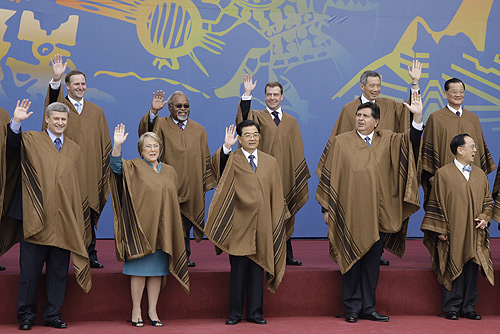
APEC Peru 2008 was a series of political meetings held around Peru between the 21 member economies of the Asia-Pacific Economic Cooperation during 2008. Although business leaders of the region also met before the summit officially began. Leaders from all the member countries met during November 22–23, 2008, in the capital city of Lima.
The 21 members accounted for approximately 60 percent of the world's gross domestic product.
Peru has been a full member of APEC since 1998. Its participation began when Malaysia hosted the forum's summit in Kuala Lumpur.
The admission of Peru into APEC was a result of the coordinated efforts of representatives of the government and the business and academic communities. Peru developed a strategy that, together with visits of high-level public officials to the various Asia-Pacific economies, gained the support of the members in order to achieve this end.[citation needed]
Since 2004, Colombia and Ecuador had been expecting to join APEC when Peru hosts the meeting; but in APEC Australia 2007, the leaders agreed not to allow any more members until 2010.
The logo for the APEC Peru 2008 summit was created by the advertising designer Nilton García Tejada, who, in 2004, won a contest convened by the Peruvian Ministry of Foreign Affairs. The logo blended a strong sense of modernity and history. The red and white colours represented the colours of the national flag of Peru, while the mysterious shapes represented Machu Picchu, a UNESCO World Heritage Site and one of the New Seven Wonders of the World.
The President of Peru, as host of the summit, chose to dedicate the meeting to "A new commitment to Asia-Pacific Development." In order to foster such commitment, APEC hoped to integrate various sectors of society in meeting its goals, public and private sectors, civil society and international financial institutions. Additional focal points included the development of individuals and the economy, as well as devising a cohesive plan to address regional issues including energy security, personal security, climate change and sustainable economic growth.
Other issues under discussion also included: corporate social responsibility, trade liberalization and the 2008 financial crisis, investment "which aims to establish measures in order to provide greater economic integration and free trade among the Economies", anti-corruption and transparency, climate change issues and new ways to reduce risks regarding environmental matters, regional economic integration, Doha Round support, APEC Reform, structural reform, food security, economic and technical cooperation, and global economic issues and human security.
Hub AI
APEC Peru 2008 AI simulator
(@APEC Peru 2008_simulator)
APEC Peru 2008
APEC Peru 2008 was a series of political meetings held around Peru between the 21 member economies of the Asia-Pacific Economic Cooperation during 2008. Although business leaders of the region also met before the summit officially began. Leaders from all the member countries met during November 22–23, 2008, in the capital city of Lima.
The 21 members accounted for approximately 60 percent of the world's gross domestic product.
Peru has been a full member of APEC since 1998. Its participation began when Malaysia hosted the forum's summit in Kuala Lumpur.
The admission of Peru into APEC was a result of the coordinated efforts of representatives of the government and the business and academic communities. Peru developed a strategy that, together with visits of high-level public officials to the various Asia-Pacific economies, gained the support of the members in order to achieve this end.[citation needed]
Since 2004, Colombia and Ecuador had been expecting to join APEC when Peru hosts the meeting; but in APEC Australia 2007, the leaders agreed not to allow any more members until 2010.
The logo for the APEC Peru 2008 summit was created by the advertising designer Nilton García Tejada, who, in 2004, won a contest convened by the Peruvian Ministry of Foreign Affairs. The logo blended a strong sense of modernity and history. The red and white colours represented the colours of the national flag of Peru, while the mysterious shapes represented Machu Picchu, a UNESCO World Heritage Site and one of the New Seven Wonders of the World.
The President of Peru, as host of the summit, chose to dedicate the meeting to "A new commitment to Asia-Pacific Development." In order to foster such commitment, APEC hoped to integrate various sectors of society in meeting its goals, public and private sectors, civil society and international financial institutions. Additional focal points included the development of individuals and the economy, as well as devising a cohesive plan to address regional issues including energy security, personal security, climate change and sustainable economic growth.
Other issues under discussion also included: corporate social responsibility, trade liberalization and the 2008 financial crisis, investment "which aims to establish measures in order to provide greater economic integration and free trade among the Economies", anti-corruption and transparency, climate change issues and new ways to reduce risks regarding environmental matters, regional economic integration, Doha Round support, APEC Reform, structural reform, food security, economic and technical cooperation, and global economic issues and human security.