



Community hub
Recent from talks
Contribute something
Nothing was collected or created yet.
Absolute radio-frequency channel number
View on Wikipedia | This article needs additional citations for verification. (November 2024) |
In GSM cellular networks, an absolute radio-frequency channel number (ARFCN) is a code that specifies a pair of physical radio carriers used for transmission and reception in a land mobile radio system, one for the uplink signal and one for the downlink signal. ARFCNs for GSM are defined in Specification 45.005 Section 2. There are also other variants of the ARFCN numbering scheme that are in use for other systems that are not GSM. One such example is the TETRA system that has 25 kHz channel spacing and uses different base frequencies for numbering.
Different frequencies (ARFCNs) are used for the frequency-based component of GSMs multiple access scheme (FDMA — frequency-division multiple access). Uplink/downlink channel pairs in GSM are identified by ARFCN. Together with the time-based component (TDMA — time-division multiple access) the physical channel is defined by selecting a certain ARFCN and a certain time slot. Note not to confuse this physical channel with the logical channels (e.g. BCCH — Broadcast Control Channel) that are time-multiplexed onto it under the rules of GSM Specification 05.03.
ARFCN table for common GSM systems
[edit]This table shows the common channel numbers and corresponding uplink and downlink frequencies associated with a particular ARFCN, as well as the way to calculate the frequency from the ARFCN number and vice versa.
Observe this table only deals with GSM systems. There are other mobile telecommunications systems that do use ARFCN to number their channels, but they may use different offsets, channel spacing and so on.
| Band | Designation | ARFCN | fUL [MHz] | fDL [MHz] |
|---|---|---|---|---|
| GSM 500 | GSM 450 | 259−293 | 450.6 + 0.2·(n−259) | fUL(n) + 10 |
| GSM 480 | 306−340 | 479.0 + 0.2·(n−306)[1] | fUL(n) + 10 | |
| GSM 700 | GSM 750 | 438−511 | 747.2 + 0.2·(n−438)[2] | fUL(n) + 30 |
| GSM 850 | GSM 850 | 128−251 | 824.2 + 0.2·(n−128) | fUL(n) + 45 |
| GSM 900 | P-GSM | 1−124 | 890.0 + 0.2·n | fUL(n) + 45 |
| E-GSM | 0−124 975−1023 |
890.0 + 0.2·n 890.0 + 0.2·(n−1024) |
fUL(n) + 45 | |
| GSM-R | 0−124 955−1023 |
890.0 + 0.2·n 890.0 + 0.2·(n−1024) |
fUL(n) + 45 | |
| GSM 1800 | DCS 1800 | 512−885 | 1710.2 + 0.2·(n−512) | fUL(n) + 95 |
| GSM 1900 | PCS 1900 | 512−810 | 1850.2 + 0.2·(n−512) | fUL(n) + 80 |
Other versions of ARFCN
[edit]TETRA uses different channel spacing compared to GSM systems. The standard is 25 kHz spacing and the center frequency of each channel may be offset in a number of fashions such as ±12.5 kHz or even ±6.25 kHz. This makes it more tricky to correlate the ARFCN strictly to a pair of frequencies, you need to know the specifics of the system. Also the duplex spacing is generally 10 MHz in TETRA although other versions are available for certain applications.
In TETRA the ARFCN is always given for the downlink frequency, the uplink is by standard 10 MHz lower in frequency than the downlink frequency.
In UMTS for 3G and 4G mobile telephone systems, ARFCN is replaced with UARFCN and EARFCN which are simpler and always has a direct relation between the frequency and the channel number.
Example ARFCN for TETRA
[edit]In many countries in Europe there is a standardised set of frequencies used for blue light services i.e. the police, firebrigade, rescue and so on. This set of frequencies correspond to ARFCN with a base of 300 MHz and an offset of 12.5 kHz.
To calculate the ARFCN from frequency the following method is used:
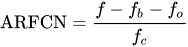
Where:
- f is the actual frequency [MHz]
- fb is the base frequency [MHz]
- fo is the offset frequency [MHz]
- fc is the channel spacing frequency [MHz]
The range of frequencies used in these tetra systems are defined by 380-385 MHz for the uplink (mobile to radio base station) paired with 390-395 MHz for the downlink (radio base station to mobile). Therefore, the base frequency fb is 300 MHz (the baseband frequency to relate from) and the offset is 0.0125 MHz (12.5 kHz) and thus we get the relation:

Inseting the frequency for the first channel 390.0125 MHz gives us an ARFCN of 3600.
Calculating the frequency from ARFCN is just the reverse of this:

See also
[edit]References
[edit]- ^ 3GPP Specification detail TS 05.05 Specification 3GPP TS 05.05 Radio Transmission and Reception.
- ^ 3GPP Specification detail TS 45.005 Specification 3GPP TS 45.005 Radio Transmission and Reception.
Absolute radio-frequency channel number
View on GrokipediaFundamentals
Definition
The Absolute Radio-Frequency Channel Number (ARFCN) is a unique integer code that specifies a pair of physical radio carrier frequencies—one for the uplink signal from mobile station to base station and one for the downlink signal from base station to mobile station—used for transmission and reception in land mobile radio systems such as GSM/EDGE.[4] This numbering scheme designates the carrier frequency employed in a cell, with frequencies spaced at 200 kHz intervals to support efficient spectrum utilization.[4] ARFCN originates from the GSM specifications defined in 3GPP TS 45.005, where it serves to identify channels within Frequency Division Multiple Access (FDMA) and Time Division Multiple Access (TDMA) frameworks.[4] In these systems, ARFCN applies to the physical layer, enabling the assignment of carrier frequencies that form the basis for TDMA frames, each comprising eight time slots.[4] ARFCN must be distinguished from logical channels, such as the Broadcast Control Channel (BCCH), which define the type of information carried over specific time slots within the physical channel identified by the ARFCN; logical channels operate at higher layers and do not directly correspond to frequency assignments.[4] Similarly, ARFCN differs from time slot allocations in TDMA, as it pertains solely to the underlying frequency pair rather than the temporal division of the carrier.[4] By providing a standardized numbering that accounts for band-specific contexts—often via a band indicator in multi-band deployments—ARFCN ensures global uniqueness across different frequency bands, preventing ambiguity in channel identification during network operations.[4]Purpose and Role
The Absolute Radio-Frequency Channel Number (ARFCN) plays a crucial role in cellular networks by providing a standardized identifier for specific pairs of uplink and downlink carrier frequencies, which simplifies frequency planning and enables efficient spectrum management across allocated bands.[1] This numbering scheme allows network operators to assign channels methodically, reducing complexity in deploying and maintaining multi-cell architectures while supporting dynamic mappings valid throughout entire public land mobile networks (PLMNs).[1] By designating carriers with precise 200 kHz spacing in systems like GSM, ARFCN facilitates interference avoidance through adherence to carrier-to-interference (C/I) ratios, such as 9 dB for co-channel and -9 dB for adjacent-channel scenarios, ensuring reliable signal quality without excessive overlap.[1] In day-to-day operations, ARFCN is integral to initial cell search and synchronization processes, where mobile stations scan designated ARFCNs to locate base stations and achieve timing alignment using synchronization bursts.[1] During device attachment to the network, it supports channel allocation by linking numerical identifiers to control channels like the Broadcast Control Channel (BCCH) and Synchronization Channel (SCH), as well as traffic channels, allowing for rapid assignment of resources.[1] For handover procedures, ARFCN enables smooth transitions between cells by specifying target frequencies, with broadcast system information conveying neighbor cell mappings to minimize disruptions in ongoing connections.[1] ARFCN enhances overall spectrum efficiency by discretely mapping channels to frequency blocks, promoting techniques like frequency reuse in cellular layouts and reallocation of unused carriers to maximize bandwidth utilization within limited allocations.[1] This approach supports higher capacity in dense deployments without requiring continuous frequency retuning. Its definition and application are standardized by the European Telecommunications Standards Institute (ETSI) and the 3rd Generation Partnership Project (3GPP), as detailed in specifications like TS 45.005, which promotes interoperability by ensuring consistent implementation across vendors, operators, and regional deployments.[1]Calculation Methods
General Principles
The absolute radio-frequency channel number (ARFCN) provides a systematic way to identify specific carrier frequencies within radio systems by establishing a direct mathematical mapping. The foundational approach employs a linear relationship, expressed as , where is the carrier frequency, is a band-specific reference frequency, is the ARFCN value, and is the channel bandwidth (or spacing). This formula ensures that each integer ARFCN corresponds to a unique frequency point, facilitating precise frequency planning and allocation in systems like GSM and its evolutions. In frequency-division duplex (FDD) configurations, an additional duplex offset is applied to distinguish uplink and downlink carriers, typically yielding the uplink frequency as , where is the offset value defined for the operating band.[5][6] A key principle underlying ARFCN is adherence to the channel raster, which defines the discrete frequency grid for channel placement. For instance, in GSM systems, the raster is 200 kHz, meaning ARFCN values align carrier centers to multiples of this interval from the reference frequency, preventing overlap and reducing inter-channel interference. This raster ensures spectral efficiency by confining emissions within allocated slots and supports interoperability across devices by standardizing frequency granularity. Similar rasters, such as 100 kHz in LTE, maintain this alignment principle across different technologies, allowing ARFCN to enforce regulatory and system-specific frequency discipline.[5][6] To manage the complexity of multi-band operations, ARFCN schemes incorporate global numbering that assigns unique identifiers across the frequency spectrum, avoiding ambiguities or overlaps between bands. In GSM, band-specific ARFCN ranges (e.g., 1–124 for one band versus higher ranges for others) combined with contextual band information achieve this uniqueness. In LTE, the E-UTRA ARFCN (EARFCN) extends this globally with non-overlapping ranges (0–262143 total), using offsets like in the linear formula to ensure each channel has a distinct number regardless of band. This approach simplifies network configuration and handover procedures while preventing erroneous frequency assignments across diverse spectrum allocations.[5][6]Band-Specific Formulas
The band-specific formulas for converting Absolute Radio Frequency Channel Numbers (ARFCNs) to actual frequencies in GSM systems follow a linear mapping principle, where each ARFCN corresponds to a 200 kHz channel raster offset from a reference frequency, with distinct equations tailored to the operating band's uplink and downlink duplex spacing.[1] For the P-GSM 900 band, the downlink frequency in MHz is given by where is the ARFCN ranging from 1 to 124, and the uplink frequency is , or equivalently . This yields downlink frequencies from 935.2 MHz to 959.8 MHz and uplink from 890.2 MHz to 914.8 MHz. For the extended E-GSM 900 band, the same formulas apply for ARFCNs 1 to 124, while ARFCNs 975 to 1023 use extending the downlink range down to 925.2 MHz for additional spectrum utilization.[1] In the DCS 1800 band, the formulas are for ARFCNs 512 to 885, resulting in downlink frequencies from 1805.2 MHz to 1879.8 MHz and uplink from 1710.2 MHz to 1784.8 MHz, with a 95 MHz duplex spacing to accommodate higher-frequency operations.[1] For the GSM 850 band, used primarily in the Americas, the conversion is with ARFCNs 128 to 251, covering downlink from 869.2 MHz to 893.8 MHz and uplink from 824.2 MHz to 848.8 MHz. Similarly, the PCS 1900 band employs for ARFCNs 512 to 810, spanning downlink 1930.2 MHz to 1989.8 MHz and uplink 1850.2 MHz to 1909.8 MHz, reflecting its 80 MHz duplex offset.[1] Reverse conversion from frequency to ARFCN follows the inverse of these equations, such as for P-GSM 900 downlink: with the result rounded to the nearest integer to ensure alignment with the 200 kHz raster; equivalent rearrangements apply to other bands and uplink directions, maintaining precision within the defined ranges. Half-rate channels, which affect data rates rather than carrier frequencies, do not alter these ARFCN-to-frequency mappings.[1]Application in GSM
GSM Frequency Bands
The Global System for Mobile Communications (GSM) operates across several frequency bands allocated for second-generation (2G) digital cellular networks, primarily defined by the European Telecommunications Standards Institute (ETSI) and harmonized under International Telecommunication Union (ITU) Radio Regulations for mobile services in specific regions. These bands support frequency-division duplex (FDD) operation, where uplink (mobile-to-base) and downlink (base-to-mobile) frequencies are separated to enable simultaneous transmission and reception. The primary bands include the original Primary GSM 900 (P-GSM 900), its Extended GSM 900 (E-GSM 900) extension, Digital Cellular System 1800 (DCS 1800), Personal Communications Service 1900 (PCS 1900), and PCS 850, each tailored to regional spectrum availability and propagation needs. P-GSM 900 utilizes the uplink band of 890–915 MHz and downlink band of 935–960 MHz, providing a 25 MHz bandwidth per direction with a 45 MHz duplex spacing; this band was the foundational allocation for GSM in ITU Region 1 (Europe, Africa, Middle East). E-GSM 900 extends this by adding lower frequencies, expanding the uplink to 880–915 MHz and downlink to 925–960 MHz (35 MHz bandwidth per direction, still with 45 MHz duplex spacing), to accommodate growing demand without disrupting existing deployments. DCS 1800, deployed in higher frequencies for denser urban environments, operates on 1710–1785 MHz uplink and 1805–1880 MHz downlink (75 MHz bandwidth, 95 MHz duplex spacing), while PCS 1900 in North America uses 1850–1910 MHz uplink and 1930–1990 MHz downlink (60 MHz bandwidth, 80 MHz duplex spacing). PCS 850, also North American, employs 824–849 MHz uplink and 869–894 MHz downlink (25 MHz bandwidth, 45 MHz duplex spacing). Across these bands, ETSI specifications include 200 kHz guard bands at the edges to minimize interference with adjacent services. These allocations originated from ITU designations for the mobile service, with ETSI standardizing the channel arrangements to ensure interoperability; for instance, the 900 MHz bands were identified in ITU Region 1 for public mobile networks, while 1800 MHz and the Americas' 850/1900 MHz bands followed regional harmonization efforts in the late 1980s and early 1990s. Guard bands and duplex spacings prevent overlap and adjacent-channel interference, supporting reliable operation within the allocated spectrum. GSM band usage evolved from initial 2G deployments in the early 1990s, with Phase 1 specifications frozen in 1990 and the first commercial network launching in Finland in 1991 using P-GSM 900. By the mid-1990s, extensions like E-GSM 900 and DCS 1800 were introduced to expand capacity, leading to widespread global adoption by the early 2000s. Today, these bands provide legacy support in modern networks, often refarmed for 3G/4G compatibility or low-power IoT applications, maintaining backward compatibility for older devices. Band-specific propagation characteristics significantly influence deployment strategies; for example, the 900 MHz band's lower frequencies enable superior penetration through obstacles and extended range in rural areas compared to higher bands like 1800 MHz, which favor capacity in urban settings but suffer greater path loss over distance.| Band | Uplink (MHz) | Downlink (MHz) | Bandwidth (MHz, per direction) | Duplex Spacing (MHz) |
|---|---|---|---|---|
| P-GSM 900 | 890–915 | 935–960 | 25 | 45 |
| E-GSM 900 | 880–915 | 925–960 | 35 | 45 |
| DCS 1800 | 1710–1785 | 1805–1880 | 75 | 95 |
| PCS 1900 | 1850–1910 | 1930–1990 | 60 | 80 |
| PCS 850 | 824–849 | 869–894 | 25 | 45 |
ARFCN Ranges and Tables
In GSM systems, ARFCN assignments are defined for specific frequency bands to ensure standardized channel allocation. For the primary GSM 900 band (P-GSM), valid ARFCNs range from 1 to 124, corresponding to uplink frequencies of 890 to 915 MHz and downlink frequencies of 935 to 960 MHz with a 45 MHz duplex spacing. Extended variants like E-GSM 900 expand this to ARFCNs 0 to 124 and 975 to 1023, covering uplink 880 to 915 MHz and downlink 925 to 960 MHz, also with 45 MHz spacing. These ranges accommodate the 200 kHz channel raster while avoiding overlap with adjacent services.[5] For higher-frequency bands, GSM 1800 (DCS 1800) uses ARFCNs 512 to 885, mapping to uplink 1710 to 1785 MHz and downlink 1805 to 1880 MHz with 95 MHz duplex spacing. In the Americas, GSM 850 employs ARFCNs 128 to 251 for uplink 824 to 849 MHz and downlink 869 to 894 MHz (45 MHz spacing), while GSM 1900 (PCS 1900) utilizes ARFCNs 512 to 810 for uplink 1850 to 1910 MHz and downlink 1930 to 1990 MHz (80 MHz spacing). These band-specific ranges prevent interference and support regional spectrum allocations.[5] The following table summarizes the valid ARFCN ranges and frequency mappings for these common GSM bands, based on fixed channel designations. Frequencies are in MHz and follow a 200 kHz increment from the base values.| Band | ARFCN Range | Uplink Base (MHz) | Downlink Base (MHz) | Duplex Spacing (MHz) | Example ARFCN (Uplink/Downlink) |
|---|---|---|---|---|---|
| GSM 900 (P-GSM) | 1–124 | 890 + 0.2 × (ARFCN) | Uplink + 45 | 45 | ARFCN 1: 890.2 / 935.2 |
| E-GSM 900 | 0–124, 975–1023 | 890 + 0.2 × (ARFCN mod 1024 adjustment) | Uplink + 45 | 45 | ARFCN 51: 900.2 / 945.2 |
| GSM 1800 (DCS) | 512–885 | 1710.2 + 0.2 × (ARFCN – 512) | Uplink + 95 | 95 | ARFCN 512: 1710.2 / 1805.2 |
| GSM 850 | 128–251 | 824.2 + 0.2 × (ARFCN – 128) | Uplink + 45 | 45 | ARFCN 128: 824.2 / 869.2 |
| GSM 1900 (PCS) | 512–810 | 1850.2 + 0.2 × (ARFCN – 512) | Uplink + 80 | 80 | ARFCN 512: 1850.2 / 1930.2 |