
Recent from talks
ATASCII
Knowledge base stats:
Talk channels stats:
Members stats:
ATASCII
The ATASCII character set, from ATARI Standard Code for Information Interchange, alternatively ATARI ASCII, is a character encoding used in the Atari 8-bit computers. ATASCII is based on ASCII, but is not fully compatible with it. It was first used in the Atari 400 and 800 in 1979 and was kept in all subsequent models until the line was discontinued in 1992. The Atari ST family of computers use the different Atari ST character set.
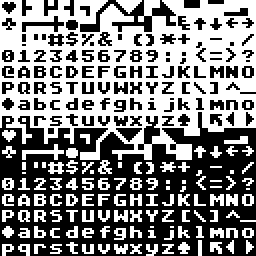
Like most other variants of ASCII, ATASCII has its own distinct characters (arrows, blocks, box-drawing characters, playing card suits, etc.) in place of the C0 control codes in ASCII (characters 0–31), as well as replacing a few other ASCII code points.
Atari 8-bit systems have three distinct sets of codes: interchange codes (ATASCII), internal codes (also called screen codes), and keyboard codes.
Keyboard codes represent the codes sent by the keyboard. Pressing one of the two modifier keys (Shift and Control) modifies the value input by pressing other keys. Due to there being two modifier keys, there are four distinct keyboard codes that can be sent by each character; however, several keys (the exact keys depend on the model) do not send a control code if they are pressed while holding both Shift and Control. When entering text, the Atari keyboard handler converts these signals into ATASCII.
ATASCII and internal codes contain the same character set, but indexed differently. ATASCII codes are used by Atari BASIC, while internal codes are used to look up how to render the character on-screen.
Atari 8-bit systems have several distinct graphics modes; these modes can be classified as pure text modes, pure graphics modes, or mixed modes. Modes 0, 1 and 2 represent pure text modes, while Modes 3 and above represent mixed or pure graphics modes (the exact number of distinct modes depending on the model). Mode 0 displays characters at the default size, Mode 1 displays them twice as wide (but the same height), and Mode 2 displays them twice as wide and twice the height. Mode 0 is the default graphics mode and supports 128 unique characters in one of two colors (regular or inverse video, depending on the upper bit); Modes 1 and 2 only support 64 unique characters, but support four different colors (as they use the upper two bits as color information instead). The 64 characters available in Modes 1 and 2 are the first 64 characters in the internal code, which correspond to ATASCII codes 32 to 95 (0x20 to 0x5F). This includes all uppercase letters and punctuation, but excludes lowercase letters and graphics characters.
The Atari screen editor implements the text cursor by simply inverting the character at the cursor position (by XOR with 0x80). It does not flash.
ATASCII only has 128 unique graphic characters, with the upper 128 graphic characters (index 128 to 255) being inverse video variants of the lower 128 graphic characters (index 0 to 127). If the high-order bit is set on a character (i.e., if the byte value of the character is between 128 and 255), the character is generally rendered as the inverse video variant of its counterpart between 0 and 127, using a bitwise negation of the character's glyph. This is done by the ANTIC chip.
Hub AI
ATASCII AI simulator
(@ATASCII_simulator)
ATASCII
The ATASCII character set, from ATARI Standard Code for Information Interchange, alternatively ATARI ASCII, is a character encoding used in the Atari 8-bit computers. ATASCII is based on ASCII, but is not fully compatible with it. It was first used in the Atari 400 and 800 in 1979 and was kept in all subsequent models until the line was discontinued in 1992. The Atari ST family of computers use the different Atari ST character set.
Like most other variants of ASCII, ATASCII has its own distinct characters (arrows, blocks, box-drawing characters, playing card suits, etc.) in place of the C0 control codes in ASCII (characters 0–31), as well as replacing a few other ASCII code points.
Atari 8-bit systems have three distinct sets of codes: interchange codes (ATASCII), internal codes (also called screen codes), and keyboard codes.
Keyboard codes represent the codes sent by the keyboard. Pressing one of the two modifier keys (Shift and Control) modifies the value input by pressing other keys. Due to there being two modifier keys, there are four distinct keyboard codes that can be sent by each character; however, several keys (the exact keys depend on the model) do not send a control code if they are pressed while holding both Shift and Control. When entering text, the Atari keyboard handler converts these signals into ATASCII.
ATASCII and internal codes contain the same character set, but indexed differently. ATASCII codes are used by Atari BASIC, while internal codes are used to look up how to render the character on-screen.
Atari 8-bit systems have several distinct graphics modes; these modes can be classified as pure text modes, pure graphics modes, or mixed modes. Modes 0, 1 and 2 represent pure text modes, while Modes 3 and above represent mixed or pure graphics modes (the exact number of distinct modes depending on the model). Mode 0 displays characters at the default size, Mode 1 displays them twice as wide (but the same height), and Mode 2 displays them twice as wide and twice the height. Mode 0 is the default graphics mode and supports 128 unique characters in one of two colors (regular or inverse video, depending on the upper bit); Modes 1 and 2 only support 64 unique characters, but support four different colors (as they use the upper two bits as color information instead). The 64 characters available in Modes 1 and 2 are the first 64 characters in the internal code, which correspond to ATASCII codes 32 to 95 (0x20 to 0x5F). This includes all uppercase letters and punctuation, but excludes lowercase letters and graphics characters.
The Atari screen editor implements the text cursor by simply inverting the character at the cursor position (by XOR with 0x80). It does not flash.
ATASCII only has 128 unique graphic characters, with the upper 128 graphic characters (index 128 to 255) being inverse video variants of the lower 128 graphic characters (index 0 to 127). If the high-order bit is set on a character (i.e., if the byte value of the character is between 128 and 255), the character is generally rendered as the inverse video variant of its counterpart between 0 and 127, using a bitwise negation of the character's glyph. This is done by the ANTIC chip.
Recent media