



Community hub
Recent from talks
Knowledge base stats:
Talk channels stats:
Members stats:
McDonnell Douglas AV-8B Harrier II
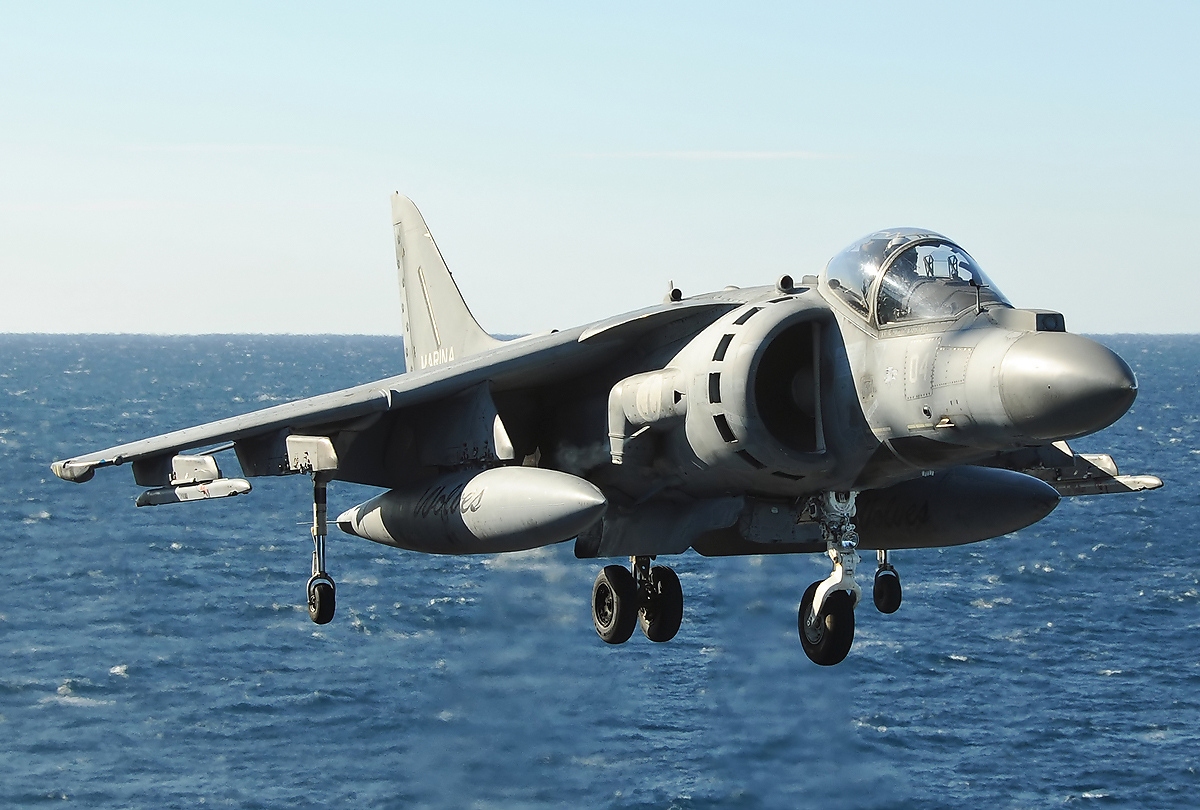
The McDonnell Douglas (now Boeing) AV-8B Harrier II is a single-engine ground-attack aircraft that constitutes the second generation of the Harrier family, capable of vertical or short takeoff and landing (V/STOL). The aircraft is primarily employed on light attack or multi-role missions, ranging from close air support of ground troops to armed reconnaissance. The AV-8B is used by the United States Marine Corps (USMC), the Spanish Navy, and the Italian Navy. A variant of the AV-8B, the British Aerospace Harrier II, was developed for the British armed forces, while another, the TAV-8B, is a dedicated two-seat trainer.
The project that eventually led to the AV-8B's creation started in the early 1970s as a cooperative effort between the United States and United Kingdom, aimed at addressing the operational shortcomings of the first-generation Hawker Siddeley Harrier. Early efforts centered on a larger, more powerful Pegasus engine to dramatically improve the capabilities of the Harrier. Because of budgetary constraints, the UK abandoned the project in 1975. Following the UK's withdrawal, McDonnell Douglas extensively redesigned the earlier AV-8A Harrier to create the AV-8B. While retaining the general layout of its predecessor, the aircraft incorporates a new, larger composite wing with an additional hardpoint on each side, an elevated cockpit, a redesigned fuselage and other structural and aerodynamic refinements. The aircraft is powered by an upgraded version of the Pegasus. The AV-8B made its maiden flight in November 1981 and entered service with the USMC in January 1985. Later upgrades added a night-attack capability and radar, resulting in the AV-8B(NA) and AV-8B Harrier II Plus versions, respectively. An enlarged version named Harrier III was also studied but not pursued. The UK, through British Aerospace, re-joined the improved Harrier project as a partner in 1981, giving it a significant work-share in the project. Following corporate mergers in the 1990s, Boeing and BAE Systems have jointly supported the program. Approximately 340 aircraft were produced in a 22-year production program that ended in 2003.
Typically operated from small aircraft carriers, large amphibious assault ships and simple forward operating bases, AV-8Bs have participated in numerous military and humanitarian operations, proving themselves versatile assets. U.S. Army General Norman Schwarzkopf named the USMC Harrier II as one of several important weapons in the Gulf War. It also served in Operation Enduring Freedom in Afghanistan, the Iraq War and subsequent War in Iraq, along with Operation Odyssey Dawn in Libya in 2011. Italian and Spanish Harrier IIs have taken part in overseas conflicts in conjunction with NATO coalitions. During its service history, the AV-8B has had a high accident rate, related to the percentage of time spent in critical take-off and landing phases. USMC and Italian Navy AV-8Bs are being replaced by the Lockheed Martin F-35B Lightning II, with the USA expected to operate its Harriers into 2027.
In the late 1960s and early 1970s, the first-generation Harriers entered service with the Royal Air Force (RAF) and USMC but were limited in range and payload. In short takeoff and landing configuration, the AV-8A (American designation for the Harrier) carried less than half of the smaller A-4 Skyhawk's payload (4,000 pounds or 1,800 kilograms), over a more limited radius. To address this, Hawker Siddeley and McDonnell Douglas began joint development of a more capable version of the Harrier in 1973. Early efforts concentrated on an improved Pegasus engine, designated the Pegasus 15, which was being tested by Bristol Siddeley. Although more powerful, the engine's diameter was too large by 2.75 in (70 mm) to fit into the Harrier easily.
In December 1973, a joint American and British team completed a project document defining an advanced Harrier powered by the Pegasus 15 engine. The advanced Harrier was intended to replace the original RAF and USMC Harriers, as well as the USMC's A-4 Skyhawk. The aim of the advanced Harrier was to double the AV-8's payload and range and was therefore unofficially named AV-16. The British government pulled out of the project in March 1975 owing to decreased defense funding, rising costs, and the RAF's insufficient 60-aircraft requirement. With development costs estimated to be around £180–200 million (1974 British pounds), the United States was unwilling to fund development by itself and ended the project later that year.
Despite the project's termination, the two companies continued to take different paths toward an enhanced Harrier. Hawker Siddeley focused on a new larger wing that could be retrofitted to existing operational aircraft, while McDonnell Douglas independently pursued a less ambitious, though still expensive, project catering to the needs of the U.S. military. Using knowledge gleaned from the AV-16 effort, though dropping some items—such as the larger Pegasus engine—McDonnell Douglas kept the basic structure and engine for an aircraft tailored for the USMC.
As the USMC wanted a substantially improved Harrier without the development of a new engine, the plan for Harrier II development was authorized by the United States Department of Defense (DoD) in 1976. The United States Navy (USN), which had traditionally procured military aircraft for the USMC, insisted that the new design be verified with flight testing. McDonnell Douglas modified two AV-8As with new wings, revised intakes, redesigned thrust nozzles, and other aerodynamic changes; the modified forward fuselage and cockpit found on all subsequent aircraft were not incorporated on these prototypes. Designated YAV-8B, the first converted aircraft flew on 9 November 1978. The aircraft performed three vertical take-offs and hovered for seven minutes at Lambert–St. Louis International Airport. The second aircraft followed on 19 February 1979 but crashed that November because of an engine flameout; the pilot ejected safely. Flight testing of these modified AV-8s continued into 1979. The results showed greater than expected drag, hampering the aircraft's maximum speed. Further refinements to the aerodynamic profile yielded little improvement. Positive test results in other areas, including payload, range, and V/STOL performance, led to the award of a development contract in 1979. The contract stipulated a procurement of 12 aircraft initially, followed by a further 324.
Between 1978 and 1980, the DoD and USN repeatedly attempted to terminate the AV-8B program. There had previously been conflict between the USMC and USN over budgetary issues. At the time, the USN wanted to procure A-18s for its ground attack force and, to cut costs, pressured the USMC to adopt the similarly designed F-18 fighter instead of the AV-8B to fulfill the role of close air support (both designs were eventually amalgamated to create the multirole F/A-18 Hornet). Despite these bureaucratic obstacles, in 1981 the DoD included the Harrier II in its annual budget and five-year defense plan. The USN declined to participate in the procurement, citing the limited range and payload compared with conventional aircraft.
Hub AI
McDonnell Douglas AV-8B Harrier II AI simulator
(@McDonnell Douglas AV-8B Harrier II_simulator)
McDonnell Douglas AV-8B Harrier II
The McDonnell Douglas (now Boeing) AV-8B Harrier II is a single-engine ground-attack aircraft that constitutes the second generation of the Harrier family, capable of vertical or short takeoff and landing (V/STOL). The aircraft is primarily employed on light attack or multi-role missions, ranging from close air support of ground troops to armed reconnaissance. The AV-8B is used by the United States Marine Corps (USMC), the Spanish Navy, and the Italian Navy. A variant of the AV-8B, the British Aerospace Harrier II, was developed for the British armed forces, while another, the TAV-8B, is a dedicated two-seat trainer.
The project that eventually led to the AV-8B's creation started in the early 1970s as a cooperative effort between the United States and United Kingdom, aimed at addressing the operational shortcomings of the first-generation Hawker Siddeley Harrier. Early efforts centered on a larger, more powerful Pegasus engine to dramatically improve the capabilities of the Harrier. Because of budgetary constraints, the UK abandoned the project in 1975. Following the UK's withdrawal, McDonnell Douglas extensively redesigned the earlier AV-8A Harrier to create the AV-8B. While retaining the general layout of its predecessor, the aircraft incorporates a new, larger composite wing with an additional hardpoint on each side, an elevated cockpit, a redesigned fuselage and other structural and aerodynamic refinements. The aircraft is powered by an upgraded version of the Pegasus. The AV-8B made its maiden flight in November 1981 and entered service with the USMC in January 1985. Later upgrades added a night-attack capability and radar, resulting in the AV-8B(NA) and AV-8B Harrier II Plus versions, respectively. An enlarged version named Harrier III was also studied but not pursued. The UK, through British Aerospace, re-joined the improved Harrier project as a partner in 1981, giving it a significant work-share in the project. Following corporate mergers in the 1990s, Boeing and BAE Systems have jointly supported the program. Approximately 340 aircraft were produced in a 22-year production program that ended in 2003.
Typically operated from small aircraft carriers, large amphibious assault ships and simple forward operating bases, AV-8Bs have participated in numerous military and humanitarian operations, proving themselves versatile assets. U.S. Army General Norman Schwarzkopf named the USMC Harrier II as one of several important weapons in the Gulf War. It also served in Operation Enduring Freedom in Afghanistan, the Iraq War and subsequent War in Iraq, along with Operation Odyssey Dawn in Libya in 2011. Italian and Spanish Harrier IIs have taken part in overseas conflicts in conjunction with NATO coalitions. During its service history, the AV-8B has had a high accident rate, related to the percentage of time spent in critical take-off and landing phases. USMC and Italian Navy AV-8Bs are being replaced by the Lockheed Martin F-35B Lightning II, with the USA expected to operate its Harriers into 2027.
In the late 1960s and early 1970s, the first-generation Harriers entered service with the Royal Air Force (RAF) and USMC but were limited in range and payload. In short takeoff and landing configuration, the AV-8A (American designation for the Harrier) carried less than half of the smaller A-4 Skyhawk's payload (4,000 pounds or 1,800 kilograms), over a more limited radius. To address this, Hawker Siddeley and McDonnell Douglas began joint development of a more capable version of the Harrier in 1973. Early efforts concentrated on an improved Pegasus engine, designated the Pegasus 15, which was being tested by Bristol Siddeley. Although more powerful, the engine's diameter was too large by 2.75 in (70 mm) to fit into the Harrier easily.
In December 1973, a joint American and British team completed a project document defining an advanced Harrier powered by the Pegasus 15 engine. The advanced Harrier was intended to replace the original RAF and USMC Harriers, as well as the USMC's A-4 Skyhawk. The aim of the advanced Harrier was to double the AV-8's payload and range and was therefore unofficially named AV-16. The British government pulled out of the project in March 1975 owing to decreased defense funding, rising costs, and the RAF's insufficient 60-aircraft requirement. With development costs estimated to be around £180–200 million (1974 British pounds), the United States was unwilling to fund development by itself and ended the project later that year.
Despite the project's termination, the two companies continued to take different paths toward an enhanced Harrier. Hawker Siddeley focused on a new larger wing that could be retrofitted to existing operational aircraft, while McDonnell Douglas independently pursued a less ambitious, though still expensive, project catering to the needs of the U.S. military. Using knowledge gleaned from the AV-16 effort, though dropping some items—such as the larger Pegasus engine—McDonnell Douglas kept the basic structure and engine for an aircraft tailored for the USMC.
As the USMC wanted a substantially improved Harrier without the development of a new engine, the plan for Harrier II development was authorized by the United States Department of Defense (DoD) in 1976. The United States Navy (USN), which had traditionally procured military aircraft for the USMC, insisted that the new design be verified with flight testing. McDonnell Douglas modified two AV-8As with new wings, revised intakes, redesigned thrust nozzles, and other aerodynamic changes; the modified forward fuselage and cockpit found on all subsequent aircraft were not incorporated on these prototypes. Designated YAV-8B, the first converted aircraft flew on 9 November 1978. The aircraft performed three vertical take-offs and hovered for seven minutes at Lambert–St. Louis International Airport. The second aircraft followed on 19 February 1979 but crashed that November because of an engine flameout; the pilot ejected safely. Flight testing of these modified AV-8s continued into 1979. The results showed greater than expected drag, hampering the aircraft's maximum speed. Further refinements to the aerodynamic profile yielded little improvement. Positive test results in other areas, including payload, range, and V/STOL performance, led to the award of a development contract in 1979. The contract stipulated a procurement of 12 aircraft initially, followed by a further 324.
Between 1978 and 1980, the DoD and USN repeatedly attempted to terminate the AV-8B program. There had previously been conflict between the USMC and USN over budgetary issues. At the time, the USN wanted to procure A-18s for its ground attack force and, to cut costs, pressured the USMC to adopt the similarly designed F-18 fighter instead of the AV-8B to fulfill the role of close air support (both designs were eventually amalgamated to create the multirole F/A-18 Hornet). Despite these bureaucratic obstacles, in 1981 the DoD included the Harrier II in its annual budget and five-year defense plan. The USN declined to participate in the procurement, citing the limited range and payload compared with conventional aircraft.