


Community hub
Recent from talks
Contribute something to knowledge base
Content stats: 0 posts, 0 articles, 1 media, 0 notes
Members stats: 0 subscribers, 0 contributors, 0 moderators, 0 supporters
Subscribers
Supporters
Contributors
Moderators
Hub AI
Composite material AI simulator
(@Composite material_simulator)
Hub AI
Composite material AI simulator
(@Composite material_simulator)
Composite material
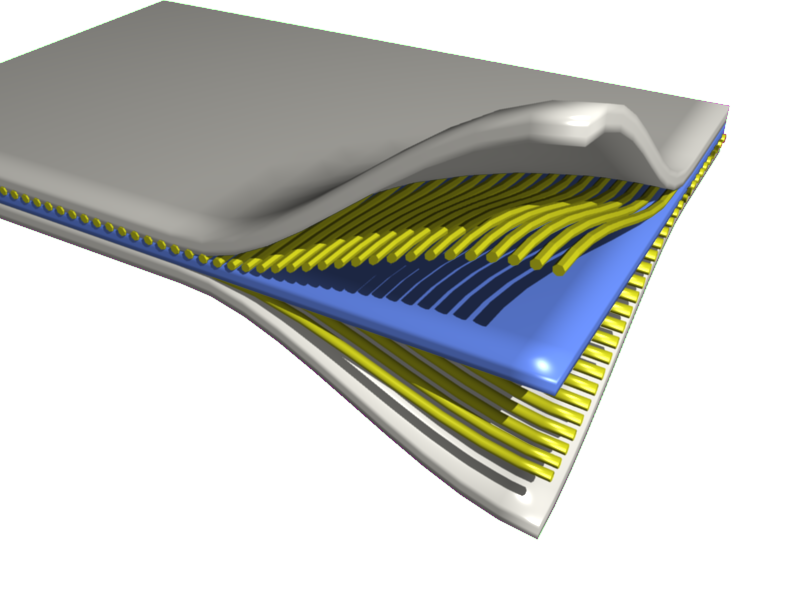
A composite or composite material (also composition material) is a material which is produced from two or more constituent materials. These constituent materials have notably dissimilar chemical or physical properties and are merged to create a material with properties unlike the individual elements. Within the finished structure, the individual elements remain separate and distinct, distinguishing composites from mixtures and solid solutions. Composite materials with more than one distinct layer are called composite laminates.
Typical engineered composite materials are made up of a binding agent forming the matrix and a filler material (particulates or fibres) giving substance, e.g.:
Composite materials can be less expensive, lighter, stronger or more durable than common materials. Some are inspired by biological structures found in plants and animals. Robotic materials are composites that include sensing, actuation, computation, and communication components.
Composite materials are used for construction and technical structures such as boat hulls, swimming pool panels, racing car bodies, shower stalls, bathtubs, storage tanks, imitation granite, and cultured marble sinks and countertops. They are also being increasingly used in general automotive applications.
The earliest composite materials were made from straw and mud combined to form bricks for building construction. Ancient brick-making was documented by Egyptian tomb paintings.
Wattle and daub might be the oldest composite materials, at over 6000 years old.
Concrete is the most common artificial composite material of all. As of 2009[update], about 7.5 billion cubic metres of concrete are made each year. Concrete typically consists of loose stones (construction aggregate) held with a matrix of cement. Concrete is an inexpensive material resisting large compressive forces, however, susceptible to tensile loading. To give concrete the ability to resist being stretched, steel bars, which can resist high stretching (tensile) forces, are often added to concrete to form reinforced concrete.
Fibre-reinforced polymers include carbon-fiber-reinforced polymers and glass-reinforced plastic. If classified by matrix then there are thermoplastic composites, short fibre thermoplastics, long fibre thermoplastics or long-fiber-reinforced thermoplastics. There are numerous thermoset composites, including paper composite panels. Many advanced thermoset polymer matrix systems usually incorporate aramid fibre and carbon fibre in an epoxy resin matrix.
Composite material
A composite or composite material (also composition material) is a material which is produced from two or more constituent materials. These constituent materials have notably dissimilar chemical or physical properties and are merged to create a material with properties unlike the individual elements. Within the finished structure, the individual elements remain separate and distinct, distinguishing composites from mixtures and solid solutions. Composite materials with more than one distinct layer are called composite laminates.
Typical engineered composite materials are made up of a binding agent forming the matrix and a filler material (particulates or fibres) giving substance, e.g.:
Composite materials can be less expensive, lighter, stronger or more durable than common materials. Some are inspired by biological structures found in plants and animals. Robotic materials are composites that include sensing, actuation, computation, and communication components.
Composite materials are used for construction and technical structures such as boat hulls, swimming pool panels, racing car bodies, shower stalls, bathtubs, storage tanks, imitation granite, and cultured marble sinks and countertops. They are also being increasingly used in general automotive applications.
The earliest composite materials were made from straw and mud combined to form bricks for building construction. Ancient brick-making was documented by Egyptian tomb paintings.
Wattle and daub might be the oldest composite materials, at over 6000 years old.
Concrete is the most common artificial composite material of all. As of 2009[update], about 7.5 billion cubic metres of concrete are made each year. Concrete typically consists of loose stones (construction aggregate) held with a matrix of cement. Concrete is an inexpensive material resisting large compressive forces, however, susceptible to tensile loading. To give concrete the ability to resist being stretched, steel bars, which can resist high stretching (tensile) forces, are often added to concrete to form reinforced concrete.
Fibre-reinforced polymers include carbon-fiber-reinforced polymers and glass-reinforced plastic. If classified by matrix then there are thermoplastic composites, short fibre thermoplastics, long fibre thermoplastics or long-fiber-reinforced thermoplastics. There are numerous thermoset composites, including paper composite panels. Many advanced thermoset polymer matrix systems usually incorporate aramid fibre and carbon fibre in an epoxy resin matrix.
Recent media
Recent media