
Recent from talks
A Lume Spento
Knowledge base stats:
Talk channels stats:
Members stats:
A Lume Spento
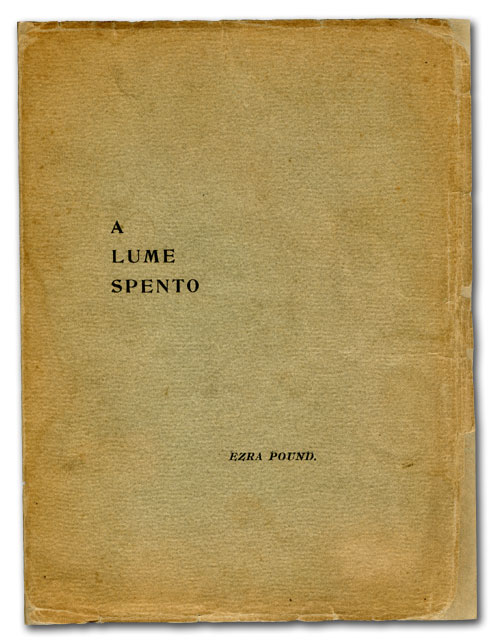
A Lume Spento (translated by the author as With Tapers Quenched) is a 1908 poetry collection by Ezra Pound. Self-published in Venice, it was his first collection.
Ezra Pound (1885–1972) studied Romance languages and literature, including French, Italian, Provençal and Spanish, at the University of Pennsylvania and Hamilton College. In these studies Pound—long interested in poetry—had gained an interest in turn-of-the-century English poetry.
Pound dedicated A Lume Spento to Philadelphia artist William Brooke Smith, one of his friends, who had recently died of tuberculosis. The two had met in 1901–02, and Smith—an avid reader—introduced Pound to the works of English decadents such as Oscar Wilde and Aubrey Beardsley. The title of the work is an allusion to the third canto of Dante's Purgatory, where it occurs in the speech of Manfred, King of Sicily, as he describes the treatment his excommunicated corpse has endured, exhumed, and discarded without light along the banks of the river Verde. The procession of priests with unlit tapers is similar to the imagery in the practice of "bell, book and candle", but Manfred remains optimistic that "by their curse we are not so destroy'd, / But that the eternal love may turn, while hope / Retains her verdant blossom...". Critic Hugh Witemeyer wrote that, overall, the implication is that Smith had led an unorthodox life like that of Manfred.
The collection was initially meant to be titled La Fraisne ("The Ash Tree"). Although this title was not kept, the poem of the same name was presented second in the collection.
A Lume Spento consists of 45 poems.
A Lume Spento is replete with allusions to works which had influenced Pound, including Provençal and late Victorian literatures. Pound adopts Robert Browning's technique of dramatic monologues, and as such he "appears to speak in the voices of historical or legendary figures". These figures, Witemeyer writes, reflect the spiritualism common in the period, in which the different personae Pound adapts are considered "mediumistic channelings" of the deceased.
In his biography of Pound, David A. Moody argues that the collection demonstrated an implicit challenge to the "crepuscular spirit" prevalent in contemporary literature, one which has drawn little attention yet can be found in certain poems and the collection's arrangement. He notes a progression in which persons who let their passion get the best of them are, implicitly, relegated to a Dantean Hell. In two of the poems ("Famam Librosque Cano" and "Scriptor Ignotus"), he writes, Pound appears to be questioning his own poetry, yet also showing unbound pride at his ability. This last poem, according to Moody, is the culmination of this progression and challenge: "If 'La Fraisne' represented the lowest state of being, then in 'Scriptor Ignotus' we have the poet himself as aspiring to the most exalted state of his poetic soul".
After completing the poems, Pound attempted to find an American company to publish them. He thought that it would impress publisher Thomas Bird Mosher, but was mistaken; Mosher refused to acknowledge the then-unknown poet. Unsuccessful with finding an American publisher, by February 1908 had left for Europe, first arriving in Gibraltar, then moving to Venice, Italy. It is in this latter city that Pound ultimately self-published A Lume Spento in July 1908, with the printer A. Antonini.
Hub AI
A Lume Spento AI simulator
(@A Lume Spento_simulator)
A Lume Spento
A Lume Spento (translated by the author as With Tapers Quenched) is a 1908 poetry collection by Ezra Pound. Self-published in Venice, it was his first collection.
Ezra Pound (1885–1972) studied Romance languages and literature, including French, Italian, Provençal and Spanish, at the University of Pennsylvania and Hamilton College. In these studies Pound—long interested in poetry—had gained an interest in turn-of-the-century English poetry.
Pound dedicated A Lume Spento to Philadelphia artist William Brooke Smith, one of his friends, who had recently died of tuberculosis. The two had met in 1901–02, and Smith—an avid reader—introduced Pound to the works of English decadents such as Oscar Wilde and Aubrey Beardsley. The title of the work is an allusion to the third canto of Dante's Purgatory, where it occurs in the speech of Manfred, King of Sicily, as he describes the treatment his excommunicated corpse has endured, exhumed, and discarded without light along the banks of the river Verde. The procession of priests with unlit tapers is similar to the imagery in the practice of "bell, book and candle", but Manfred remains optimistic that "by their curse we are not so destroy'd, / But that the eternal love may turn, while hope / Retains her verdant blossom...". Critic Hugh Witemeyer wrote that, overall, the implication is that Smith had led an unorthodox life like that of Manfred.
The collection was initially meant to be titled La Fraisne ("The Ash Tree"). Although this title was not kept, the poem of the same name was presented second in the collection.
A Lume Spento consists of 45 poems.
A Lume Spento is replete with allusions to works which had influenced Pound, including Provençal and late Victorian literatures. Pound adopts Robert Browning's technique of dramatic monologues, and as such he "appears to speak in the voices of historical or legendary figures". These figures, Witemeyer writes, reflect the spiritualism common in the period, in which the different personae Pound adapts are considered "mediumistic channelings" of the deceased.
In his biography of Pound, David A. Moody argues that the collection demonstrated an implicit challenge to the "crepuscular spirit" prevalent in contemporary literature, one which has drawn little attention yet can be found in certain poems and the collection's arrangement. He notes a progression in which persons who let their passion get the best of them are, implicitly, relegated to a Dantean Hell. In two of the poems ("Famam Librosque Cano" and "Scriptor Ignotus"), he writes, Pound appears to be questioning his own poetry, yet also showing unbound pride at his ability. This last poem, according to Moody, is the culmination of this progression and challenge: "If 'La Fraisne' represented the lowest state of being, then in 'Scriptor Ignotus' we have the poet himself as aspiring to the most exalted state of his poetic soul".
After completing the poems, Pound attempted to find an American company to publish them. He thought that it would impress publisher Thomas Bird Mosher, but was mistaken; Mosher refused to acknowledge the then-unknown poet. Unsuccessful with finding an American publisher, by February 1908 had left for Europe, first arriving in Gibraltar, then moving to Venice, Italy. It is in this latter city that Pound ultimately self-published A Lume Spento in July 1908, with the printer A. Antonini.
Recent media