



Community hub
Recent from talks
Knowledge base stats:
Talk channels stats:
Members stats:
ATLAS experiment
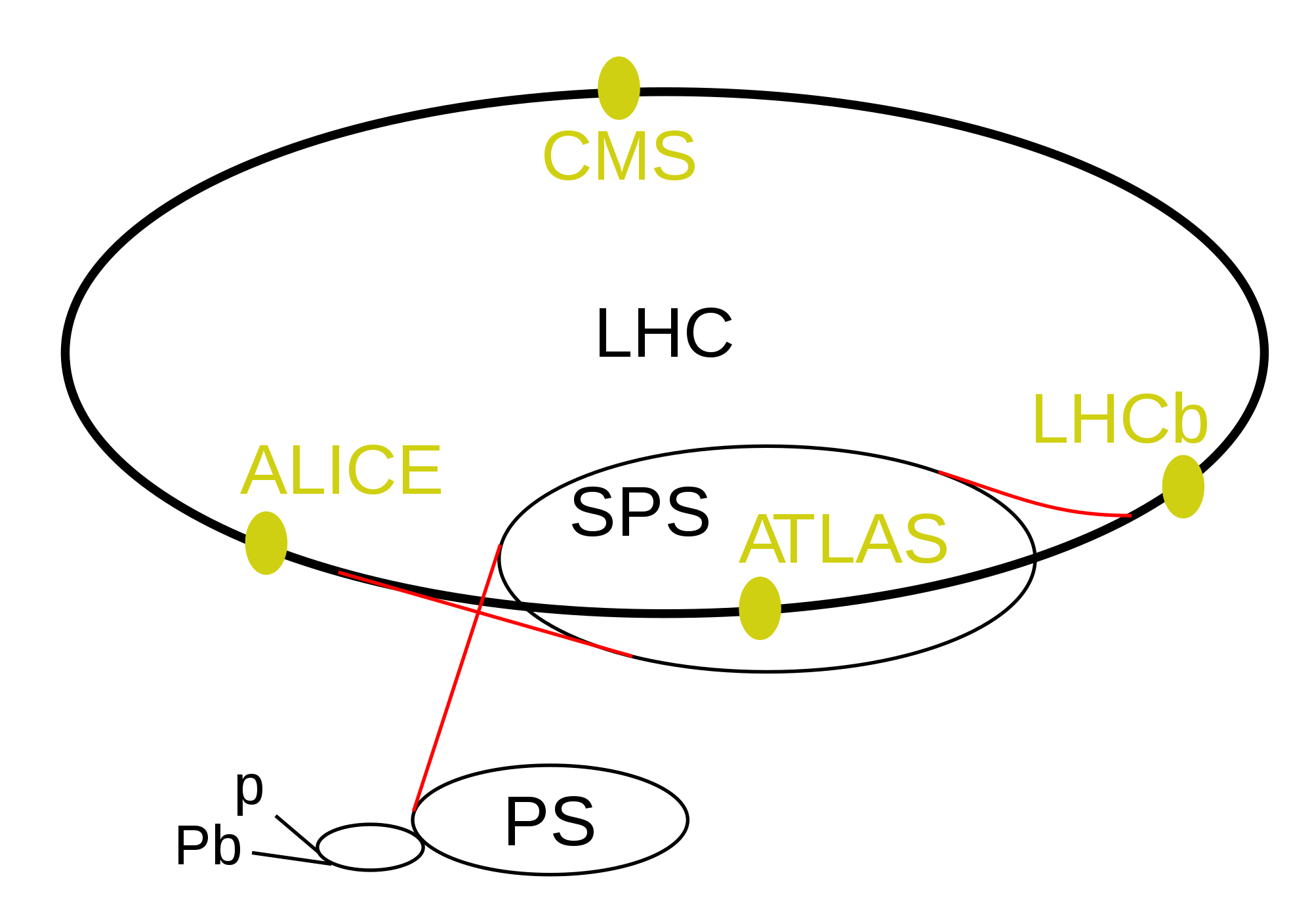
ATLAS is the largest general-purpose particle detector experiment at the Large Hadron Collider (LHC), a particle accelerator at CERN (the European Organization for Nuclear Research) in Switzerland. The experiment is designed to take advantage of the unprecedented energy available at the LHC and observe phenomena that involve highly massive particles which were not observable using earlier lower-energy accelerators. ATLAS was one of the two LHC experiments involved in the discovery of the Higgs boson in July 2012. It was also designed to search for evidence of theories of particle physics beyond the Standard Model.
The experiment is a collaboration involving 6,003 members, out of which 3,822 are physicists (last update: June 26, 2022) from 243 institutions in 40 countries.
The first cyclotron, an early type of particle accelerator, was built by Ernest O. Lawrence in 1931, with a radius of just a few centimetres and a particle energy of 1 megaelectronvolt (MeV). Since then, accelerators have grown enormously in the quest to produce new particles of greater and greater mass. As accelerators have grown, so too has the list of known particles that they might be used to investigate.
The ATLAS Collaboration, the international group of physicists belonging to different universities and research centres who built and run the detector, was formed in 1992 when the proposed EAGLE (Experiment for Accurate Gamma, Lepton and Energy Measurements) and ASCOT (Apparatus with Super Conducting Toroids) collaborations merged their efforts to build a single, general-purpose particle detector for a new particle accelerator, the Large Hadron Collider. At present, the ATLAS Collaboration involves 6,003 members, out of which 3,822 are physicists (last update: June 26, 2022) from 257 institutions in 42 countries.
The design was a combination of two previous projects for LHC, EAGLE and ASCOT, and also benefitted from the detector research and development that had been done for the Superconducting Super Collider, a US project interrupted in 1993. The ATLAS experiment was proposed in its current form in 1994, and officially funded by the CERN member countries in 1995. Additional countries, universities, and laboratories have joined in subsequent years. Construction work began at individual institutions, with detector components then being shipped to CERN and assembled in the ATLAS experiment pit starting in 2003.
Construction was completed in 2008 and the experiment detected its first single proton beam events on 10 September of that year. Data-taking was then interrupted for over a year due to an LHC magnet quench incident. On 23 November 2009, the first proton–proton collisions occurred at the LHC and were recorded by ATLAS, at a relatively low injection energy of 900 GeV in the center of mass of the collision. Since then, the LHC energy has been increasing: 1.8 TeV at the end of 2009, 7 TeV for the whole of 2010 and 2011, then 8 TeV in 2012. The first data-taking period performed between 2010 and 2012 is referred to as Run I. After a long shutdown (LS1) in 2013 and 2014, in 2015 ATLAS saw 13 TeV collisions. The second data-taking period, Run II, was completed, always at 13 TeV energy, at the end of 2018 with a recorded integrated luminosity of nearly 140 fb−1 (inverse femtobarn). A second long shutdown (LS2) in 2019–22 with upgrades to the ATLAS detector was followed by Run III, which started in July 2022.
The ATLAS Collaboration is currently led by Spokesperson Stephane Willocq and Deputy Spokespersons Anna Sfyrla and Guillaume Unal. Former Spokespersons have been:
In the field of particle physics, ATLAS studies different types of processes detected or detectable in energetic collisions at the Large Hadron Collider (LHC). For the processes already known, it is a matter of measuring more and more accurately the properties of known particles or finding quantitative confirmations of the Standard Model. Processes not observed so far would allow, if detected, to discover new particles or to have confirmation of physical theories that go beyond the Standard Model.
Hub AI
ATLAS experiment AI simulator
(@ATLAS experiment_simulator)
ATLAS experiment
ATLAS is the largest general-purpose particle detector experiment at the Large Hadron Collider (LHC), a particle accelerator at CERN (the European Organization for Nuclear Research) in Switzerland. The experiment is designed to take advantage of the unprecedented energy available at the LHC and observe phenomena that involve highly massive particles which were not observable using earlier lower-energy accelerators. ATLAS was one of the two LHC experiments involved in the discovery of the Higgs boson in July 2012. It was also designed to search for evidence of theories of particle physics beyond the Standard Model.
The experiment is a collaboration involving 6,003 members, out of which 3,822 are physicists (last update: June 26, 2022) from 243 institutions in 40 countries.
The first cyclotron, an early type of particle accelerator, was built by Ernest O. Lawrence in 1931, with a radius of just a few centimetres and a particle energy of 1 megaelectronvolt (MeV). Since then, accelerators have grown enormously in the quest to produce new particles of greater and greater mass. As accelerators have grown, so too has the list of known particles that they might be used to investigate.
The ATLAS Collaboration, the international group of physicists belonging to different universities and research centres who built and run the detector, was formed in 1992 when the proposed EAGLE (Experiment for Accurate Gamma, Lepton and Energy Measurements) and ASCOT (Apparatus with Super Conducting Toroids) collaborations merged their efforts to build a single, general-purpose particle detector for a new particle accelerator, the Large Hadron Collider. At present, the ATLAS Collaboration involves 6,003 members, out of which 3,822 are physicists (last update: June 26, 2022) from 257 institutions in 42 countries.
The design was a combination of two previous projects for LHC, EAGLE and ASCOT, and also benefitted from the detector research and development that had been done for the Superconducting Super Collider, a US project interrupted in 1993. The ATLAS experiment was proposed in its current form in 1994, and officially funded by the CERN member countries in 1995. Additional countries, universities, and laboratories have joined in subsequent years. Construction work began at individual institutions, with detector components then being shipped to CERN and assembled in the ATLAS experiment pit starting in 2003.
Construction was completed in 2008 and the experiment detected its first single proton beam events on 10 September of that year. Data-taking was then interrupted for over a year due to an LHC magnet quench incident. On 23 November 2009, the first proton–proton collisions occurred at the LHC and were recorded by ATLAS, at a relatively low injection energy of 900 GeV in the center of mass of the collision. Since then, the LHC energy has been increasing: 1.8 TeV at the end of 2009, 7 TeV for the whole of 2010 and 2011, then 8 TeV in 2012. The first data-taking period performed between 2010 and 2012 is referred to as Run I. After a long shutdown (LS1) in 2013 and 2014, in 2015 ATLAS saw 13 TeV collisions. The second data-taking period, Run II, was completed, always at 13 TeV energy, at the end of 2018 with a recorded integrated luminosity of nearly 140 fb−1 (inverse femtobarn). A second long shutdown (LS2) in 2019–22 with upgrades to the ATLAS detector was followed by Run III, which started in July 2022.
The ATLAS Collaboration is currently led by Spokesperson Stephane Willocq and Deputy Spokespersons Anna Sfyrla and Guillaume Unal. Former Spokespersons have been:
In the field of particle physics, ATLAS studies different types of processes detected or detectable in energetic collisions at the Large Hadron Collider (LHC). For the processes already known, it is a matter of measuring more and more accurately the properties of known particles or finding quantitative confirmations of the Standard Model. Processes not observed so far would allow, if detected, to discover new particles or to have confirmation of physical theories that go beyond the Standard Model.