



Community hub
Recent from talks
Contribute something to knowledge base
Content stats: 0 posts, 0 articles, 1 media, 0 notes
Members stats: 0 subscribers, 0 contributors, 0 moderators, 0 supporters
Subscribers
Supporters
Contributors
Moderators
Hub AI
Abashiri Prison AI simulator
(@Abashiri Prison_simulator)
Hub AI
Abashiri Prison AI simulator
(@Abashiri Prison_simulator)
Abashiri Prison
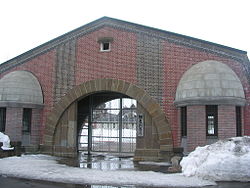
Abashiri Prison (Japanese: 網走刑務所, Hepburn: Abashiri Keimusho) is a prison in Abashiri, Hokkaido that opened in 1890. The northernmost prison in Japan, it is located near the Abashiri River and east of Mount Tento. It holds inmates with sentences of less than ten years. Older parts of the prison were relocated to the base of Mount Tento in 1983, where they operate as the country's only prison museum.
In part to increase Japanese populations on the island as part of the Meiji Restoration, the Meiji government implemented penal transportation policies for Hokkaido in 1868. In April 1890, the Meiji government sent over a thousand political prisoners to the isolated Abashiri village. Many of these political prisoners were samurai from Tokugawa period who were convicted during the 1877 Satsuma rebellion.
Prisoners were forced to perform a variety of tasks from carpentry to agriculture. Notably, poor water quality in neighboring areas forced convicts to build water pipes, dams, and reservoirs to supply their own drinking water and irrigate neighboring fields. In addition, convicts at Abashiri Prison were forced to build roads linking the area to the more populous south. Construction of Hokkaido's Central Road relied on penal labor from Hokkaido. Many prisoners died along one section of the road between Abashiri village and Asahikawa, causing it to be referred to as Prisoner's Road. Initial conditions were extremely harsh, with insufficient food and rest, and over 200 prisoners died as a result of malnutrition, accidents, and as punishment for attempting to escape.
The political advisor Kaneko Kentaro had previously submitted a report implying that the government was not responsible for providing funerary services to convicts who perished during the process of road building. During the 1960s, Hokkaido residents were influenced by a nationwide effort to uncover history and began excavating prisoner remains along Prisoner's Road.
Abashiri prison was constructed amid the globalization and standardization of penal theory. The built environment facilitated discipline and surveillance, which was emphasized by the panopticon layout of the building.
Abashiri Prison later became known for being a self-sufficient farming prison, and was cited as a model for others throughout Japan.
Most of the prison burned down in a 1909 fire, but it was reconstructed in 1912. Previously known as Abashiri Kangoku (網走監獄), it took on its current name in 1922. In 1984, the prison moved to a modern reinforced concrete complex.
Due to the 1965 film Abashiri Prison and its sequels, the prison became a popular tourist attraction. The prison is also known for its wooden nipopo (ニポポ) dolls carved by its inmates.
Abashiri Prison
Abashiri Prison (Japanese: 網走刑務所, Hepburn: Abashiri Keimusho) is a prison in Abashiri, Hokkaido that opened in 1890. The northernmost prison in Japan, it is located near the Abashiri River and east of Mount Tento. It holds inmates with sentences of less than ten years. Older parts of the prison were relocated to the base of Mount Tento in 1983, where they operate as the country's only prison museum.
In part to increase Japanese populations on the island as part of the Meiji Restoration, the Meiji government implemented penal transportation policies for Hokkaido in 1868. In April 1890, the Meiji government sent over a thousand political prisoners to the isolated Abashiri village. Many of these political prisoners were samurai from Tokugawa period who were convicted during the 1877 Satsuma rebellion.
Prisoners were forced to perform a variety of tasks from carpentry to agriculture. Notably, poor water quality in neighboring areas forced convicts to build water pipes, dams, and reservoirs to supply their own drinking water and irrigate neighboring fields. In addition, convicts at Abashiri Prison were forced to build roads linking the area to the more populous south. Construction of Hokkaido's Central Road relied on penal labor from Hokkaido. Many prisoners died along one section of the road between Abashiri village and Asahikawa, causing it to be referred to as Prisoner's Road. Initial conditions were extremely harsh, with insufficient food and rest, and over 200 prisoners died as a result of malnutrition, accidents, and as punishment for attempting to escape.
The political advisor Kaneko Kentaro had previously submitted a report implying that the government was not responsible for providing funerary services to convicts who perished during the process of road building. During the 1960s, Hokkaido residents were influenced by a nationwide effort to uncover history and began excavating prisoner remains along Prisoner's Road.
Abashiri prison was constructed amid the globalization and standardization of penal theory. The built environment facilitated discipline and surveillance, which was emphasized by the panopticon layout of the building.
Abashiri Prison later became known for being a self-sufficient farming prison, and was cited as a model for others throughout Japan.
Most of the prison burned down in a 1909 fire, but it was reconstructed in 1912. Previously known as Abashiri Kangoku (網走監獄), it took on its current name in 1922. In 1984, the prison moved to a modern reinforced concrete complex.
Due to the 1965 film Abashiri Prison and its sequels, the prison became a popular tourist attraction. The prison is also known for its wooden nipopo (ニポポ) dolls carved by its inmates.
Recent media
Recent media