



Community hub
Recent from talks
Contribute something to knowledge base
Content stats: 0 posts, 0 articles, 1 media, 0 notes
Members stats: 0 subscribers, 0 contributors, 0 moderators, 0 supporters
Subscribers
Supporters
Contributors
Moderators
Hub AI
Abdominal wall AI simulator
(@Abdominal wall_simulator)
Hub AI
Abdominal wall AI simulator
(@Abdominal wall_simulator)
Abdominal wall
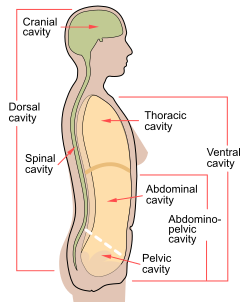
In anatomy, the abdominal wall represents the boundaries of the abdominal cavity. The abdominal wall is split into the anterolateral and posterior walls.
There is a common set of layers covering and forming all the walls: the deepest being the visceral peritoneum, which covers many of the abdominal organs (most of the large and small intestines, for example), and the parietal peritoneum—which covers the visceral peritoneum below it, the extraperitoneal fat, the transversalis fascia, the internal and external oblique and transversus abdominis aponeurosis, and a layer of fascia, which has different names according to what it covers (e.g., transversalis, psoas fascia).
In medical vernacular, the term 'abdominal wall' most commonly refers to the layers composing the anterior abdominal wall which, in addition to the layers mentioned above, includes the three layers of muscle: the transversus abdominis (transverse abdominal muscle), the internal (obliquus internus) and the external oblique (obliquus externus).
The contour of the abdominal wall is roughly hexagonal. Its superior border is bounded by the coastal margins, lateral borders by mid-axillary lines, and inferior borders bounded by the anterior half of the iliac crest, inguinal ligaments, pubic crest, and pubic symphysis.
In human anatomy, the layers of the anterolateral abdominal wall are (from superficial to deep):
The surface contains several ligaments separated by fossae:
Abdominal wall
In anatomy, the abdominal wall represents the boundaries of the abdominal cavity. The abdominal wall is split into the anterolateral and posterior walls.
There is a common set of layers covering and forming all the walls: the deepest being the visceral peritoneum, which covers many of the abdominal organs (most of the large and small intestines, for example), and the parietal peritoneum—which covers the visceral peritoneum below it, the extraperitoneal fat, the transversalis fascia, the internal and external oblique and transversus abdominis aponeurosis, and a layer of fascia, which has different names according to what it covers (e.g., transversalis, psoas fascia).
In medical vernacular, the term 'abdominal wall' most commonly refers to the layers composing the anterior abdominal wall which, in addition to the layers mentioned above, includes the three layers of muscle: the transversus abdominis (transverse abdominal muscle), the internal (obliquus internus) and the external oblique (obliquus externus).
The contour of the abdominal wall is roughly hexagonal. Its superior border is bounded by the coastal margins, lateral borders by mid-axillary lines, and inferior borders bounded by the anterior half of the iliac crest, inguinal ligaments, pubic crest, and pubic symphysis.
In human anatomy, the layers of the anterolateral abdominal wall are (from superficial to deep):
The surface contains several ligaments separated by fossae:
Recent media
Recent media