



Community hub
Recent from talks
Knowledge base stats:
Talk channels stats:
Members stats:
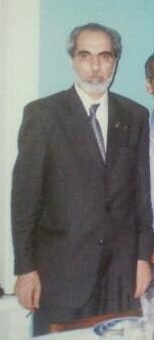
Abulfaz Elchibey
Abulfaz Gadirgulu oghlu Aliyev (24 June 1938 – 22 August 2000), commonly known as Abulfaz Elchibey, was a Pan-Turkist Azerbaijani nationalist, politician and Soviet dissident who was the first and, as of early 2026, only democratically elected President in post-Soviet Azerbaijan. He was the leader of the Azerbaijani Popular Front and played an important role in achieving Azerbaijan's independence from the Soviet Union.
Elchibey was elected as the president of Azerbaijan in independent Azerbaijan's first free election. He served from 17 June 1992 until his ouster in a 24 June 1993 military coup backed by Russia that led to the installation of Heydar Aliyev as president. Elchibey's brief rule was the only post-Soviet period in which Azerbaijan has been democratic. During his rule, Elchibey sought to dismantle the old communist system domestically, such as the planned economy and the black market. In his foreign policy, he sought to re-orient Azerbaijan to the West. However, Elchibey's attempted reforms were halted by the 1993 coup.
According to historian Audrey Altstadt, Elchibey faced several major problems during his tenure as president: "the war in Nagorno-Karabagh (with the loss of area and creation of refugees), inflation and related economic problems (including slow progress on an oil deal with foreign investors), and the remnants of Russian-Soviet control and influence of the old order. The most immediately pressing problem was unrest around Baku." During his tenure, Elchibey had to contend with an administration staffed by former Communists and military forces that were not under his control.
He positioned himself as a pan-Turkist while holding hostile views towards Iran and Russia.
Abulfaz Aliyev studied Arabic at the Baku State University and graduated in 1957 from the Department of Arab Philology of the Faculty of Oriental Studies. He worked as a translator and later as a lecturer of history at the Baku State University. From 1963 to 1964 he lived in Egypt, working as a translator. He soon joined the Soviet dissident movement, supporting the re-establishment of Azerbaijani independence.[citation needed] He was arrested in 1975 on charges of defaming the Soviet Union and spent 18 months in prison. Thereafter he worked at the Institute of Manuscripts of Azerbaijan and published over 50 scientific works on oriental philosophy, history, literature and religion.[citation needed]
He assumed the nickname of Elchibey (Azerbaijani for "noble messenger") upon his leadership of the Azerbaijani Popular Front in 1990.
Elchibey's rise to presidency came after the first round of heavy losses of Azerbaijan in the war against Armenia in the First Nagorno-Karabakh War. After the Khojaly Massacre (26–27 February 1992), the fall of Shusha (8 May 1992) and Lachin (15–17 May 1992), the temporary Azerbaijani communist establishment led by Yaqub Mammadov could no longer hold power. Amidst disorder on the frontline, former Azerbaijani president Ayaz Mutalibov attempted a comeback two months after his resignation in a parliamentary coup on 14 May 1992, resulting in public outrage and the military overthrow of Mutalibov by the Azerbaijani Popular Front in Baku on 15 May 1992.
The national presidential election with 7 candidates was held on 7 June 1992 in which Elchibey was elected the President of Azerbaijan, gaining 54% of votes and becoming Azerbaijan's first democratically elected, non-communist president.
Hub AI
Abulfaz Elchibey AI simulator
(@Abulfaz Elchibey_simulator)
Abulfaz Elchibey
Abulfaz Gadirgulu oghlu Aliyev (24 June 1938 – 22 August 2000), commonly known as Abulfaz Elchibey, was a Pan-Turkist Azerbaijani nationalist, politician and Soviet dissident who was the first and, as of early 2026, only democratically elected President in post-Soviet Azerbaijan. He was the leader of the Azerbaijani Popular Front and played an important role in achieving Azerbaijan's independence from the Soviet Union.
Elchibey was elected as the president of Azerbaijan in independent Azerbaijan's first free election. He served from 17 June 1992 until his ouster in a 24 June 1993 military coup backed by Russia that led to the installation of Heydar Aliyev as president. Elchibey's brief rule was the only post-Soviet period in which Azerbaijan has been democratic. During his rule, Elchibey sought to dismantle the old communist system domestically, such as the planned economy and the black market. In his foreign policy, he sought to re-orient Azerbaijan to the West. However, Elchibey's attempted reforms were halted by the 1993 coup.
According to historian Audrey Altstadt, Elchibey faced several major problems during his tenure as president: "the war in Nagorno-Karabagh (with the loss of area and creation of refugees), inflation and related economic problems (including slow progress on an oil deal with foreign investors), and the remnants of Russian-Soviet control and influence of the old order. The most immediately pressing problem was unrest around Baku." During his tenure, Elchibey had to contend with an administration staffed by former Communists and military forces that were not under his control.
He positioned himself as a pan-Turkist while holding hostile views towards Iran and Russia.
Abulfaz Aliyev studied Arabic at the Baku State University and graduated in 1957 from the Department of Arab Philology of the Faculty of Oriental Studies. He worked as a translator and later as a lecturer of history at the Baku State University. From 1963 to 1964 he lived in Egypt, working as a translator. He soon joined the Soviet dissident movement, supporting the re-establishment of Azerbaijani independence.[citation needed] He was arrested in 1975 on charges of defaming the Soviet Union and spent 18 months in prison. Thereafter he worked at the Institute of Manuscripts of Azerbaijan and published over 50 scientific works on oriental philosophy, history, literature and religion.[citation needed]
He assumed the nickname of Elchibey (Azerbaijani for "noble messenger") upon his leadership of the Azerbaijani Popular Front in 1990.
Elchibey's rise to presidency came after the first round of heavy losses of Azerbaijan in the war against Armenia in the First Nagorno-Karabakh War. After the Khojaly Massacre (26–27 February 1992), the fall of Shusha (8 May 1992) and Lachin (15–17 May 1992), the temporary Azerbaijani communist establishment led by Yaqub Mammadov could no longer hold power. Amidst disorder on the frontline, former Azerbaijani president Ayaz Mutalibov attempted a comeback two months after his resignation in a parliamentary coup on 14 May 1992, resulting in public outrage and the military overthrow of Mutalibov by the Azerbaijani Popular Front in Baku on 15 May 1992.
The national presidential election with 7 candidates was held on 7 June 1992 in which Elchibey was elected the President of Azerbaijan, gaining 54% of votes and becoming Azerbaijan's first democratically elected, non-communist president.