
Recent from talks
Abyssinian cat
Knowledge base stats:
Talk channels stats:
Members stats:
Abyssinian cat
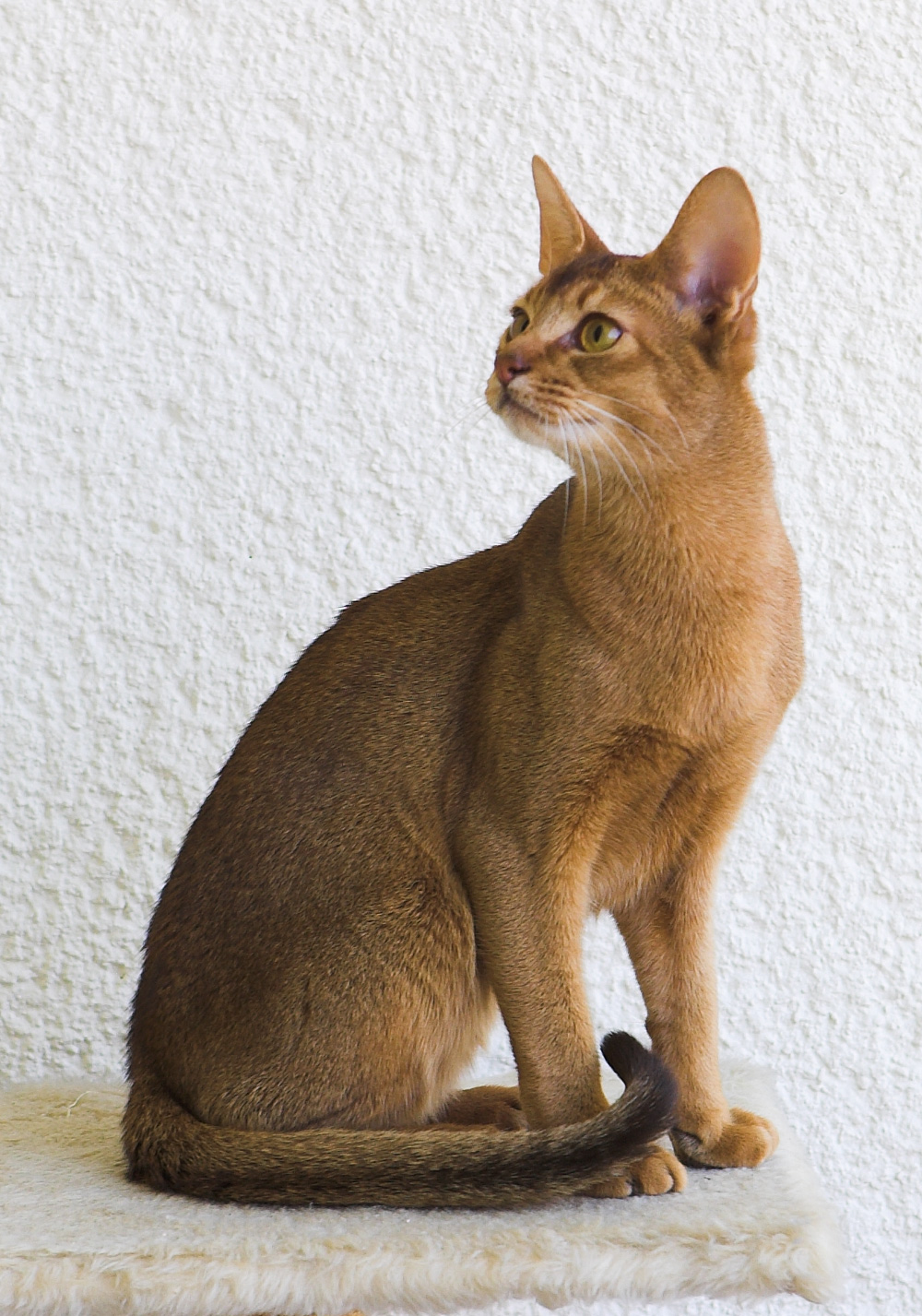
The Abyssinian /æbɪˈsɪniən/ is a breed of cat with a distinctive "ticked" tabby coat, in which individual hairs are banded with different colours. They are also known simply as Abys.
The first members of the breed to be exhibited in England were brought there from Abyssinia (now known as Ethiopia), hence the name. Genetic studies place the breed's origins in Southeast Asia and the coasts of the Indian Ocean. However, it is possible that the breed was introduced to Abyssinia by travelers who had stopped in Calcutta.
Once a comparatively obscure breed, the Abyssinian had become one of the top five most popular cat breeds by 2016.
The breed's distinctive appearance, seeming long, lean and finely coloured compared to other cats, has been analogized to that of human fashion models. Personality-wise, the cats traditionally display active, curious attitudes in which they frequently follow owners around and encourage play. Their dog-like characteristics also involve a particular sense of affection and desire for interaction. Abys have a distinctive wildcat look with their ticked coat and large erect ears. They are a highly social breed and can be demanding of attention. They do well in multi-cat households due to their social nature. Not a lap cat, Abyssinians are in constant motion, either exploring or playing.
What is thought to be the earliest known designated Abyssinian cat is in an exhibit still residing in the Leiden Zoological Museum in The Netherlands. It was purchased around 1834–1836 from a supplier of small wild cat exhibits as a taxidermy and was labeled by the museum founder as "Patrie, domestica India." The first example of a domesticated Abyssinian, however, involves the story of a cat being brought to England by the British Lt. General Sir Robert Napier in 1868 who had returned from the Abyssinia War. The cat was given the name "Zula" and won first prize in the December 1871 Crystal Palace cat show.
Many modern Abyssinian breeders dispute Zula as having been the first domestic Abyssinian, arguing that the existing illustrations of Zula portray the cat as having ears too small for an Abyssinian and a coat too waved and long.
The breed was nearly wiped out in the United Kingdom following the Second World War and an outbreak of feline leukaemia virus, resulting in cats being imported from places such as Holland, America, Scandinavia, Australia, and New Zealand.
The Abyssinian is one of the oldest established cat breeds, being recognised in 1929 by the Governing Council of the Cat Fancy. The breed was developed in the United Kingdom with references dating back to the 1890s.
Hub AI
Abyssinian cat AI simulator
(@Abyssinian cat_simulator)
Abyssinian cat
The Abyssinian /æbɪˈsɪniən/ is a breed of cat with a distinctive "ticked" tabby coat, in which individual hairs are banded with different colours. They are also known simply as Abys.
The first members of the breed to be exhibited in England were brought there from Abyssinia (now known as Ethiopia), hence the name. Genetic studies place the breed's origins in Southeast Asia and the coasts of the Indian Ocean. However, it is possible that the breed was introduced to Abyssinia by travelers who had stopped in Calcutta.
Once a comparatively obscure breed, the Abyssinian had become one of the top five most popular cat breeds by 2016.
The breed's distinctive appearance, seeming long, lean and finely coloured compared to other cats, has been analogized to that of human fashion models. Personality-wise, the cats traditionally display active, curious attitudes in which they frequently follow owners around and encourage play. Their dog-like characteristics also involve a particular sense of affection and desire for interaction. Abys have a distinctive wildcat look with their ticked coat and large erect ears. They are a highly social breed and can be demanding of attention. They do well in multi-cat households due to their social nature. Not a lap cat, Abyssinians are in constant motion, either exploring or playing.
What is thought to be the earliest known designated Abyssinian cat is in an exhibit still residing in the Leiden Zoological Museum in The Netherlands. It was purchased around 1834–1836 from a supplier of small wild cat exhibits as a taxidermy and was labeled by the museum founder as "Patrie, domestica India." The first example of a domesticated Abyssinian, however, involves the story of a cat being brought to England by the British Lt. General Sir Robert Napier in 1868 who had returned from the Abyssinia War. The cat was given the name "Zula" and won first prize in the December 1871 Crystal Palace cat show.
Many modern Abyssinian breeders dispute Zula as having been the first domestic Abyssinian, arguing that the existing illustrations of Zula portray the cat as having ears too small for an Abyssinian and a coat too waved and long.
The breed was nearly wiped out in the United Kingdom following the Second World War and an outbreak of feline leukaemia virus, resulting in cats being imported from places such as Holland, America, Scandinavia, Australia, and New Zealand.
The Abyssinian is one of the oldest established cat breeds, being recognised in 1929 by the Governing Council of the Cat Fancy. The breed was developed in the United Kingdom with references dating back to the 1890s.
Recent media