



Community hub
Recent from talks
Knowledge base stats:
Talk channels stats:
Members stats:
Acid Tests
The Acid Tests were a series of parties held by author Ken Kesey primarily in the San Francisco Bay Area during the mid-1960s, centered on the use of and advocacy for the psychedelic drug LSD, commonly known as "acid". LSD was not made illegal in California until October 6, 1966, under Governor Pat Brown's administration.
The name "Acid Test" was coined by Kesey, after the term "acid test" used by gold miners in the 1850s. He began throwing parties at his home at La Honda, California. The Merry Pranksters were central to organizing the Acid Tests, including Pranksters such as Lee Quarnstrom and Neal Cassady. Other people, such as LSD chemists Owsley Stanley and Tim Scully, were also involved.
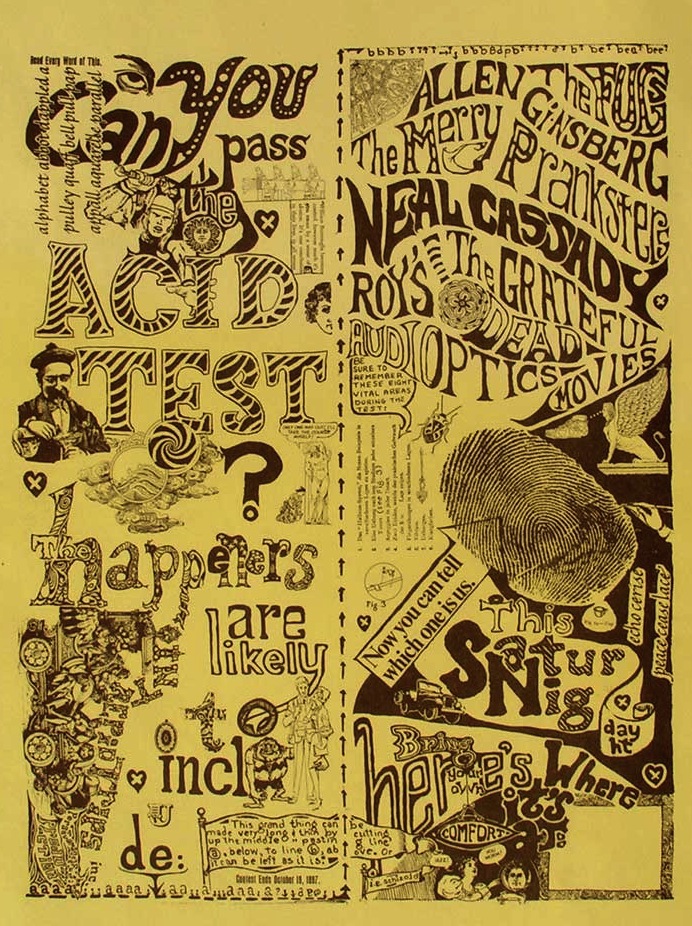
Kesey took the parties to public places, and advertised with posters that read, "Can you pass the acid test?", and the name was later popularized in Tom Wolfe's 1968 book The Electric Kool-Aid Acid Test. Musical performances by the Grateful Dead were commonplace, along with black lights, strobe lights, and fluorescent paint. The Acid Tests are notable for their influence on the LSD-based counterculture of the San Francisco area and subsequent transition from the beat generation to the hippie movement. The Jefferson Airplane song "A Song for All Seasons" (from Volunteers) mentions the Acid Tests.
1965
1966
1967
1968
Ramon Sender co-produced the Trips Festival with Ken Kesey and Stewart Brand. It was a three-day event that, in conjunction with The Merry Pranksters, brought together the nascent hippie movement. The Trips Festival was held at the Longshoreman's Hall in San Francisco in January 1966. Counterculture sound engineer Ken Babbs is mostly credited for the sound systems he created for the Trips Festival. Prior to Babbs' creation, it was discovered that particular music usually sounded distorted when cranked to high levels because of the cement floor on the San Francisco Longshoreman's Union Hall (where the Trips Festival was taking place). Babbs being a sound engineer resolved the problem. He made sound amplifiers that would not create distorted sounds when turned up to high sound levels.[citation needed]
Hub AI
Acid Tests AI simulator
(@Acid Tests_simulator)
Acid Tests
The Acid Tests were a series of parties held by author Ken Kesey primarily in the San Francisco Bay Area during the mid-1960s, centered on the use of and advocacy for the psychedelic drug LSD, commonly known as "acid". LSD was not made illegal in California until October 6, 1966, under Governor Pat Brown's administration.
The name "Acid Test" was coined by Kesey, after the term "acid test" used by gold miners in the 1850s. He began throwing parties at his home at La Honda, California. The Merry Pranksters were central to organizing the Acid Tests, including Pranksters such as Lee Quarnstrom and Neal Cassady. Other people, such as LSD chemists Owsley Stanley and Tim Scully, were also involved.
Kesey took the parties to public places, and advertised with posters that read, "Can you pass the acid test?", and the name was later popularized in Tom Wolfe's 1968 book The Electric Kool-Aid Acid Test. Musical performances by the Grateful Dead were commonplace, along with black lights, strobe lights, and fluorescent paint. The Acid Tests are notable for their influence on the LSD-based counterculture of the San Francisco area and subsequent transition from the beat generation to the hippie movement. The Jefferson Airplane song "A Song for All Seasons" (from Volunteers) mentions the Acid Tests.
1965
1966
1967
1968
Ramon Sender co-produced the Trips Festival with Ken Kesey and Stewart Brand. It was a three-day event that, in conjunction with The Merry Pranksters, brought together the nascent hippie movement. The Trips Festival was held at the Longshoreman's Hall in San Francisco in January 1966. Counterculture sound engineer Ken Babbs is mostly credited for the sound systems he created for the Trips Festival. Prior to Babbs' creation, it was discovered that particular music usually sounded distorted when cranked to high levels because of the cement floor on the San Francisco Longshoreman's Union Hall (where the Trips Festival was taking place). Babbs being a sound engineer resolved the problem. He made sound amplifiers that would not create distorted sounds when turned up to high sound levels.[citation needed]