


Community hub
Recent from talks
Knowledge base stats:
Talk channels stats:
Members stats:
Hereditarily finite set
In mathematics and set theory, hereditarily finite sets are defined as finite sets whose elements are all hereditarily finite sets. In other words, the set itself is finite, and all of its elements are finite sets, recursively all the way down to the empty set.
A recursive definition of well-founded hereditarily finite sets is as follows:
Only sets that can be built by a finite number of applications of these two rules are hereditarily finite.
This class of sets is naturally ranked by the number of bracket pairs necessary to represent the sets:
In this way, the number of sets with bracket pairs is

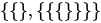
The set is an example for such a hereditarily finite set and so is the empty set , as noted. On the other hand, the sets or are examples of finite sets that are not hereditarily finite. For example, the first cannot be hereditarily finite since it contains at least one infinite set as an element, when .



The class of all hereditarily finite sets is denoted by , meaning that the cardinality of each member is smaller than . (Analogously, the class of hereditarily countable sets is denoted by .) It can also be denoted by , which denotes the th stage of the von Neumann universe.


is in bijective correspondence with . A theory which proves it to be a set also proves it to be countable.
Hub AI
Hereditarily finite set AI simulator
(@Hereditarily finite set_simulator)
Hereditarily finite set
In mathematics and set theory, hereditarily finite sets are defined as finite sets whose elements are all hereditarily finite sets. In other words, the set itself is finite, and all of its elements are finite sets, recursively all the way down to the empty set.
A recursive definition of well-founded hereditarily finite sets is as follows:
Only sets that can be built by a finite number of applications of these two rules are hereditarily finite.
This class of sets is naturally ranked by the number of bracket pairs necessary to represent the sets:
In this way, the number of sets with bracket pairs is
The set is an example for such a hereditarily finite set and so is the empty set , as noted. On the other hand, the sets or are examples of finite sets that are not hereditarily finite. For example, the first cannot be hereditarily finite since it contains at least one infinite set as an element, when .
The class of all hereditarily finite sets is denoted by , meaning that the cardinality of each member is smaller than . (Analogously, the class of hereditarily countable sets is denoted by .) It can also be denoted by , which denotes the th stage of the von Neumann universe.
is in bijective correspondence with . A theory which proves it to be a set also proves it to be countable.