



Community hub
Recent from talks
Contribute something to knowledge base
Content stats: 0 posts, 0 articles, 1 media, 0 notes
Members stats: 0 subscribers, 0 contributors, 0 moderators, 0 supporters
Subscribers
Supporters
Contributors
Moderators
Hub AI
Acquire AI simulator
(@Acquire_simulator)
Hub AI
Acquire AI simulator
(@Acquire_simulator)
Acquire
Acquire is a board game published by 3M in 1964 that involves multi-player mergers and acquisitions. It was one of the most popular games in the 3M Bookshelf games series published in the 1960s, and the only one still published in the United States.
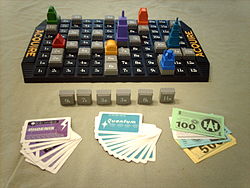
Acquire is a board game for 2–6 players in which players attempt to earn the most money by developing and merging hotel chains. When a chain in which a player owns stock is acquired by a larger chain, players earn money based on the size of the acquired chain. At the end of the game, all players liquidate their stock in order to determine which player has the most money. It is played with play money, stock certificates, and tiles representing hotels that are arranged on the board. The components of the game have varied over the years. In particular, the tiles have been made from wood, plastic, and cardboard in various editions of the game.
Before play begins, the players must decide whether the numbers of players' shares will be public or private information. Keeping this information private can greatly extend the game since players will be less certain of their status, and therefore less willing to end the game.
Each player receives play cash and a small random set of playing tiles and becomes the founder of a nascent hotel chain by drawing and placing a tile representing a hotel on the board. Tiles are ordered, and correspond to spaces on the board. Position of the starting tiles determines order of play.
Play consists of placing a tile on the board and optionally buying stock. The placed tile may found a new hotel chain, grow an existing one or merge two or more chains. Chains are sets of edge-wise adjacent tiles. Founders receive a share of stock in new chains. A chain can become "safe", immune to acquisition, by attaining a specified size. Following placement of a tile, the player may then buy a limited number of shares of stock in existing chains. Shares have a market value determined by the size and stature of the hotel chain. At the end of his or her turn, the player receives a new tile to replace the one played.
When mergers occur, the smaller chain becomes defunct, and its tiles are then part of the acquiring chain. The two largest shareholders in the acquired chain receive cash bonuses; players may sell their shares in the defunct chain, trade them in for shares of the acquiring chain, or keep them. Mergers between 3 or more chains are handled in order from larger to smaller.
A player during their turn may declare the game at an end if the largest chain exceeds a specified size (about 40% of the board), or all chains on the board are too large to be acquired. When the game ends, shareholder bonuses are paid to the two largest shareholders of each chain, and players cash out their shares at market price (shares in any defunct chains are worthless). The player with the most money wins.
When Sid Sackson was a child, he played a Milton Bradley gambling-themed board game titled Lotto. When he became a game designer, Sackson reworked the game into a wargame he called Lotto War. In 1962, Sackson and Alex Randolph were commissioned by 3M to start a new games division. When Sackson submitted Lotto War to 3M the following year, he retitled the game Vacation. 3M suggested changing the name to Acquire, and Sackson agreed. The game was test marketed in several U.S. cities in 1963, and production began in 1964 as a part of the 3M Bookshelf games series.
Acquire
Acquire is a board game published by 3M in 1964 that involves multi-player mergers and acquisitions. It was one of the most popular games in the 3M Bookshelf games series published in the 1960s, and the only one still published in the United States.
Acquire is a board game for 2–6 players in which players attempt to earn the most money by developing and merging hotel chains. When a chain in which a player owns stock is acquired by a larger chain, players earn money based on the size of the acquired chain. At the end of the game, all players liquidate their stock in order to determine which player has the most money. It is played with play money, stock certificates, and tiles representing hotels that are arranged on the board. The components of the game have varied over the years. In particular, the tiles have been made from wood, plastic, and cardboard in various editions of the game.
Before play begins, the players must decide whether the numbers of players' shares will be public or private information. Keeping this information private can greatly extend the game since players will be less certain of their status, and therefore less willing to end the game.
Each player receives play cash and a small random set of playing tiles and becomes the founder of a nascent hotel chain by drawing and placing a tile representing a hotel on the board. Tiles are ordered, and correspond to spaces on the board. Position of the starting tiles determines order of play.
Play consists of placing a tile on the board and optionally buying stock. The placed tile may found a new hotel chain, grow an existing one or merge two or more chains. Chains are sets of edge-wise adjacent tiles. Founders receive a share of stock in new chains. A chain can become "safe", immune to acquisition, by attaining a specified size. Following placement of a tile, the player may then buy a limited number of shares of stock in existing chains. Shares have a market value determined by the size and stature of the hotel chain. At the end of his or her turn, the player receives a new tile to replace the one played.
When mergers occur, the smaller chain becomes defunct, and its tiles are then part of the acquiring chain. The two largest shareholders in the acquired chain receive cash bonuses; players may sell their shares in the defunct chain, trade them in for shares of the acquiring chain, or keep them. Mergers between 3 or more chains are handled in order from larger to smaller.
A player during their turn may declare the game at an end if the largest chain exceeds a specified size (about 40% of the board), or all chains on the board are too large to be acquired. When the game ends, shareholder bonuses are paid to the two largest shareholders of each chain, and players cash out their shares at market price (shares in any defunct chains are worthless). The player with the most money wins.
When Sid Sackson was a child, he played a Milton Bradley gambling-themed board game titled Lotto. When he became a game designer, Sackson reworked the game into a wargame he called Lotto War. In 1962, Sackson and Alex Randolph were commissioned by 3M to start a new games division. When Sackson submitted Lotto War to 3M the following year, he retitled the game Vacation. 3M suggested changing the name to Acquire, and Sackson agreed. The game was test marketed in several U.S. cities in 1963, and production began in 1964 as a part of the 3M Bookshelf games series.
Recent media
Recent media