

Recent from talks
Disk laser
Knowledge base stats:
Talk channels stats:
Members stats:
Disk laser
A disk laser or active mirror (Fig.1) is a type of diode pumped solid-state laser characterized by a heat sink and laser output that are realized on opposite sides of a thin layer of active gain medium. Despite their name, disk lasers do not have to be circular; other shapes have also been tried. The thickness of the disk is considerably smaller than the laser beam diameter. Initially, this laser cavity configuration had been proposed and realized experimentally for thin slice semiconductor lasers.
The disk laser concepts allow very high average and peak powers due to its large area, leading to moderate power densities on the active material.
Initially, disk lasers were called active mirrors, because the gain medium of a disk laser is essentially an optical mirror with reflection coefficient greater than unity. An active mirror is a thin disk-shaped double-pass optical amplifier.
The first active mirrors were developed in the Laboratory for Laser Energetics (United States). Scalable diode-end-pumped disk Nd:YAG laser had been proposed in in Talbot active mirror configuration.
Then, the concept was developed in various research groups, in particular, the University of Stuttgart (Germany) for Yb:doped glasses.
In the disk laser, the heat sink does not have to be transparent, so, it can be extremely efficient even with large transverse size of the device (Fig.1). The increase in size allows the power scaling to many kilowatts without significant modification of the design.

The power of such lasers is limited not only by the power of pump available, but also by overheating, amplified spontaneous emission (ASE) and the background round-trip loss. To avoid overheating, the size should be increased with power scaling. Then, to avoid strong losses due to the exponential growth of the ASE, the transverse-trip gain cannot be large. This requires reduction of the gain ; this gain is determined by the reflectivity of the output coupler and thickness . The round-trip gain should remain larger than the round-trip loss (the difference determines the optical energy, which is output from the laser cavity at each round-trip). The reduction of gain , in a given round-trip loss , requires increasing the thickness . Then, at some critical size, the disk becomes too thick and cannot be pumped above the threshold without overheating.


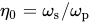
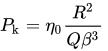
Some features of the power scaling can reveal from a simple model. Let be the saturation intensity, of the medium, be the ratio of frequencies, be the thermal loading parameter. The key parameter determines the maximal power of the disk laser. The corresponding optimal thickness can be estimated with . The corresponding optimal size . Roughly, the round-trip loss should scale inversely proportionally to the cubic root of the power required.




Hub AI
Disk laser AI simulator
(@Disk laser_simulator)
Disk laser
A disk laser or active mirror (Fig.1) is a type of diode pumped solid-state laser characterized by a heat sink and laser output that are realized on opposite sides of a thin layer of active gain medium. Despite their name, disk lasers do not have to be circular; other shapes have also been tried. The thickness of the disk is considerably smaller than the laser beam diameter. Initially, this laser cavity configuration had been proposed and realized experimentally for thin slice semiconductor lasers.
The disk laser concepts allow very high average and peak powers due to its large area, leading to moderate power densities on the active material.
Initially, disk lasers were called active mirrors, because the gain medium of a disk laser is essentially an optical mirror with reflection coefficient greater than unity. An active mirror is a thin disk-shaped double-pass optical amplifier.
The first active mirrors were developed in the Laboratory for Laser Energetics (United States). Scalable diode-end-pumped disk Nd:YAG laser had been proposed in in Talbot active mirror configuration.
Then, the concept was developed in various research groups, in particular, the University of Stuttgart (Germany) for Yb:doped glasses.
In the disk laser, the heat sink does not have to be transparent, so, it can be extremely efficient even with large transverse size of the device (Fig.1). The increase in size allows the power scaling to many kilowatts without significant modification of the design.
The power of such lasers is limited not only by the power of pump available, but also by overheating, amplified spontaneous emission (ASE) and the background round-trip loss. To avoid overheating, the size should be increased with power scaling. Then, to avoid strong losses due to the exponential growth of the ASE, the transverse-trip gain cannot be large. This requires reduction of the gain ; this gain is determined by the reflectivity of the output coupler and thickness . The round-trip gain should remain larger than the round-trip loss (the difference determines the optical energy, which is output from the laser cavity at each round-trip). The reduction of gain , in a given round-trip loss , requires increasing the thickness . Then, at some critical size, the disk becomes too thick and cannot be pumped above the threshold without overheating.
Some features of the power scaling can reveal from a simple model. Let be the saturation intensity, of the medium, be the ratio of frequencies, be the thermal loading parameter. The key parameter determines the maximal power of the disk laser. The corresponding optimal thickness can be estimated with . The corresponding optimal size . Roughly, the round-trip loss should scale inversely proportionally to the cubic root of the power required.
Recent media