



Community hub
Recent from talks
Contribute something
Nothing was collected or created yet.
Thermal shock
View on Wikipedia| Mechanical failure modes |
|---|
.jpg) |
Thermal shock is a phenomenon characterized by a rapid change in temperature that results in a transient mechanical load on an object. The load is caused by the differential expansion of different parts of the object due to the temperature change. This differential expansion can be understood in terms of strain, rather than stress. When the strain exceeds the tensile strength of the material, it can cause cracks to form, and eventually lead to structural failure.
Methods to prevent thermal shock include:[1]
- Minimizing the thermal gradient by changing the temperature gradually
- Increasing the thermal conductivity of the material
- Reducing the coefficient of thermal expansion of the material
- Increasing the strength of the material
- Introducing compressive stress in the material, such as in tempered glass
- Decreasing the Young's modulus of the material
- Increasing the toughness of the material through crack tip blunting or crack deflection, utilizing the process of plastic deformation, and phase transformation
Effect on materials
[edit]Borosilicate glass is made to withstand thermal shock better than most other glass through a combination of reduced expansion coefficient, and greater strength, though fused quartz outperforms it in both these respects. Some glass-ceramic materials (mostly in the lithium aluminosilicate (LAS) system[2]) include a controlled proportion of material with a negative expansion coefficient, so that the overall coefficient can be reduced to almost exactly zero over a reasonably wide range of temperatures.
Among the best thermomechanical materials, there are alumina, zirconia, tungsten alloys, silicon nitride, silicon carbide, boron carbide, and some stainless steels.
Reinforced carbon-carbon is extremely resistant to thermal shock, due to graphite's extremely high thermal conductivity and low expansion coefficient, the high strength of carbon fiber, and a reasonable ability to deflect cracks within the structure.
To measure thermal shock, the impulse excitation technique proved to be a useful tool. It can be used to measure Young's modulus, Shear modulus, Poisson's ratio, and damping coefficient in a non destructive way. The same test-piece can be measured after different thermal shock cycles, and this way the deterioration in physical properties can be mapped out.
Thermal shock resistance
[edit]Thermal shock resistance measures can be used for material selection in applications subject to rapid temperature changes. A common measure of thermal shock resistance is the maximum temperature differential, , which can be sustained by the material for a given thickness.[3]

Strength-controlled thermal shock resistance
[edit]Thermal shock resistance measures can be used for material selection in applications subject to rapid temperature changes. The maximum temperature jump, , sustainable by a material can be defined for strength-controlled models by:[4][3] where is the failure stress (which can be yield or fracture stress), is the coefficient of thermal expansion, is the Young's modulus, and is a constant depending upon the part constraint, material properties, and thickness.
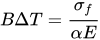


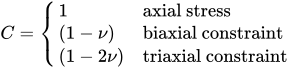
where is a system constrain constant dependent upon the Poisson's ratio, , and is a non-dimensional parameter dependent upon the Biot number, .


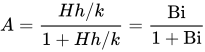
may be approximated by: where is the thickness, is the heat transfer coefficient, and is the thermal conductivity.


Perfect heat transfer
[edit]If perfect heat transfer () is assumed, the maximum heat transfer supported by the material is:[4][5]

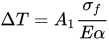
- for cold shock in plates
- for hot shock in plates


A material index for material selection according to thermal shock resistance in the fracture stress derived perfect heat transfer case is therefore:

Poor heat transfer
[edit]For cases with poor heat transfer (), the maximum heat differential supported by the material is:[4][5]


- for cold shock
- for hot shock


In the poor heat transfer case, a higher thermal conductivity is beneficial for thermal shock resistance. The material index for the poor heat transfer case is often taken as:

According to both the perfect and poor heat transfer models, larger temperature differentials can be tolerated for hot shock than for cold shock.
Fracture toughness controlled thermal shock resistance
[edit]In addition to thermal shock resistance defined by material fracture strength, models have also been defined within the fracture mechanics framework. Lu and Fleck produced criteria for thermal shock cracking based on fracture toughness controlled cracking. The models were based on thermal shock in ceramics (generally brittle materials). Assuming an infinite plate, and mode I cracking, the crack was predicted to start from the edge for cold shock, but the center of the plate for hot shock.[4] Cases were divided into perfect, and poor heat transfer to further simplify the models.
Perfect heat transfer
[edit]The sustainable temperature jump decreases, with increasing convective heat transfer (and therefore larger Biot number). This is represented in the model shown below for perfect heat transfer ().[4][5]
where is the mode I fracture toughness, is the Young's modulus, is the thermal expansion coefficient, and is half the thickness of the plate.
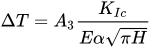

- for cold shock
- for hot shock


A material index for material selection in the fracture mechanics derived perfect heat transfer case is therefore:

Poor heat transfer
[edit]For cases with poor heat transfer, the Biot number is an important factor in the sustainable temperature jump.[4][5]
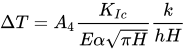
Critically, for poor heat transfer cases, materials with higher thermal conductivity, k, have higher thermal shock resistance. As a result, a commonly chosen material index for thermal shock resistance in the poor heat transfer case is:

Kingery thermal shock methods
[edit]The temperature difference to initiate fracture has been described by William David Kingery to be:[6][7] where is a shape factor, is the fracture stress, is the thermal conductivity, is the Young's modulus, is the coefficient of thermal expansion, is the heat transfer coefficient, and is a fracture resistance parameter. The fracture resistance parameter is a common metric used to define the thermal shock tolerance of materials.[1]



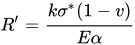
The formulas were derived for ceramic materials, and make the assumptions of a homogeneous body with material properties independent of temperature, but can be well applied to other brittle materials.[7]
Testing
[edit]Thermal shock testing exposes products to alternating low and high temperatures to accelerate failures caused by temperature cycles or thermal shocks during normal use. The transition between temperature extremes occurs very rapidly, greater than 15 °C per minute.
Equipment with single or multiple chambers is typically used to perform thermal shock testing. When using single chamber thermal shock equipment, the products remain in one chamber and the chamber air temperature is rapidly cooled and heated. Some equipment uses separate hot and cold chambers with an elevator mechanism that transports the products between two or more chambers.
Glass containers can be sensitive to sudden changes in temperature. One method of testing involves rapid movement from cold to hot water baths, and back.[8]
Examples of thermal shock failure
[edit]- Hard rocks containing ore veins such as quartzite were formerly broken down using fire-setting, which involved heating the rock face with a wood fire, then quenching with water to induce crack growth. It is described by Diodorus Siculus in Egyptian gold mines, Pliny the Elder, and Georg Agricola.[9]
- Ice cubes placed in a glass of warm water crack by thermal shock as the exterior surface increases in temperature much faster than the interior. The outer layer expands as it warms, while the interior remains largely unchanged. This rapid change in volume between different layers creates stresses in the ice that build until the force exceeds the strength of the ice, and a crack forms, sometimes with enough force to shoot ice shards out of the container.[10]
- Incandescent bulbs that have been running for a while have a very hot surface. Splashing cold water on them can cause the glass to shatter due to thermal shock, and the bulb to implode.[11]
- An antique cast iron cookstove is a simple iron box on legs, with a cast iron top. A wood or coal fire is built inside the box and food is cooked on the top outer surface of the box, like a griddle. If a fire is built too hot, and then the stove is cooled by pouring water on the top surface, it will crack due to thermal shock.
- The strong gradient of temperature (due to the dousing of a fire with water) is believed to have caused the breakage of the third Tsar Bell.[12]
- Thermal shock is a primary contributor to head gasket failure in internal combustion engines.[13]
See also
[edit]References
[edit]- ^ a b Askeland, Donald R.; Wright, Wendelin J. (January 2015). "22-4 Thermal Shock". The science and engineering of materials (Seventh ed.). Boston, MA. pp. 792–793. ISBN 978-1-305-07676-1. OCLC 903959750.
{{cite book}}: CS1 maint: location missing publisher (link) - ^ US Patent 6066585, Scott L. Swartz, "Ceramics having negative coefficient of thermal expansion, method of making such ceramics, and parts made from such ceramics", issued 2000-05-23, assigned to Emerson Electric Co.
- ^ a b Ashby, M. F. (1999). Materials selection in mechanical design (2nd ed.). Oxford, OX: Butterworth-Heinemann. ISBN 0-7506-4357-9. OCLC 49708474.
- ^ a b c d e f Soboyejo, Wole O. (2003). "12.10.2 Materials Selection for Thermal Shock Resistance". Mechanical properties of engineered materials. Marcel Dekker. ISBN 0-8247-8900-8. OCLC 300921090.
- ^ a b c d T. J. Lu; N. A. Fleck (1998). "The Thermal Shock Resistance of Solids" (PDF). Acta Materialia. 46 (13): 4755–4768. Bibcode:1998AcMat..46.4755L. doi:10.1016/S1359-6454(98)00127-X.
- ^ KINGERY, W. D. (Jan 1955). "Factors Affecting Thermal Stress Resistance of Ceramic Materials". Journal of the American Ceramic Society. 38 (1): 3–15. doi:10.1111/j.1151-2916.1955.tb14545.x. ISSN 0002-7820.
- ^ a b Soboyejo, Wole O. (2003). "12.10 Thermal Shock Response". Mechanical properties of engineered materials. Marcel Dekker. ISBN 0-8247-8900-8. OCLC 300921090.
- ^ ASTM C149 — Standard Test Method for Thermal Shock Resistance of Glass Containers
- ^ Weisgerber, Gerd; Willies, Lynn (2000). "The Use of Fire in Prehistoric and Ancient Mining : Firesetting". Paléorient. 26 (2): 131–149. ISSN 0153-9345.
- ^ King, W. D.; Fletcher, N. H. (Jan 1976). "Thermal Shock as an Ice Multiplication Mechanism. Part II. Experimental". Journal of the Atmospheric Sciences. 33 (1): 97–102. doi:10.1175/1520-0469(1976)033<0097:TSAAIM>2.0.CO;2. ISSN 0022-4928.
- ^ "Light Bulb Current-Voltage Characteristic — Collection of Experiments". physicsexperiments.eu. Archived from the original on 2024-12-01. Retrieved 2025-08-27.
First, we heat the socket of the glass bulb for several seconds using a burner. Then we immerse the bulb in cold water. The thermal shock causes the bulb to crack and separate from the socket
- ^ Lerner, Y. S.; Rao, P. N. (2013). Metalcasting Principles & Techniques (PDF).
- ^ Payton, Scott (2023-08-11). "Thermal Shock Within Coolant System and How It Affects Gaskets". MotoRad. Retrieved 2025-03-09.

Thermal shock
View on GrokipediaFundamentals
Definition and Causes
Thermal shock refers to the mechanical stresses induced in a material by rapid and nonuniform temperature changes, which can lead to cracking or fracture without any external mechanical loading. These stresses arise from transient thermal gradients that cause differential expansion or contraction within the material, particularly in brittle substances like ceramics and glass.[1][4] The primary causes of thermal shock involve sudden heating or cooling scenarios that establish steep temperature gradients. For instance, quenching a hot metal or ceramic component in cold water creates rapid cooling on the surface while the interior remains hot, leading to tensile stresses on the exterior and compressive stresses internally. Similarly, immersing a cold material in a hot fluid, such as during certain manufacturing processes, induces the opposite effect with surface compression and internal tension. These gradients drive differential thermal expansion, where regions at different temperatures expand or contract unequally, generating internal stresses that may exceed the material's strength.[1][4] At its core, thermal shock stems from the prerequisite physics of thermal expansion, quantified by the linear thermal expansion coefficient α, which measures a material's fractional change in length per unit temperature change. The resulting thermal strain ε is expressed as ε = α ΔT, where ΔT is the temperature difference; this unconstrained strain becomes problematic when the material's geometry or surroundings prevent free expansion, converting it into stress. Materials with high α, such as certain metals and glasses, are particularly susceptible.[1][5]Basic Mechanisms
Thermal shock arises from rapid temperature changes that induce internal stresses through a sequence of physical processes. Initially, exposure to a sudden temperature shift—such as quenching in a cooler fluid or sudden heating—triggers heat transfer across the material's surface via convection, conduction, or radiation, establishing nonuniform temperature distributions within the body.[6] These temperature gradients develop because the material's internal thermal conduction cannot instantaneously equalize the heat flux, leading to hotter or cooler regions expanding or contracting at different rates according to the linear thermal expansion coefficient α.[4] The differential expansion creates incompatible strains, necessitating mechanical strains to maintain geometric compatibility, which in turn generate thermal stresses: typically tensile stresses on the cooler or less-heated surfaces and compressive stresses on the opposite sides.[1] If these stresses surpass the material's tensile strength, crack initiation occurs at vulnerable sites, followed by propagation under the sustained gradient until failure.[6] The severity of temperature gradients is governed by the modes of heat transfer and the material's properties. Conduction dominates internally, transferring heat through atomic vibrations, while convection and radiation primarily affect the surface boundary conditions. The Biot number, defined as , where is the heat transfer coefficient, is the characteristic length (e.g., half-thickness for slabs), and is the thermal conductivity, quantifies the relative resistance to conduction within the material versus convection at the surface. A high Biot number (Bi > 0.1) indicates significant internal gradients and pronounced thermal shock risk, as surface temperatures change rapidly while the interior lags; conversely, low Bi values suggest nearly uniform temperatures and minimal stress.[6] Thermal stresses can be estimated from basic thermoelastic principles. For a fully constrained material under uniform temperature change ΔT, the free thermal strain is . To ensure strain compatibility in a restrained configuration, a mechanical strain counteracts it, yielding uniaxial stress , where E is Young's modulus. In three-dimensional cases, such as biaxial constraint common in thermal shock (e.g., surface layers), Poisson's effects modify this to , where ν is Poisson's ratio, accounting for lateral strain constraints.[7] This formula, derived from equilibrium and compatibility in linear elasticity, applies to the maximum surface stress in quenching scenarios.[4] Geometry significantly influences stress distribution by altering gradient profiles and constraint levels. In thin plates or films (small L), heat penetrates uniformly, minimizing differentials and stresses, as seen in low-Bi regimes. Conversely, thick blocks or cylinders exhibit steep gradients, with surface layers experiencing high tensile stresses during cooling due to restrained contraction against the warmer core, amplifying crack risks. For instance, in cylindrical vessels, radial variations lead to hoop and axial stresses that scale with wall thickness.[1]Effects on Materials
Types of Damage
Thermal shock induces several primary types of physical damage in materials, categorized by their observable outcomes. Surface cracking, often manifesting as spalling, occurs when rapid cooling or heating generates tensile stresses on the exposed surface, causing the detachment and flaking of outer layers. Bulk fracture involves the extension of cracks through the material's interior, leading to complete structural disintegration. In composite materials, delamination represents a distinct damage mode, where interfacial separation between layers arises from mismatched thermal expansions under sudden temperature gradients. Brittle responses to thermal shock are characterized by sudden snapping with little to no plastic deformation, resulting in rapid, catastrophic failure, whereas ductile responses involve gradual deformation and energy absorption prior to fracture. The progression of thermal shock damage follows distinct stages, beginning with crack initiation at stress concentration points such as surface flaws or preexisting defects, where localized tensile stresses exceed the material's strength (typically when stresses reach 50-70% of ultimate tensile strength). Cracks then propagate along planes of weakness, such as grain boundaries or interfaces, under the influence of sustained thermal gradients, with growth rates accelerating under high dT/dt. This leads to ultimate failure modes, including shattering or fragmentation, as interconnected cracks destabilize the structure. These stages stem from thermal stress mechanisms that produce differential strains during rapid heating or cooling.[1] Factors that accelerate thermal shock damage include the rate of temperature change (dT/dt), the overall temperature differential (ΔT), and environmental conditions like moisture presence, which promotes crack growth through steam pressure buildup. Elevated dT/dt intensifies transient stresses, hastening initiation and propagation, while larger ΔT amplifies the magnitude of induced strains. Moisture, in particular, facilitates explosive progression in scenarios involving vaporization, exacerbating surface and subsurface damage. Microscopically, thermal shock damage originates from the nucleation of microcracks due to localized stresses, followed by their coalescence into larger macro-fractures that compromise integrity. In ceramics, these microcracks may propagate via intergranular paths along grain boundaries, especially in coarse-grained structures with weak interphase phases, or transgranular paths cleaving through grains, as seen in fine-grained or single-crystal variants. Intergranular modes often dominate under high-temperature or slow-growth conditions, while transgranular paths prevail in rapid, cleavage-dominated failures, with coalescence driven by repeated loading or microstructural defects.Material-Specific Responses
Ceramics and glasses exhibit high sensitivity to thermal shock due to their inherent brittleness and low fracture toughness, often resulting in catastrophic fracture from rapid temperature changes that induce surface tensile stresses exceeding the material's strength. For instance, quenching hot pottery in cold water can cause instantaneous cracking as the exterior contracts faster than the interior, generating surface tensile stresses that initiate and propagate flaws from the surface, while the interior experiences compression. This vulnerability is exacerbated by their relatively low thermal conductivity, which promotes steep temperature gradients.[2] Metals and alloys generally demonstrate greater resilience to thermal shock compared to ceramics, owing to their higher ductility and ability to accommodate stresses through plastic deformation rather than immediate cracking. However, rapid cooling can still induce warping or residual stresses. In applications like turbine blades, repeated thermal cycling may lead to fatigue, but the high thermal conductivity of metals helps mitigate severe gradients.[2] Polymers and composites suffer from thermal shock primarily due to their low thermal conductivity, which creates significant internal temperature gradients and differential expansion between matrix and reinforcements. This often results in matrix cracking or delamination, especially in fiber-reinforced polymer composites where interfacial stresses cause debonding between fibers and matrix. For example, exposure to sudden heat can warp thin polymer sheets, while cryogenic shocks may embrittle the material, reducing its impact resistance.[8] While the focus remains on engineered materials, biological tissues illustrate thermal shock effects through phenomena like frostbite, where rapid freezing forms ice crystals that mechanically disrupt cell membranes and cause vascular damage.[9]| Material Class | Thermal Expansion Coefficient (α, ×10⁻⁶ K⁻¹) | Thermal Conductivity (k, W/m·K) | Typical Failure ΔT (°C) |
|---|---|---|---|
| Ceramics | 5–10 | 1–5 | 100–200 |
| Metals | 10–20 | 20–400 | >500 |
| Polymers | 50–100 | 0.1–0.5 | 50–100 |