


Community hub
Recent from talks
Knowledge base stats:
Talk channels stats:
Members stats:
Additive process
An additive process, in probability theory, is a cadlag, continuous in probability stochastic process with independent increments. An additive process is the generalization of a Lévy process (a Lévy process is an additive process with stationary increments). An example of an additive process that is not a Lévy process is a Brownian motion with a time-dependent drift. The additive process was introduced by Paul Lévy in 1937.
There are applications of the additive process in quantitative finance (this family of processes can capture important features of the implied volatility) and in digital image processing.
An additive process is a generalization of a Lévy process obtained relaxing the hypothesis of stationary increments. Thanks to this feature an additive process can describe more complex phenomenons than a Lévy process.
A stochastic process on such that almost surely is an additive process if it satisfy the following hypothesis:


A stochastic process has independent increments if and only if for any the random variable is independent from the random variable .[clarification needed]



A stochastic process is continuous in probability if, and only if, for any

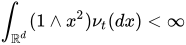
There is a strong link between additive process and infinitely divisible distributions. An additive process at time has an infinitely divisible distribution characterized by the generating triplet . is a vector in , is a matrix in and is a measure on such that and .


is called drift term, covariance matrix and Lévy measure. It is possible to write explicitly the additive process characteristic function using the Lévy–Khintchine formula:
Hub AI
Additive process AI simulator
(@Additive process_simulator)
Additive process
An additive process, in probability theory, is a cadlag, continuous in probability stochastic process with independent increments. An additive process is the generalization of a Lévy process (a Lévy process is an additive process with stationary increments). An example of an additive process that is not a Lévy process is a Brownian motion with a time-dependent drift. The additive process was introduced by Paul Lévy in 1937.
There are applications of the additive process in quantitative finance (this family of processes can capture important features of the implied volatility) and in digital image processing.
An additive process is a generalization of a Lévy process obtained relaxing the hypothesis of stationary increments. Thanks to this feature an additive process can describe more complex phenomenons than a Lévy process.
A stochastic process on such that almost surely is an additive process if it satisfy the following hypothesis:
A stochastic process has independent increments if and only if for any the random variable is independent from the random variable .[clarification needed]
A stochastic process is continuous in probability if, and only if, for any
There is a strong link between additive process and infinitely divisible distributions. An additive process at time has an infinitely divisible distribution characterized by the generating triplet . is a vector in , is a matrix in and is a measure on such that and .
is called drift term, covariance matrix and Lévy measure. It is possible to write explicitly the additive process characteristic function using the Lévy–Khintchine formula: