
Recent from talks
Buoyancy compensator (diving)
Knowledge base stats:
Talk channels stats:
Members stats:
Buoyancy compensator (diving)
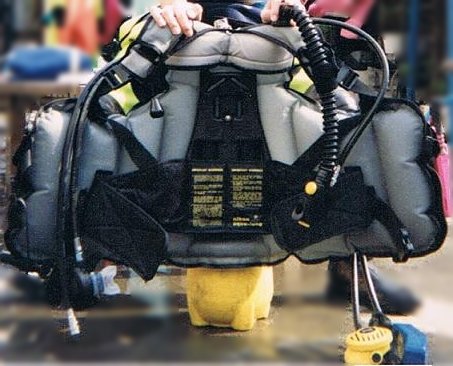
A buoyancy compensator (BC), also called a buoyancy control device (BCD), stabilizer, stabilisor, stab jacket, wing or adjustable buoyancy life jacket (ABLJ), depending on design, is a type of diving equipment which is worn by divers to establish neutral buoyancy underwater and positive buoyancy at the surface, when needed.
The buoyancy is usually controlled by adjusting the volume of gas in an inflatable bladder, which is filled with ambient pressure gas from the diver's primary breathing gas cylinder via a low-pressure hose from the regulator first stage, directly from a small cylinder dedicated to this purpose, or from the diver's mouth through the oral inflation valve. Ambient pressure bladder buoyancy compensators can be broadly classified as having the buoyancy primarily in front, surrounding the torso, or behind the diver. This affects the ergonomics, and to a lesser degree, the safety of the unit. They can also be broadly classified as having the buoyancy bladder as an integral part of the construction, or as a replaceable component supported inside the structural body.
The buoyancy compensator requires a significant amount of skill and attention to operate, because control is entirely manual, adjustment is required throughout the dive as weight reduces due to gas consumption, and buoyancy of the diving suit and BC generally varies with depth. Fine buoyancy adjustment can be done by breath control on open circuit, reducing the amount of actual BC volume adjustment needed, and a skilled diver will develop the ability to adjust volume to maintain neutral buoyancy while remaining aware of the surroundings and performing other tasks. The buoyancy compensator is both an important safety device when used correctly and a significant hazard when misused or malfunctioning.
The ability to control trim effectively is dependent on both appropriate buoyancy distribution and ballast weight distribution. This too is a skill acquired by practice, and is facilitated by minimising the required BC gas volume by correct weighting.
The buoyancy compensator is used by ambient pressure divers using underwater breathing apparatus to adjust buoyancy underwater or at the surface within the range of slightly negative to slightly positive, to allow neutral buoyancy to be maintained throughout the depth range of the planned dive, and to compensate for changes in weight due to breathing gas consumption during the dive. Where staged cylinders are used, it may also be used to compensate for weight changes when dropping and retrieving these cylinders. Variations in the buoyancy of wetsuits depend on the volume and density of the suit and the ambient pressure, but for thick suits at depth it can be in the order of 10 kg. Variations in the buoyancy of dry suits should be compensated by maintaining a constant volume of gas inside the suit, by manual addition and a combination of automatic and manual dumping, independently of the adjustments to the buoyancy compensator made to compensate for gas usage.
The buoyancy compensator is a standard item of scuba diving equipment, though not always necessary, and an optional item for surface-supplied diving, where neutral or positive buoyancy may not be necessary or desirable. Breathhold divers do not have a gas supply to operate a buoyancy compensator, so they cannot use them, though they may wear an inflatable vest lifejacket for positive buoyancy at the surface. Atmospheric pressure diving suits may use a trim tank similar to that on a submarine for small adjustments, but can be ballasted to be almost precisely neutral, and are virtually incompressible within their designed operating range.
Accurate and reliable depth control is necessary for safe decompression. The surface-supplied diver has the option to use the umbilical for depth control with the assistance of the line tender, and a tethered scuba diver can use the lifeline in the same way. Similarly, any diver using a shotline or jackstay to navigate between the surface and the work site can use it for depth control, making a buoyancy compensator non-essential provided the diver can find the shotline when needed.
In most recreational and professional scuba, neutral buoyancy during most of the dive is necessary or desirable, as it gives the diver enhanced mobility and maneuverability, and allows the diver to avoid contact with delicate benthic organisms, and to fin without disturbing sediment which can rapidly reduce visibility. For this function a buoyancy compensator is necessary.
Hub AI
Buoyancy compensator (diving) AI simulator
(@Buoyancy compensator (diving)_simulator)
Buoyancy compensator (diving)
A buoyancy compensator (BC), also called a buoyancy control device (BCD), stabilizer, stabilisor, stab jacket, wing or adjustable buoyancy life jacket (ABLJ), depending on design, is a type of diving equipment which is worn by divers to establish neutral buoyancy underwater and positive buoyancy at the surface, when needed.
The buoyancy is usually controlled by adjusting the volume of gas in an inflatable bladder, which is filled with ambient pressure gas from the diver's primary breathing gas cylinder via a low-pressure hose from the regulator first stage, directly from a small cylinder dedicated to this purpose, or from the diver's mouth through the oral inflation valve. Ambient pressure bladder buoyancy compensators can be broadly classified as having the buoyancy primarily in front, surrounding the torso, or behind the diver. This affects the ergonomics, and to a lesser degree, the safety of the unit. They can also be broadly classified as having the buoyancy bladder as an integral part of the construction, or as a replaceable component supported inside the structural body.
The buoyancy compensator requires a significant amount of skill and attention to operate, because control is entirely manual, adjustment is required throughout the dive as weight reduces due to gas consumption, and buoyancy of the diving suit and BC generally varies with depth. Fine buoyancy adjustment can be done by breath control on open circuit, reducing the amount of actual BC volume adjustment needed, and a skilled diver will develop the ability to adjust volume to maintain neutral buoyancy while remaining aware of the surroundings and performing other tasks. The buoyancy compensator is both an important safety device when used correctly and a significant hazard when misused or malfunctioning.
The ability to control trim effectively is dependent on both appropriate buoyancy distribution and ballast weight distribution. This too is a skill acquired by practice, and is facilitated by minimising the required BC gas volume by correct weighting.
The buoyancy compensator is used by ambient pressure divers using underwater breathing apparatus to adjust buoyancy underwater or at the surface within the range of slightly negative to slightly positive, to allow neutral buoyancy to be maintained throughout the depth range of the planned dive, and to compensate for changes in weight due to breathing gas consumption during the dive. Where staged cylinders are used, it may also be used to compensate for weight changes when dropping and retrieving these cylinders. Variations in the buoyancy of wetsuits depend on the volume and density of the suit and the ambient pressure, but for thick suits at depth it can be in the order of 10 kg. Variations in the buoyancy of dry suits should be compensated by maintaining a constant volume of gas inside the suit, by manual addition and a combination of automatic and manual dumping, independently of the adjustments to the buoyancy compensator made to compensate for gas usage.
The buoyancy compensator is a standard item of scuba diving equipment, though not always necessary, and an optional item for surface-supplied diving, where neutral or positive buoyancy may not be necessary or desirable. Breathhold divers do not have a gas supply to operate a buoyancy compensator, so they cannot use them, though they may wear an inflatable vest lifejacket for positive buoyancy at the surface. Atmospheric pressure diving suits may use a trim tank similar to that on a submarine for small adjustments, but can be ballasted to be almost precisely neutral, and are virtually incompressible within their designed operating range.
Accurate and reliable depth control is necessary for safe decompression. The surface-supplied diver has the option to use the umbilical for depth control with the assistance of the line tender, and a tethered scuba diver can use the lifeline in the same way. Similarly, any diver using a shotline or jackstay to navigate between the surface and the work site can use it for depth control, making a buoyancy compensator non-essential provided the diver can find the shotline when needed.
In most recreational and professional scuba, neutral buoyancy during most of the dive is necessary or desirable, as it gives the diver enhanced mobility and maneuverability, and allows the diver to avoid contact with delicate benthic organisms, and to fin without disturbing sediment which can rapidly reduce visibility. For this function a buoyancy compensator is necessary.
Recent media