
Recent from talks
Advanced Precision Kill Weapon System
Knowledge base stats:
Talk channels stats:
Members stats:
Advanced Precision Kill Weapon System
The AGR-20 Advanced Precision Kill Weapon System (APKWS) is a design conversion of Hydra 70 unguided rockets with a laser guidance kit to turn them into precision-guided munitions (PGMs). APKWS is approximately one-third the cost and one-third the weight of the current[when?] inventory of laser-guided weapons, has a lower yield more suitable for avoiding collateral damage, and takes one quarter of the time for ordnance personnel to load and unload.
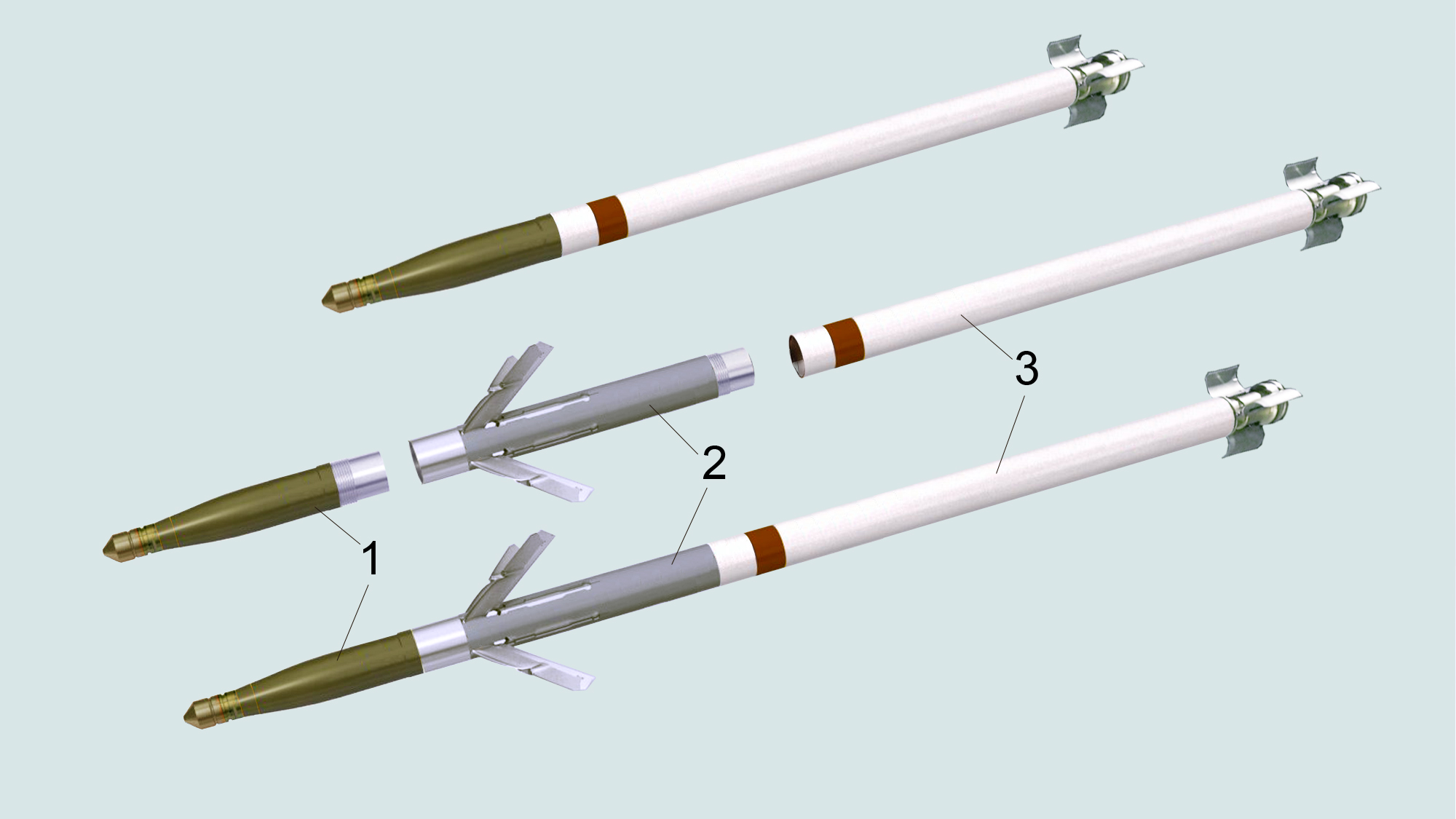
Where possible the system utilizes existing Hydra 70 components such as launchers, rocket motors, warheads and fuzes. The weapon bridges the gap between the Hydra 70 and AGM-114 Hellfire systems and provides a cost-effective method of engaging lightly armored point targets. APKWS is the U.S. government's only Program of Record for the semi-active, laser-guided 2.75 inches (70 mm) rocket.
It converts the Hydra 70 unguided rocket into a precision guided munition through the addition of a mid-body guidance unit developed by BAE Systems. The APKWS has also been successfully tested in live fire exercises with the Forges de Zeebrugge unguided rocket, converting it into a precision guided munition and demonstrating the technology can be used on other rocket types than the Hydra 70.
The winning bidder for the APKWS contract was the team of BAE Systems, Northrop Grumman and General Dynamics, beating the offerings from Lockheed Martin and Raytheon Systems.
The APKWS uses the Distributed Aperture Semi-Active Laser Seeker (DASALS) technology. This system allows a laser seeker to be located in the leading edge of each of the forward control canards, working in unison as if they were a single seeker. This configuration allows existing warheads from the Hydra 70 system to be used without the need for a laser seeker in the missile nose.
The APKWS system is composed of the launch platform, rockets equipped with the WGU-59/B mid-body guidance unit, the lengthened 7-tube LAU-68 F/A rocket launcher, the SCS 7 aiming cue (not needed for attack helicopters), and Fastpack PA-140 and CNU-711/E storage kits for rockets and guidance kits, respectively, to ensure they are safe in the field. The WGU-59/B mid-body guidance unit is equipped with DASALS seeker optics which deploy 0.5 seconds after launch. They are attached in between the Mk 66 Mod 4 rocket motor and a warhead and fuze, which increases length by 18.5 in (47 cm) and weight by 9 lb (4.1 kg) over the legacy Hydra system.
The firing range is 1,100–5,000 meters; at the minimum range, the target can be struck less than 5 seconds after launch. Maximum range is constrained by use of the existing Hydra 70 motor, but since the seeker can see as far as 14 km (8.7 mi), a more powerful motor could extend range while retaining accuracy. Nammo is working on a modified rocket motor that can extend range to 12–15 km (7.5–9.3 mi).
A software upgrade of the APKWS was planned for late 2021; the upgrade increases range by 30% by means of an optimized flight trajectory to engage targets at a steeper angle of attack, while also being qualified on both fixed- and rotary-wing aircraft in a single variant and improving the surface danger zone logic for better training range options.
Hub AI
Advanced Precision Kill Weapon System AI simulator
(@Advanced Precision Kill Weapon System_simulator)
Advanced Precision Kill Weapon System
The AGR-20 Advanced Precision Kill Weapon System (APKWS) is a design conversion of Hydra 70 unguided rockets with a laser guidance kit to turn them into precision-guided munitions (PGMs). APKWS is approximately one-third the cost and one-third the weight of the current[when?] inventory of laser-guided weapons, has a lower yield more suitable for avoiding collateral damage, and takes one quarter of the time for ordnance personnel to load and unload.
Where possible the system utilizes existing Hydra 70 components such as launchers, rocket motors, warheads and fuzes. The weapon bridges the gap between the Hydra 70 and AGM-114 Hellfire systems and provides a cost-effective method of engaging lightly armored point targets. APKWS is the U.S. government's only Program of Record for the semi-active, laser-guided 2.75 inches (70 mm) rocket.
It converts the Hydra 70 unguided rocket into a precision guided munition through the addition of a mid-body guidance unit developed by BAE Systems. The APKWS has also been successfully tested in live fire exercises with the Forges de Zeebrugge unguided rocket, converting it into a precision guided munition and demonstrating the technology can be used on other rocket types than the Hydra 70.
The winning bidder for the APKWS contract was the team of BAE Systems, Northrop Grumman and General Dynamics, beating the offerings from Lockheed Martin and Raytheon Systems.
The APKWS uses the Distributed Aperture Semi-Active Laser Seeker (DASALS) technology. This system allows a laser seeker to be located in the leading edge of each of the forward control canards, working in unison as if they were a single seeker. This configuration allows existing warheads from the Hydra 70 system to be used without the need for a laser seeker in the missile nose.
The APKWS system is composed of the launch platform, rockets equipped with the WGU-59/B mid-body guidance unit, the lengthened 7-tube LAU-68 F/A rocket launcher, the SCS 7 aiming cue (not needed for attack helicopters), and Fastpack PA-140 and CNU-711/E storage kits for rockets and guidance kits, respectively, to ensure they are safe in the field. The WGU-59/B mid-body guidance unit is equipped with DASALS seeker optics which deploy 0.5 seconds after launch. They are attached in between the Mk 66 Mod 4 rocket motor and a warhead and fuze, which increases length by 18.5 in (47 cm) and weight by 9 lb (4.1 kg) over the legacy Hydra system.
The firing range is 1,100–5,000 meters; at the minimum range, the target can be struck less than 5 seconds after launch. Maximum range is constrained by use of the existing Hydra 70 motor, but since the seeker can see as far as 14 km (8.7 mi), a more powerful motor could extend range while retaining accuracy. Nammo is working on a modified rocket motor that can extend range to 12–15 km (7.5–9.3 mi).
A software upgrade of the APKWS was planned for late 2021; the upgrade increases range by 30% by means of an optimized flight trajectory to engage targets at a steeper angle of attack, while also being qualified on both fixed- and rotary-wing aircraft in a single variant and improving the surface danger zone logic for better training range options.
Recent media