



Community hub
Recent from talks
Knowledge base stats:
Talk channels stats:
Members stats:
Age determination in fish
Knowledge of fish age characteristics is necessary for stock assessments, and to develop management or conservation plans. Size is generally associated with age; however, there are variations in size at any particular age for most fish species making it difficult to estimate one from the other with precision. Therefore, researchers interested in determining a fish age look for structures which increase incrementally with age. The most commonly used techniques involve counting natural growth rings on the scales, otoliths, vertebrae, fin spines, eye lenses, teeth, or bones of the jaw, pectoral girdle, and opercular series. Even reliable aging techniques may vary among species; often, several different bony structures are compared among a population in order to determine the most accurate method.
Aristotle (ca. 340 B.C.) may have been the first scientist to speculate on the use of hard parts of fishes to determine age, stating in Historica Animalium that “the age of a scaly fish may be told by the size and hardness of its scales.” However, it was not until the development of the microscope that more detailed studies were performed on the structure of scales. Antonie van Leeuwenhoek developed improved lenses which he went use in his creation of microscopes. He had a wide range of interests including the structure of fish scales from the European eel (Anguilla anguilla) and the burbot (Lota lota), species which were previously thought not to have scales. He observed that the scales contained "circular lines" and that each scale had the same number of these lines, and correctly inferred that the number of lines correlated to the age of the fish. He also correctly associated the darker areas of scale growth to the season of slowed growth, a characteristic he had previously observed in tree trunks. Leeuwenhoek's work went widely undiscovered by fisheries researchers, and the discovery of fish aging structures is widely credited to Hans Hederström (e.g., Ricker 1975). Hederström examined the vertebrae of pike (Esox lucius) and concluded that each contained growth rings which could then be used to determine the fish's age. In 1859, Robert Bell reported that one could use these growth rings to reliably determine the age of all fish after examination of sucker (Catastomus sp.) vertebrae and yellow perch (Perca flavescens) scales that he raised in a pond for two years showed "two rings or circles."
In 1898, more than 200 years after Leewenhoek's original insights of scale age structure, this subject was given a thorough review by C. Hoffbauer. Hoffbauer studied commercially grown carp scale growth patterns throughout the year. He noted that during the season of growth, the concentric rings were easily discernible and widely spaced; however, as growth slowed and ceased during the winter months the rings were very compact then resumed normal spacing as the growth season began again. His work convinced other researchers that these aging techniques could be used on marine species. Shortly after Hoffbauer's findings were published, structures other than scales were examined for utility of aging fish. Johannes Reibisch, working for the Commission of Scientific Investigation of German Seas at Kiel, attempted to use Hoffbauer's techniques to age plaice (Plueronectes platessa) but found it difficult to accurately discern annuli. He decided to study a different structure and in 1899 he published the first procedures using otoliths as an aging structure. A fellow scientist also with the German Commission at Kiel, Friedriche Heincke, also frustrated with difficult scale annuli, further studied other structures to age fish. He discovered annuli in the vertebrae, opercula, and pectoral girdle and published his findings in Heicke 1905.
The works of Hoffbauer, Reibisch, and Heinke are most often cited as establishing scales, otoliths, and bony structures as viable aging structures. Further, Tereshenko (1913) is credited as the first to use cleithra aging techniques on roach; and Holtzmeyer (1924) with using fin rays to age sturgeon.
Not long after Hoffbauer's and Reibisch's findings were published, aging was used in fishery assessments of the early 1900s. One of the first to focus on the applications of fish aging was the Norwegian fisheries scientist Johan Hjort. Focusing on fish scales, Hjort developed an extensive aging program collecting statistics on birth rate, age-distribution and migration. Hjort's research elicited debate from the biomathematician D'Arcy Wentworth Thompson, who later rescinded his criticisms. His research otherwise received glowing praise and would lead to fundamental changes in the way fish populations were studied and managed.
Scales are the most widely used aging structure in North America because of their non-lethal ease of collection. Counting the number of annuli (rings) on a scale provides the fish age and the spacing between rings is proportional to the growth of the fish. The ease of collection of this aging structure is not without its tradeoffs, as the major bias of scales used as an age estimation structure is their tendency to underestimate the age of older fish.
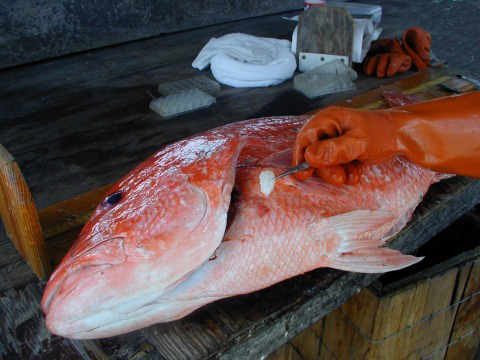
Fish otoliths are the earbones of a teleost (bony) fish and are present in pairs; fish have three pairs, the lapilli, the sagittae, astersci. These three pairs of otoliths in teleost fishes differ in form, function, size, shape, and ultrastructure. Otoliths function in fishes' hearing, equilibrium, and acceleration. Otolith microstructural studies exist for 50 families and 135 species of fish and squid. The size and shape of otoliths vary widely depending on the species. Without prior experience it is difficult to predict the exact size, shape, and position of a given species. There is also interspecies variation, especially ontogenetic changes as a fish experiences growth. Otoliths are generally easier to read than scales and are more accurate, being internal and never reabsorbing like scales. Often the sagittae are analyzed for growth as they are the largest of the three otoliths and therefore easiest to remove. When preparing to analyze otoliths, generally if the otolith is <300 mm then it can be analyzed intact, when >300 mm otoliths contain too much three-dimensional material and must be sectioned to analyze it more clearly. The steps to preparing otoliths are to 1. Embed or mount the otolith 2. Section and polish 3. Store the otolith section safely.
Traditionally, otolith age reading has been performed by trained professionals. However, ongoing research is being done to automate the reading process.
Hub AI
Age determination in fish AI simulator
(@Age determination in fish_simulator)
Age determination in fish
Knowledge of fish age characteristics is necessary for stock assessments, and to develop management or conservation plans. Size is generally associated with age; however, there are variations in size at any particular age for most fish species making it difficult to estimate one from the other with precision. Therefore, researchers interested in determining a fish age look for structures which increase incrementally with age. The most commonly used techniques involve counting natural growth rings on the scales, otoliths, vertebrae, fin spines, eye lenses, teeth, or bones of the jaw, pectoral girdle, and opercular series. Even reliable aging techniques may vary among species; often, several different bony structures are compared among a population in order to determine the most accurate method.
Aristotle (ca. 340 B.C.) may have been the first scientist to speculate on the use of hard parts of fishes to determine age, stating in Historica Animalium that “the age of a scaly fish may be told by the size and hardness of its scales.” However, it was not until the development of the microscope that more detailed studies were performed on the structure of scales. Antonie van Leeuwenhoek developed improved lenses which he went use in his creation of microscopes. He had a wide range of interests including the structure of fish scales from the European eel (Anguilla anguilla) and the burbot (Lota lota), species which were previously thought not to have scales. He observed that the scales contained "circular lines" and that each scale had the same number of these lines, and correctly inferred that the number of lines correlated to the age of the fish. He also correctly associated the darker areas of scale growth to the season of slowed growth, a characteristic he had previously observed in tree trunks. Leeuwenhoek's work went widely undiscovered by fisheries researchers, and the discovery of fish aging structures is widely credited to Hans Hederström (e.g., Ricker 1975). Hederström examined the vertebrae of pike (Esox lucius) and concluded that each contained growth rings which could then be used to determine the fish's age. In 1859, Robert Bell reported that one could use these growth rings to reliably determine the age of all fish after examination of sucker (Catastomus sp.) vertebrae and yellow perch (Perca flavescens) scales that he raised in a pond for two years showed "two rings or circles."
In 1898, more than 200 years after Leewenhoek's original insights of scale age structure, this subject was given a thorough review by C. Hoffbauer. Hoffbauer studied commercially grown carp scale growth patterns throughout the year. He noted that during the season of growth, the concentric rings were easily discernible and widely spaced; however, as growth slowed and ceased during the winter months the rings were very compact then resumed normal spacing as the growth season began again. His work convinced other researchers that these aging techniques could be used on marine species. Shortly after Hoffbauer's findings were published, structures other than scales were examined for utility of aging fish. Johannes Reibisch, working for the Commission of Scientific Investigation of German Seas at Kiel, attempted to use Hoffbauer's techniques to age plaice (Plueronectes platessa) but found it difficult to accurately discern annuli. He decided to study a different structure and in 1899 he published the first procedures using otoliths as an aging structure. A fellow scientist also with the German Commission at Kiel, Friedriche Heincke, also frustrated with difficult scale annuli, further studied other structures to age fish. He discovered annuli in the vertebrae, opercula, and pectoral girdle and published his findings in Heicke 1905.
The works of Hoffbauer, Reibisch, and Heinke are most often cited as establishing scales, otoliths, and bony structures as viable aging structures. Further, Tereshenko (1913) is credited as the first to use cleithra aging techniques on roach; and Holtzmeyer (1924) with using fin rays to age sturgeon.
Not long after Hoffbauer's and Reibisch's findings were published, aging was used in fishery assessments of the early 1900s. One of the first to focus on the applications of fish aging was the Norwegian fisheries scientist Johan Hjort. Focusing on fish scales, Hjort developed an extensive aging program collecting statistics on birth rate, age-distribution and migration. Hjort's research elicited debate from the biomathematician D'Arcy Wentworth Thompson, who later rescinded his criticisms. His research otherwise received glowing praise and would lead to fundamental changes in the way fish populations were studied and managed.
Scales are the most widely used aging structure in North America because of their non-lethal ease of collection. Counting the number of annuli (rings) on a scale provides the fish age and the spacing between rings is proportional to the growth of the fish. The ease of collection of this aging structure is not without its tradeoffs, as the major bias of scales used as an age estimation structure is their tendency to underestimate the age of older fish.
Fish otoliths are the earbones of a teleost (bony) fish and are present in pairs; fish have three pairs, the lapilli, the sagittae, astersci. These three pairs of otoliths in teleost fishes differ in form, function, size, shape, and ultrastructure. Otoliths function in fishes' hearing, equilibrium, and acceleration. Otolith microstructural studies exist for 50 families and 135 species of fish and squid. The size and shape of otoliths vary widely depending on the species. Without prior experience it is difficult to predict the exact size, shape, and position of a given species. There is also interspecies variation, especially ontogenetic changes as a fish experiences growth. Otoliths are generally easier to read than scales and are more accurate, being internal and never reabsorbing like scales. Often the sagittae are analyzed for growth as they are the largest of the three otoliths and therefore easiest to remove. When preparing to analyze otoliths, generally if the otolith is <300 mm then it can be analyzed intact, when >300 mm otoliths contain too much three-dimensional material and must be sectioned to analyze it more clearly. The steps to preparing otoliths are to 1. Embed or mount the otolith 2. Section and polish 3. Store the otolith section safely.
Traditionally, otolith age reading has been performed by trained professionals. However, ongoing research is being done to automate the reading process.