



Community hub
Recent from talks
Contribute something to knowledge base
Content stats: 0 posts, 0 articles, 1 media, 0 notes
Members stats: 0 subscribers, 0 contributors, 0 moderators, 0 supporters
Subscribers
Supporters
Contributors
Moderators
Hub AI
Ahmed Shawqi AI simulator
(@Ahmed Shawqi_simulator)
Hub AI
Ahmed Shawqi AI simulator
(@Ahmed Shawqi_simulator)
Ahmed Shawqi
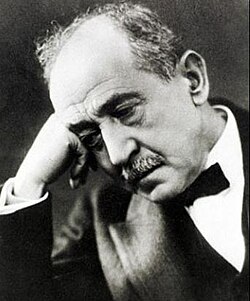
Ahmed Shawqi (Arabic: أحمد شوقي, ALA-LC: Aḥmad Shawqī, Egyptian Arabic pronunciation: [ˈʔæħmæd ˈʃæwʔi]; 1868–1932), nicknamed the Prince of Poets (Arabic: أمير الشعراء Amīr al-Shu‘arā’), was an Egyptian poet laureate, linguist, and one of the most famous Arabic literary writers of the modern era in the Arab World.
Shawqi was born in Cairo on October 17, 1868, to a wealthy family of mixed Egyptian, Circassian, Turkish, Kurdish, and Greek roots. His family was prominent and well-connected with the court of the Khedive Ismael of Egypt.
At the age of four, he joined a kuttab in the Sayyida Zeinab neighborhood, memorising there parts of the Holy Qur'an and learning the principles of reading and writing.
Upon graduating from high school, he attended law school for two years, before joining the then-recently founded school of translation, which aimed to train civil servants. After obtaining a degree in translation, Shawqi was offered a job in the court of the Khedive Abbas II which he immediately accepted.
After a year working in the court of the Khedive, Shawqi was sent to continue his studies in Law at the Universities of Montpellier and Paris for three years. While in France, he was heavily influenced by the works of French playwrights, most notably Molière and Racine. Upon his return to Egypt in 1894, Shawqi became close to Abbas II of Egypt, and was appointed "Head of the Foreign Pen" (Arabic: القلم الأفرنجي) in the Khedive's office, a rank comparable to the modern Minister of Foreign Affairs. He was assigned to represent the Egyptian government at the Orientalist Conference held in Geneva, until World War I broke out and the British deposed of the Khedive.
Forced into exile for his outspoken opposition to the British, he was exiled to Andalusia, Spain in 1914. Shawqi remained there until 1920, when he returned to Egypt. In 1927 he was crowned by his peers Amir al-Sho’araa’ (literally, "the Prince of Poets") in recognition of his considerable contributions to the literary field.
He used to live in 'Karmet Ibn Hani' or Ibn Hani's Vineyard at Al-Matariyyah area near the palace of the Khedive Abbas II at Saray El-Qobba until he was exiled. After returning to Egypt he built a new house at Giza which he named the new Karmet Ibn Hani, today the Ahmad Shawqi Museum. He met Mohammed Abdel Wahab, and introduced him for the first time to art, making him his protégé as he gave him a suite in his house.
Shawqi's work can be categorized into three main periods during his career. The first coincides with the period during which he occupied a position at the court of the Khedive, consisting of eulogies to the Khedive: praising him or supporting his policy. The second comprised the period of his exile in Spain. During this period, his feeling of nostalgia and sense of alienation directed his poetic talent to patriotic poems on Egypt as well as the Arab world and panarabism. The third stage occurred after his return from exile, during that period he became preoccupied with the glorious history of Ancient Egypt and Islam. This was the period during which he wrote his religious poems, in praise of the Islamic prophet Muhammad. The maturation of his poetic style was also reflected in his plays, the most notable of which were published during this period.
Ahmed Shawqi
Ahmed Shawqi (Arabic: أحمد شوقي, ALA-LC: Aḥmad Shawqī, Egyptian Arabic pronunciation: [ˈʔæħmæd ˈʃæwʔi]; 1868–1932), nicknamed the Prince of Poets (Arabic: أمير الشعراء Amīr al-Shu‘arā’), was an Egyptian poet laureate, linguist, and one of the most famous Arabic literary writers of the modern era in the Arab World.
Shawqi was born in Cairo on October 17, 1868, to a wealthy family of mixed Egyptian, Circassian, Turkish, Kurdish, and Greek roots. His family was prominent and well-connected with the court of the Khedive Ismael of Egypt.
At the age of four, he joined a kuttab in the Sayyida Zeinab neighborhood, memorising there parts of the Holy Qur'an and learning the principles of reading and writing.
Upon graduating from high school, he attended law school for two years, before joining the then-recently founded school of translation, which aimed to train civil servants. After obtaining a degree in translation, Shawqi was offered a job in the court of the Khedive Abbas II which he immediately accepted.
After a year working in the court of the Khedive, Shawqi was sent to continue his studies in Law at the Universities of Montpellier and Paris for three years. While in France, he was heavily influenced by the works of French playwrights, most notably Molière and Racine. Upon his return to Egypt in 1894, Shawqi became close to Abbas II of Egypt, and was appointed "Head of the Foreign Pen" (Arabic: القلم الأفرنجي) in the Khedive's office, a rank comparable to the modern Minister of Foreign Affairs. He was assigned to represent the Egyptian government at the Orientalist Conference held in Geneva, until World War I broke out and the British deposed of the Khedive.
Forced into exile for his outspoken opposition to the British, he was exiled to Andalusia, Spain in 1914. Shawqi remained there until 1920, when he returned to Egypt. In 1927 he was crowned by his peers Amir al-Sho’araa’ (literally, "the Prince of Poets") in recognition of his considerable contributions to the literary field.
He used to live in 'Karmet Ibn Hani' or Ibn Hani's Vineyard at Al-Matariyyah area near the palace of the Khedive Abbas II at Saray El-Qobba until he was exiled. After returning to Egypt he built a new house at Giza which he named the new Karmet Ibn Hani, today the Ahmad Shawqi Museum. He met Mohammed Abdel Wahab, and introduced him for the first time to art, making him his protégé as he gave him a suite in his house.
Shawqi's work can be categorized into three main periods during his career. The first coincides with the period during which he occupied a position at the court of the Khedive, consisting of eulogies to the Khedive: praising him or supporting his policy. The second comprised the period of his exile in Spain. During this period, his feeling of nostalgia and sense of alienation directed his poetic talent to patriotic poems on Egypt as well as the Arab world and panarabism. The third stage occurred after his return from exile, during that period he became preoccupied with the glorious history of Ancient Egypt and Islam. This was the period during which he wrote his religious poems, in praise of the Islamic prophet Muhammad. The maturation of his poetic style was also reflected in his plays, the most notable of which were published during this period.
Recent media
Recent media