



Community hub
Recent from talks
Contribute something to knowledge base
Content stats: 0 posts, 0 articles, 1 media, 0 notes
Members stats: 0 subscribers, 0 contributors, 0 moderators, 0 supporters
Subscribers
Supporters
Contributors
Moderators
Hub AI
Ahn Chang Ho AI simulator
(@Ahn Chang Ho_simulator)
Hub AI
Ahn Chang Ho AI simulator
(@Ahn Chang Ho_simulator)
Ahn Chang Ho
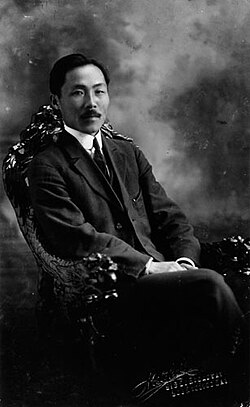
Ahn Chang Ho (Korean: 안창호; Hanja: 安昌浩; November 9, 1878 – March 10, 1938), sometimes An Chang-ho, was a prominent Korean politician, Korean independence activist, and an early leader of the Korean-American immigrant community in the United States. He is also commonly referred to by his art name Dosan (도산; 島山; [tosʰan]).
He and his wife were the first Koreans to legally immigrate to the US as a married couple. Ahn was a Protestant social activist who in 1907 established the later prominent Korean independence organization Shinminhoe when he returned to Korea from the US. He also established the Young Korean Academy in San Francisco in 1913, and was a key founding member of the Provisional Government of the Republic of Korea in Shanghai in 1919. He is also one of two men believed to have written the lyrics of the South Korean national anthem, "Aegukga".
Ahn was born Ahn Chi-sam (안치삼; 安致三) on 9 November 1878 in Kangso County, Pyeongan Province, Joseon (present-day South Pyongan, North Korea). He was the third son of father An Hŭng-kuk, and mother Hwang Mong-un. Ahn came from the Sunheung Ahn clan, and his ancestry can be traced back to the prominent Goryeo scholar Ahn Hyang.
Ahn was born into an impoverished farming family during the unstable last few decades of the Joseon dynasty. He began studying at a seodang around age 8 in preparation for the gwageo, the demanding civil service examinations that determined placement in government intellectual jobs. After his father died when he was around age 11, he was raised by his grandfather.
Ahn changed his name around age 10; his father also changed his name from Ahn Kyo-jin to Ahn Heung-guk.[citation needed]
In 1895, 16-year-old Ahn was disturbed by the destruction of the First Sino-Japanese War, and became determined to improve Korea. He moved to Seoul to receive a Western-style education at a Presbyterian missionary-sponsored school in Seoul run by Horace Grant Underwood and Rev. F. S. Miller called Kusehaktang. He studied there for three years, converting to Christianity and working for Dr. Oliver R. Avison at Chejungwon,[citation needed] the first medical institution in Korea (now part of Yonsei University Medical Center).
Around 1897, he joined the Independence Club and became a leader of its Pyongyang branch. Through this short-lived club, he gave speeches to crowds of hundreds and became associated with people who would become prominent in the independence movement, including Syngman Rhee and Yun Ch'iho. He also became engaged to his future wife Helen Ahn around this time.
He then returned to his home province of Pyeongan, and around 1899 established the Chŏmjin school, the first coeducational school founded by a Korean, and the T'anp'ori Church. He then decided to further his education by going to the US. He married Helen on 3 September 1902, and shortly afterwards departed for the US.
Ahn Chang Ho
Ahn Chang Ho (Korean: 안창호; Hanja: 安昌浩; November 9, 1878 – March 10, 1938), sometimes An Chang-ho, was a prominent Korean politician, Korean independence activist, and an early leader of the Korean-American immigrant community in the United States. He is also commonly referred to by his art name Dosan (도산; 島山; [tosʰan]).
He and his wife were the first Koreans to legally immigrate to the US as a married couple. Ahn was a Protestant social activist who in 1907 established the later prominent Korean independence organization Shinminhoe when he returned to Korea from the US. He also established the Young Korean Academy in San Francisco in 1913, and was a key founding member of the Provisional Government of the Republic of Korea in Shanghai in 1919. He is also one of two men believed to have written the lyrics of the South Korean national anthem, "Aegukga".
Ahn was born Ahn Chi-sam (안치삼; 安致三) on 9 November 1878 in Kangso County, Pyeongan Province, Joseon (present-day South Pyongan, North Korea). He was the third son of father An Hŭng-kuk, and mother Hwang Mong-un. Ahn came from the Sunheung Ahn clan, and his ancestry can be traced back to the prominent Goryeo scholar Ahn Hyang.
Ahn was born into an impoverished farming family during the unstable last few decades of the Joseon dynasty. He began studying at a seodang around age 8 in preparation for the gwageo, the demanding civil service examinations that determined placement in government intellectual jobs. After his father died when he was around age 11, he was raised by his grandfather.
Ahn changed his name around age 10; his father also changed his name from Ahn Kyo-jin to Ahn Heung-guk.[citation needed]
In 1895, 16-year-old Ahn was disturbed by the destruction of the First Sino-Japanese War, and became determined to improve Korea. He moved to Seoul to receive a Western-style education at a Presbyterian missionary-sponsored school in Seoul run by Horace Grant Underwood and Rev. F. S. Miller called Kusehaktang. He studied there for three years, converting to Christianity and working for Dr. Oliver R. Avison at Chejungwon,[citation needed] the first medical institution in Korea (now part of Yonsei University Medical Center).
Around 1897, he joined the Independence Club and became a leader of its Pyongyang branch. Through this short-lived club, he gave speeches to crowds of hundreds and became associated with people who would become prominent in the independence movement, including Syngman Rhee and Yun Ch'iho. He also became engaged to his future wife Helen Ahn around this time.
He then returned to his home province of Pyeongan, and around 1899 established the Chŏmjin school, the first coeducational school founded by a Korean, and the T'anp'ori Church. He then decided to further his education by going to the US. He married Helen on 3 September 1902, and shortly afterwards departed for the US.
Recent media
Recent media