
Recent from talks
Aichi E13A
Knowledge base stats:
Talk channels stats:
Members stats:
Aichi E13A
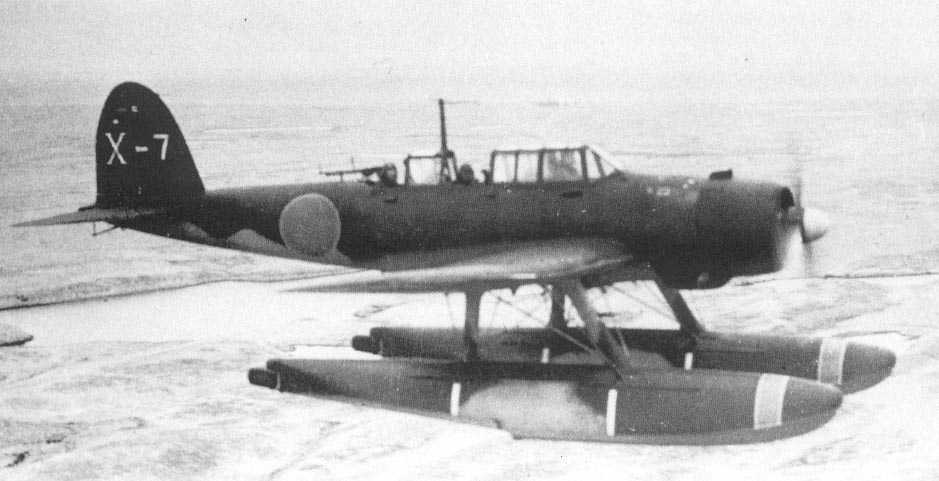
The Aichi E13A (Allied reporting name: "Jake") is a long-range reconnaissance seaplane designed and produced by the Japanese aviation company Aichi Kokuki KK. The Imperial Japanese Navy (IJN) designation was "Navy Type 0 Reconnaissance Seaplane" (零式水上偵察機).
Development of the E13A started in 1937 in response to an Imperial Japanese Navy (IJN) specification for a twin-seat reconnaissance floatplane, although this was effectively superseded by a later specification for a larger three-seat floatplane. The E13A could carry a crew of three and a bombload of 250 kg (550 lb), and was suitable for performing coastal patrols, anti-shipping, liaison, personnel transports, and air-sea rescues amongst other roles. The prototype, which made its maiden flight in late 1938, proved superior to the twin-seat E12A1 and was awarded a production contract from the IJN in December 1940. In addition to Aichi, both Kyushu Hikoki and the Hiro Naval Arsenal, would manufacture the type.
Introduced to service with the IJN in 1941, the E13A became one of the most important floatplanes operated by the service due to its numbers. First used during the Second Sino-Japanese War, it was used extensively throughout the Pacific War, from flying reconnaissance missions in support of the Attack on Pearl Harbor to occasionally being deployed as a bomber in uncontested skies, from ship and shore bases alike. The E13A was withdrawn from IHN service shortly after the Surrender of Japan, although numerous other operators would make (typically brief) use of abandoned aircraft.
As the Empire of Japan expanded during the early 20th century, it became commonplace for the Imperial Japanese Navy (IJN) to provide escorts to maritime convoys that were operating outside of the range of land-based aircraft. In response to this dilemma, the service made increasingly heavy use of floatplanes, to the extent that, by the outbreak of World War II, the IJN operated more reconnaissance floatplanes than any other air service. In June 1937, the Naval Staff issued a 12-Shi specification seeking a twin-seat reconnaissance floatplane to replace the Kawanishi E7K2 to numerous Japanese aircraft manufacturers, including Aichi Kokuki KK, Nakajima, and Kawanishi. Months later, another specification emerged that called for a three-seat reconnaissance floatplane that possessed greater range and speed than the prior specification had sought. In contrast to Nakajima, which opted to focus on the twin-seat requirement, and Kawanishi, which pursued the three-seat requirement, Aichi opted to simultaneously work on two designs, one for each requirement.
Aichi's design team, headed by Kishiro Matsuo, designed that the E13A would be heavily based on the twin-seat E12A1, essentially being a larger and more powerful version of this aircraft. In late 1938, the first prototype was completed and promptly proved itself to be superior to the E12A1 prototypes during manufacturer's trials, possessing better performance in terms of both stability and manoeuvrability despite of its bigger dimensions and greater weight. By this point, IJN officials were increasingly favouring the three-seat requirement over the earlier twin-seat specification, thus the company decided to suspend work on the E12A1 to focus on the more promising E13A.
In December 1940, the E13A1 was selected as the winner and was accepted for production as the Navy Type 0 Reconnaissance Seaplane Model 1. While initially produced solely by Aichi, due to increasing demand for the company's products, it was decided to involve two other entities, Kyushu Hikoki and the Hiro Naval Arsenal, in producing the E13A in 1942. No major changes were made for the first four years of the type's production; in 1944, the E13A1 and E13A2 emerged. While the former was outfitted with improved radio apparatus, the latter benefitted from air-to-surface radar; both models could be fitted with exhaust flame suppressors (for night time operations) and a 20 mm cannon (intended for use against patrol boats).
In 1941, the E13A made its combat debut during the Second Sino-Japanese War; in this theatre, the type was typically operated from seaplane tenders and cruisers, from which it conducted numerous anti-shipping patrols as well as strikes on the Canton-Hankou railway.
In December 1941, cruiser-based E13As were used to perform reconnaissance for the Attack on Pearl Harbor at the initiation of the Pacific War. Thereafter, it was routinely used in combat against the United States Navy, such as during the Battles of Coral Sea and Midway. The type was in service throughout the conflict, operating from both ship and shore bases alike, and typically performed coastal patrols, anti-shipping, liaison, personnel transports, air-sea rescues, and other missions. When there was only limited aerial opposition from the Allies, the E13A would occasionally be deployed to perform bombing missions.
Hub AI
Aichi E13A AI simulator
(@Aichi E13A_simulator)
Aichi E13A
The Aichi E13A (Allied reporting name: "Jake") is a long-range reconnaissance seaplane designed and produced by the Japanese aviation company Aichi Kokuki KK. The Imperial Japanese Navy (IJN) designation was "Navy Type 0 Reconnaissance Seaplane" (零式水上偵察機).
Development of the E13A started in 1937 in response to an Imperial Japanese Navy (IJN) specification for a twin-seat reconnaissance floatplane, although this was effectively superseded by a later specification for a larger three-seat floatplane. The E13A could carry a crew of three and a bombload of 250 kg (550 lb), and was suitable for performing coastal patrols, anti-shipping, liaison, personnel transports, and air-sea rescues amongst other roles. The prototype, which made its maiden flight in late 1938, proved superior to the twin-seat E12A1 and was awarded a production contract from the IJN in December 1940. In addition to Aichi, both Kyushu Hikoki and the Hiro Naval Arsenal, would manufacture the type.
Introduced to service with the IJN in 1941, the E13A became one of the most important floatplanes operated by the service due to its numbers. First used during the Second Sino-Japanese War, it was used extensively throughout the Pacific War, from flying reconnaissance missions in support of the Attack on Pearl Harbor to occasionally being deployed as a bomber in uncontested skies, from ship and shore bases alike. The E13A was withdrawn from IHN service shortly after the Surrender of Japan, although numerous other operators would make (typically brief) use of abandoned aircraft.
As the Empire of Japan expanded during the early 20th century, it became commonplace for the Imperial Japanese Navy (IJN) to provide escorts to maritime convoys that were operating outside of the range of land-based aircraft. In response to this dilemma, the service made increasingly heavy use of floatplanes, to the extent that, by the outbreak of World War II, the IJN operated more reconnaissance floatplanes than any other air service. In June 1937, the Naval Staff issued a 12-Shi specification seeking a twin-seat reconnaissance floatplane to replace the Kawanishi E7K2 to numerous Japanese aircraft manufacturers, including Aichi Kokuki KK, Nakajima, and Kawanishi. Months later, another specification emerged that called for a three-seat reconnaissance floatplane that possessed greater range and speed than the prior specification had sought. In contrast to Nakajima, which opted to focus on the twin-seat requirement, and Kawanishi, which pursued the three-seat requirement, Aichi opted to simultaneously work on two designs, one for each requirement.
Aichi's design team, headed by Kishiro Matsuo, designed that the E13A would be heavily based on the twin-seat E12A1, essentially being a larger and more powerful version of this aircraft. In late 1938, the first prototype was completed and promptly proved itself to be superior to the E12A1 prototypes during manufacturer's trials, possessing better performance in terms of both stability and manoeuvrability despite of its bigger dimensions and greater weight. By this point, IJN officials were increasingly favouring the three-seat requirement over the earlier twin-seat specification, thus the company decided to suspend work on the E12A1 to focus on the more promising E13A.
In December 1940, the E13A1 was selected as the winner and was accepted for production as the Navy Type 0 Reconnaissance Seaplane Model 1. While initially produced solely by Aichi, due to increasing demand for the company's products, it was decided to involve two other entities, Kyushu Hikoki and the Hiro Naval Arsenal, in producing the E13A in 1942. No major changes were made for the first four years of the type's production; in 1944, the E13A1 and E13A2 emerged. While the former was outfitted with improved radio apparatus, the latter benefitted from air-to-surface radar; both models could be fitted with exhaust flame suppressors (for night time operations) and a 20 mm cannon (intended for use against patrol boats).
In 1941, the E13A made its combat debut during the Second Sino-Japanese War; in this theatre, the type was typically operated from seaplane tenders and cruisers, from which it conducted numerous anti-shipping patrols as well as strikes on the Canton-Hankou railway.
In December 1941, cruiser-based E13As were used to perform reconnaissance for the Attack on Pearl Harbor at the initiation of the Pacific War. Thereafter, it was routinely used in combat against the United States Navy, such as during the Battles of Coral Sea and Midway. The type was in service throughout the conflict, operating from both ship and shore bases alike, and typically performed coastal patrols, anti-shipping, liaison, personnel transports, air-sea rescues, and other missions. When there was only limited aerial opposition from the Allies, the E13A would occasionally be deployed to perform bombing missions.
Recent media