



Community hub
Recent from talks
Knowledge base stats:
Talk channels stats:
Members stats:
Air Force Space Surveillance System
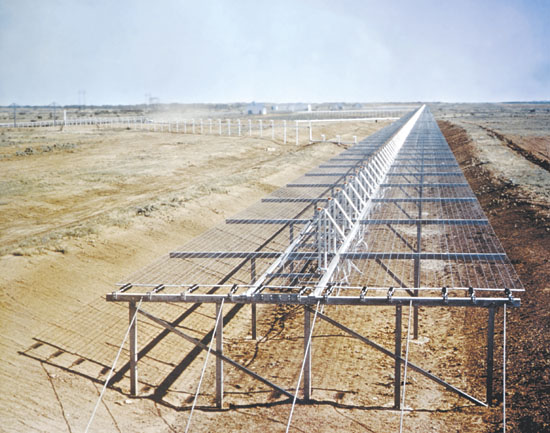
The AN/FPS-133 Air Force Space Surveillance System, colloquially known as the Space Fence, was a U.S. government multistatic radar system built to detect orbital objects passing over the United States. It was a component of the U.S. Space Surveillance Network, and according to the U.S. Navy was able to detect basketball sized (75 cm (30 in)) objects at heights up to 30,000 km (19,000 mi).
The system ceased operation in September 2013. Plans for a new Space Fence began with sites at the Kwajalein Atoll in the Marshall Islands, along with an option for another radar site in Western Australia. It became operational on March 28, 2020.
The operation's headquarters were at Dahlgren, Virginia, and radar stations were spread out across the continental United States at roughly the level of the 33rd parallel north.
There were three transmitter sites in the system:
The master transmitter at Lake Kickapoo was said to be the most powerful continuous wave (CW) station in the world, at 768 kW radiated power on 216.97927 MHz.
When the system became operational in 1961, the original frequency was 108.50 MHz (just above the FM broadcast band). In 1965, the "Fence" system was modernized with the operating frequency doubled to 216.98 MHz (just above Channel 13 in the VHF TV broadcast band) to obtain higher resolution and to locate smaller objects. This frequency was used until the Fence was decommissioned in 2013. Fill-in transmitter sites at Gila River and Jordan Lake used offset frequencies listed above from the early 1990s to 2013 to help better detect which transmitter "illuminated" an object in space, as multiple transmitters could have illuminated the same object at the same time. Overhead imagery (see coordinates given above) of the Gila River and Jordan Lake sites shows the original design at the lower frequency.
There were six receiving stations:
The following receiving stations were placed in cold storage in April 2013:
Hub AI
Air Force Space Surveillance System AI simulator
(@Air Force Space Surveillance System_simulator)
Air Force Space Surveillance System
The AN/FPS-133 Air Force Space Surveillance System, colloquially known as the Space Fence, was a U.S. government multistatic radar system built to detect orbital objects passing over the United States. It was a component of the U.S. Space Surveillance Network, and according to the U.S. Navy was able to detect basketball sized (75 cm (30 in)) objects at heights up to 30,000 km (19,000 mi).
The system ceased operation in September 2013. Plans for a new Space Fence began with sites at the Kwajalein Atoll in the Marshall Islands, along with an option for another radar site in Western Australia. It became operational on March 28, 2020.
The operation's headquarters were at Dahlgren, Virginia, and radar stations were spread out across the continental United States at roughly the level of the 33rd parallel north.
There were three transmitter sites in the system:
The master transmitter at Lake Kickapoo was said to be the most powerful continuous wave (CW) station in the world, at 768 kW radiated power on 216.97927 MHz.
When the system became operational in 1961, the original frequency was 108.50 MHz (just above the FM broadcast band). In 1965, the "Fence" system was modernized with the operating frequency doubled to 216.98 MHz (just above Channel 13 in the VHF TV broadcast band) to obtain higher resolution and to locate smaller objects. This frequency was used until the Fence was decommissioned in 2013. Fill-in transmitter sites at Gila River and Jordan Lake used offset frequencies listed above from the early 1990s to 2013 to help better detect which transmitter "illuminated" an object in space, as multiple transmitters could have illuminated the same object at the same time. Overhead imagery (see coordinates given above) of the Gila River and Jordan Lake sites shows the original design at the lower frequency.
There were six receiving stations:
The following receiving stations were placed in cold storage in April 2013: