
Recent from talks
Air compressor


Knowledge base stats:
Talk channels stats:
Members stats:
Air compressor
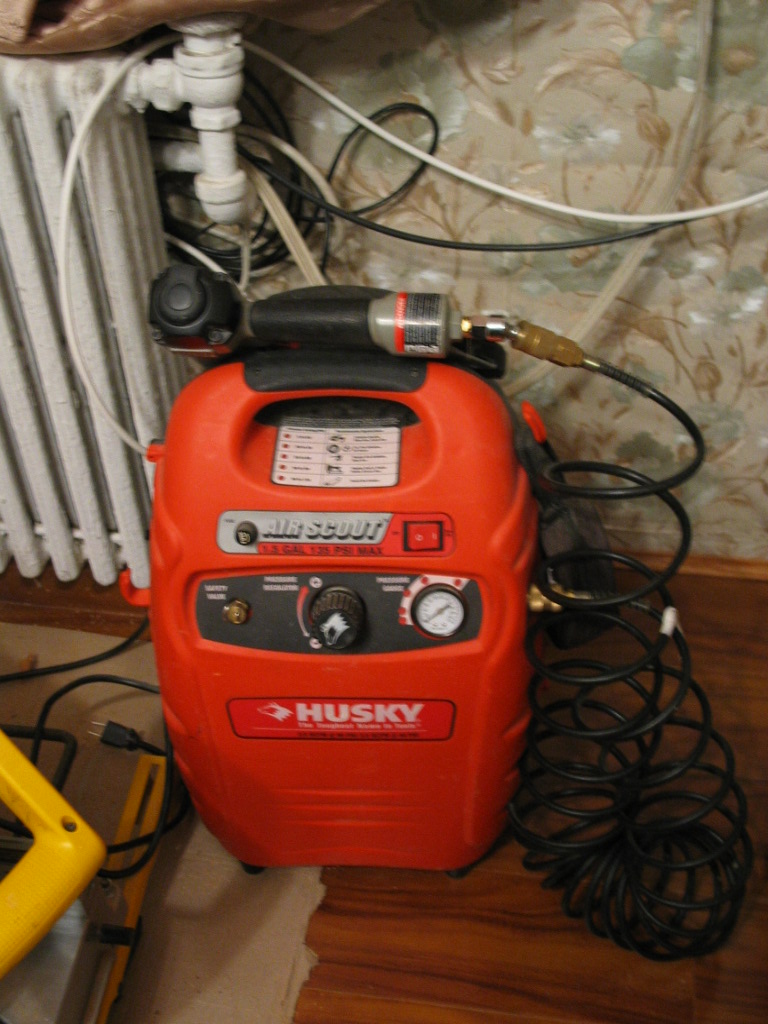
An air compressor is a machine that takes ambient air from the surroundings and discharges it at a higher pressure. It is an application of a gas compressor and a pneumatic device that converts mechanical power (from an electric motor, diesel or gasoline engine, etc.) into potential energy stored in compressed air, which has many uses. A common application is to compress air into a storage tank, for immediate or later use. When the delivery pressure reaches its set upper limit, the compressor is shut off, or the excess air is released through an overpressure valve. The compressed air is stored in the tank until it is needed. The pressure energy provided by the compressed air can be used for a variety of applications such as pneumatic tools as it is released. When tank pressure reaches its lower limit, the air compressor turns on again and re-pressurizes the tank. A compressor is different from a pump because it works on a gas, while pumps work on a liquid.
Compressors may be classified according to the pressure delivered:
There are numerous methods of air compression, divided into either positive-displacement or roto-dynamic types.
Positive-displacement compressors work by forcing air through a chamber whose volume is decreased to compress the air. Once the pressure is greater than the pressure outside the discharge valve, a port or valve opens and air is discharged into the outlet system from the compression chamber. Common types of positive displacement compressors are
The capacities for both single-stage and two-stage compressors are generally specified in Standard Cubic feet per Minute (SCFM) or litres per minute and pounds per square Inch (PSI) or bar. To a lesser extent, some compressors are rated in actual cubic feet per minute (ACFM).[clarification needed][citation needed] Still others are rated in cubic feet per minute (CFM).[clarification needed][citation needed] Using CFM alone to rate a compressor is ambiguous because it represents a flow rate without a pressure reference. i.e. 20 CFM at 60 PSI.
Single stage compressors usually fall into the fractional through 5 horsepower range.[citation needed] Two-stage compressors normally fall into the 5 through 30 horsepower range.[citation needed][clarification needed]
Roto-dynamic air compressors include centrifugal compressors where Rotating vanes impart kinetic energy to a gas and stationary passages convert velocity into a rise in pressure, and axial compressors, where rotor blades impart the kinetic energy and stator blades convert it to a rise in pressure.
Due to adiabatic heating, air compressors require some method of disposing of waste heat. Generally this is some form of air- or water-cooling, although some (particularly rotary type) compressors may be cooled by oil (that is then in turn air- or water-cooled). The atmospheric changes are also considered during cooling of compressors.[clarification needed] The type of cooling is determined by considering the factors such as inlet temperature, ambient temperature, power of the compressor and area of application. There is no single type of compressor that could be used for any application.
Hub AI
Air compressor AI simulator
(@Air compressor_simulator)
Air compressor
An air compressor is a machine that takes ambient air from the surroundings and discharges it at a higher pressure. It is an application of a gas compressor and a pneumatic device that converts mechanical power (from an electric motor, diesel or gasoline engine, etc.) into potential energy stored in compressed air, which has many uses. A common application is to compress air into a storage tank, for immediate or later use. When the delivery pressure reaches its set upper limit, the compressor is shut off, or the excess air is released through an overpressure valve. The compressed air is stored in the tank until it is needed. The pressure energy provided by the compressed air can be used for a variety of applications such as pneumatic tools as it is released. When tank pressure reaches its lower limit, the air compressor turns on again and re-pressurizes the tank. A compressor is different from a pump because it works on a gas, while pumps work on a liquid.
Compressors may be classified according to the pressure delivered:
There are numerous methods of air compression, divided into either positive-displacement or roto-dynamic types.
Positive-displacement compressors work by forcing air through a chamber whose volume is decreased to compress the air. Once the pressure is greater than the pressure outside the discharge valve, a port or valve opens and air is discharged into the outlet system from the compression chamber. Common types of positive displacement compressors are
The capacities for both single-stage and two-stage compressors are generally specified in Standard Cubic feet per Minute (SCFM) or litres per minute and pounds per square Inch (PSI) or bar. To a lesser extent, some compressors are rated in actual cubic feet per minute (ACFM).[clarification needed][citation needed] Still others are rated in cubic feet per minute (CFM).[clarification needed][citation needed] Using CFM alone to rate a compressor is ambiguous because it represents a flow rate without a pressure reference. i.e. 20 CFM at 60 PSI.
Single stage compressors usually fall into the fractional through 5 horsepower range.[citation needed] Two-stage compressors normally fall into the 5 through 30 horsepower range.[citation needed][clarification needed]
Roto-dynamic air compressors include centrifugal compressors where Rotating vanes impart kinetic energy to a gas and stationary passages convert velocity into a rise in pressure, and axial compressors, where rotor blades impart the kinetic energy and stator blades convert it to a rise in pressure.
Due to adiabatic heating, air compressors require some method of disposing of waste heat. Generally this is some form of air- or water-cooling, although some (particularly rotary type) compressors may be cooled by oil (that is then in turn air- or water-cooled). The atmospheric changes are also considered during cooling of compressors.[clarification needed] The type of cooling is determined by considering the factors such as inlet temperature, ambient temperature, power of the compressor and area of application. There is no single type of compressor that could be used for any application.
Recent media