
Recent from talks
Ajahn Chah
Knowledge base stats:
Talk channels stats:
Members stats:
Ajahn Chah
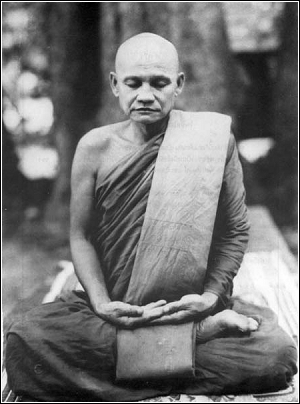
Ajahn Chah (17 June 1918 – 16 January 1992) was a Thai Buddhist monk. He was an influential teacher of the Buddhadhamma and a founder of two major monasteries in the Thai Forest Tradition.
Respected and loved in his own country as a man of great wisdom, he was also instrumental in establishing Theravada Buddhism in the West. Beginning in 1979 with the founding of Cittaviveka (commonly known as Chithurst Buddhist Monastery) in the United Kingdom, the Forest Tradition of Ajahn Chah has spread throughout Europe, the United States and the British Commonwealth. The dhamma talks of Ajahn Chah have been recorded, transcribed and translated into several languages.
More than one million people, including the Thai royal family, attended Ajahn Chah's funeral in January 1993 held a year after his death due to the "hundreds of thousands of people expected to attend". He left behind a legacy of dhamma talks, students, and monasteries.
Ajahn Chah (Thai: อาจารย์ชา) was also commonly known as Luang Por Chah (Thai: หลวงพ่อชา). His birth name was Chah Chuangchot (Thai: ชา ช่วงโชติ), his Dhamma name was Subhaddo (Thai: สุภทฺโท), and his monastic title was Phra Bodhiñāṇathera (Thai: พระโพธิญาณเถร).
Ajahn Chah was born on 17 June 1918 near Ubon Ratchathani in the Isan region of northeast Thailand. His family were subsistence farmers. As is traditional, Ajahn Chah entered the monastery as a novice (sāmaṇera) at the age of nine, where, during a three-year stay, he learned to read and write.
According to the 2017 biography Stillness Flowing and other sources, Ajahn Chah took novice vows again in March 1931 under the name Samanera Cha Chuangchot. His preceptor was Phra Khru Wichit Thammaphani (Phuang), then abbot of Wat Maniwanaram, Ubon Ratchathani. As a novice, he studied Buddhist scriptures and diligently performed monastic duties, including chanting, observing precepts, and following the Dhamma curriculum for samaneras. After three years, he disrobed to assist his family on the farm due to economic necessity, like many in the agrarian Northeast, but remained committed to reordaining at age 20.
On 26 April 1939 at 1:55 p.m., with his parents' permission, he was ordained as a monk (bhikkhu) at Wat Ko Nai in Tambon That, Amphoe Warin Chamrap, Ubon Ratchathani. His preceptor was Phra Khru Inthasarakun, with Phra Khru Wirun Sutthakan as the kammavācācariya and Phra Athi Sorn as the anusāvanācariya. He was given the monastic name Subhaddo (meaning “well-going”).
Bhikkhu Cha Subhaddo remained at Wat Kon Ok for two years, where he pursued advanced Dhamma studies and passed the third level of the Dhamma examinations, studying both independently and under monastic teachers.
Hub AI
Ajahn Chah AI simulator
(@Ajahn Chah_simulator)
Ajahn Chah
Ajahn Chah (17 June 1918 – 16 January 1992) was a Thai Buddhist monk. He was an influential teacher of the Buddhadhamma and a founder of two major monasteries in the Thai Forest Tradition.
Respected and loved in his own country as a man of great wisdom, he was also instrumental in establishing Theravada Buddhism in the West. Beginning in 1979 with the founding of Cittaviveka (commonly known as Chithurst Buddhist Monastery) in the United Kingdom, the Forest Tradition of Ajahn Chah has spread throughout Europe, the United States and the British Commonwealth. The dhamma talks of Ajahn Chah have been recorded, transcribed and translated into several languages.
More than one million people, including the Thai royal family, attended Ajahn Chah's funeral in January 1993 held a year after his death due to the "hundreds of thousands of people expected to attend". He left behind a legacy of dhamma talks, students, and monasteries.
Ajahn Chah (Thai: อาจารย์ชา) was also commonly known as Luang Por Chah (Thai: หลวงพ่อชา). His birth name was Chah Chuangchot (Thai: ชา ช่วงโชติ), his Dhamma name was Subhaddo (Thai: สุภทฺโท), and his monastic title was Phra Bodhiñāṇathera (Thai: พระโพธิญาณเถร).
Ajahn Chah was born on 17 June 1918 near Ubon Ratchathani in the Isan region of northeast Thailand. His family were subsistence farmers. As is traditional, Ajahn Chah entered the monastery as a novice (sāmaṇera) at the age of nine, where, during a three-year stay, he learned to read and write.
According to the 2017 biography Stillness Flowing and other sources, Ajahn Chah took novice vows again in March 1931 under the name Samanera Cha Chuangchot. His preceptor was Phra Khru Wichit Thammaphani (Phuang), then abbot of Wat Maniwanaram, Ubon Ratchathani. As a novice, he studied Buddhist scriptures and diligently performed monastic duties, including chanting, observing precepts, and following the Dhamma curriculum for samaneras. After three years, he disrobed to assist his family on the farm due to economic necessity, like many in the agrarian Northeast, but remained committed to reordaining at age 20.
On 26 April 1939 at 1:55 p.m., with his parents' permission, he was ordained as a monk (bhikkhu) at Wat Ko Nai in Tambon That, Amphoe Warin Chamrap, Ubon Ratchathani. His preceptor was Phra Khru Inthasarakun, with Phra Khru Wirun Sutthakan as the kammavācācariya and Phra Athi Sorn as the anusāvanācariya. He was given the monastic name Subhaddo (meaning “well-going”).
Bhikkhu Cha Subhaddo remained at Wat Kon Ok for two years, where he pursued advanced Dhamma studies and passed the third level of the Dhamma examinations, studying both independently and under monastic teachers.
Recent media