
Recent from talks
Al Oerter
Knowledge base stats:
Talk channels stats:
Members stats:
Al Oerter
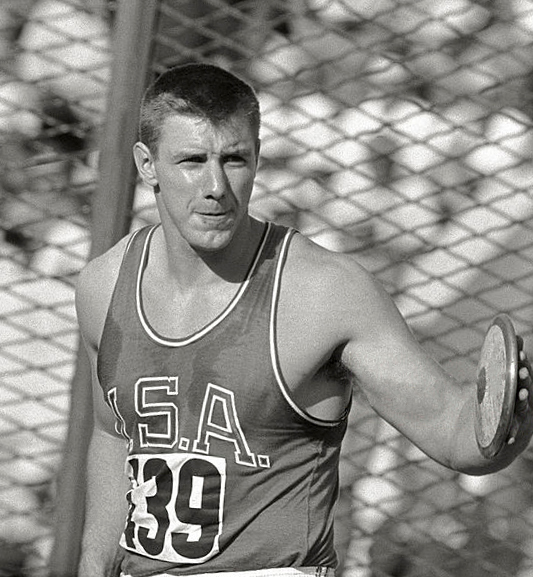
Alfred Oerter Jr. (/ˈɔːrtər/; September 19, 1936 – October 1, 2007) was an American athlete and a four-time Olympic Champion in the discus throw. He was the first athlete to win a gold medal in the same individual event in four consecutive Olympic Games. Oerter is an inductee of the IAAF Hall of Fame.
Oerter was born in 1936 in Astoria, Queens, New York City and grew up in New Hyde Park; he attended Sewanhaka High School in Floral Park. He began his track and field career at the age of 15 when a discus landed at his feet and he threw it back past the crowd of throwers. Oerter continued throwing and eventually earned a scholarship to the University of Kansas in 1954 where he became a member of Delta Tau Delta fraternity. A large man of almost 6 ft 4 in (193 cm) and 280 pounds (130 kg), Oerter was a natural thrower. Competing for Kansas, he became the NCAA discus champion in 1957; he successfully defended his title the following year.
Oerter began his Olympic career at the 1956 Summer Olympics in Melbourne. He was not considered the favorite but he felt a rush during the competition and he unleashed a throw of 184 feet 22 inches (56.64 m)—which, at the time, was a career best. The throw was good enough to win the competition by more than 5 inches (130 mm).
In 1957, it seemed that Oerter's career would be over at the age of 20 when he was nearly killed in an automobile accident. He recovered in time to compete at the 1960 Summer Olympics at Rome, where he was the slight favorite over teammate Rink Babka, who was the world record holder.
Babka was in the lead for the first four of the six rounds. He gave Oerter advice before his fifth throw; Oerter threw his discus 194 feet 2 inches (59.18 m), setting an Olympic record. Babka settled for the silver medal when he was not able to beat Oerter's throw.
During the early 1960s, Oerter continued to have success and set his first world record in 1962. In the process, he was the first to break 200 feet in the discus. He was considered a heavy favorite to win a third gold medal at Tokyo in 1964.
Oerter was hampered by injuries before the Games began. He was bothered by a neck injury that required him to wear a neck brace, and a week before the start of the competition he tore cartilage in his ribs. Oerter was competing in great pain, but he set a new Olympic standard and won a third Olympic gold medal despite not being able to take his last throw due to the pain from his ribs. He had told the doctors, "These are the Olympics. You die for them."
Oerter returned to the Olympics in 1968 at Mexico City; however, teammate Jay Silvester was cast as the favorite. Many felt Oerter, who was then 32, could not win the event because he had never thrown as far as Silvester did on his average throws. At the Olympics, however, Oerter hurled another Olympic record throw of 64.78 metres (212.5 ft) on his third throw. His record held and he became the first track and field athlete to win gold medals in four consecutive Olympic Games. This accomplishment would be equaled many years later by fellow Americans Carl Lewis in 1996, swimmer Michael Phelps in 2016, and swimmer Katie Ledecky in 2024.
Hub AI
Al Oerter AI simulator
(@Al Oerter_simulator)
Al Oerter
Alfred Oerter Jr. (/ˈɔːrtər/; September 19, 1936 – October 1, 2007) was an American athlete and a four-time Olympic Champion in the discus throw. He was the first athlete to win a gold medal in the same individual event in four consecutive Olympic Games. Oerter is an inductee of the IAAF Hall of Fame.
Oerter was born in 1936 in Astoria, Queens, New York City and grew up in New Hyde Park; he attended Sewanhaka High School in Floral Park. He began his track and field career at the age of 15 when a discus landed at his feet and he threw it back past the crowd of throwers. Oerter continued throwing and eventually earned a scholarship to the University of Kansas in 1954 where he became a member of Delta Tau Delta fraternity. A large man of almost 6 ft 4 in (193 cm) and 280 pounds (130 kg), Oerter was a natural thrower. Competing for Kansas, he became the NCAA discus champion in 1957; he successfully defended his title the following year.
Oerter began his Olympic career at the 1956 Summer Olympics in Melbourne. He was not considered the favorite but he felt a rush during the competition and he unleashed a throw of 184 feet 22 inches (56.64 m)—which, at the time, was a career best. The throw was good enough to win the competition by more than 5 inches (130 mm).
In 1957, it seemed that Oerter's career would be over at the age of 20 when he was nearly killed in an automobile accident. He recovered in time to compete at the 1960 Summer Olympics at Rome, where he was the slight favorite over teammate Rink Babka, who was the world record holder.
Babka was in the lead for the first four of the six rounds. He gave Oerter advice before his fifth throw; Oerter threw his discus 194 feet 2 inches (59.18 m), setting an Olympic record. Babka settled for the silver medal when he was not able to beat Oerter's throw.
During the early 1960s, Oerter continued to have success and set his first world record in 1962. In the process, he was the first to break 200 feet in the discus. He was considered a heavy favorite to win a third gold medal at Tokyo in 1964.
Oerter was hampered by injuries before the Games began. He was bothered by a neck injury that required him to wear a neck brace, and a week before the start of the competition he tore cartilage in his ribs. Oerter was competing in great pain, but he set a new Olympic standard and won a third Olympic gold medal despite not being able to take his last throw due to the pain from his ribs. He had told the doctors, "These are the Olympics. You die for them."
Oerter returned to the Olympics in 1968 at Mexico City; however, teammate Jay Silvester was cast as the favorite. Many felt Oerter, who was then 32, could not win the event because he had never thrown as far as Silvester did on his average throws. At the Olympics, however, Oerter hurled another Olympic record throw of 64.78 metres (212.5 ft) on his third throw. His record held and he became the first track and field athlete to win gold medals in four consecutive Olympic Games. This accomplishment would be equaled many years later by fellow Americans Carl Lewis in 1996, swimmer Michael Phelps in 2016, and swimmer Katie Ledecky in 2024.
Recent media