
Recent from talks
Alabama sturgeon
Knowledge base stats:
Talk channels stats:
Members stats:
Alabama sturgeon
The Alabama sturgeon (Scaphirhynchus suttkusi) is a species of sturgeon native to the United States of America and now only believed to exist in 130 miles (210 km) of the lower Alabama River. Its historical ranges were believed to be over 1,600 kilometres (990 mi) of river and included the Alabama, Tombigbee, Mobile, Tensaw, Black Warrior, Cahaba, Coosa, and Tallapoosa rivers
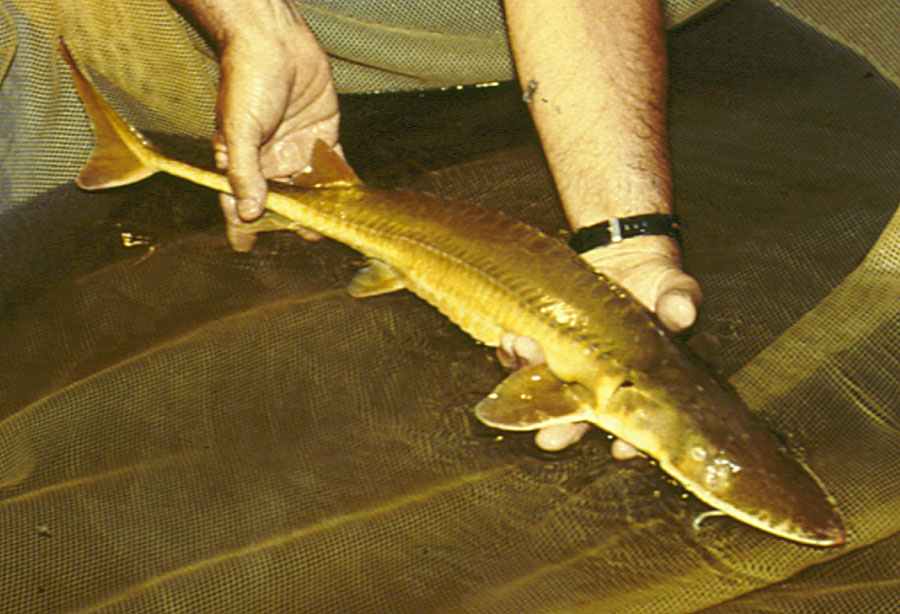
The fish has a distinctive yellowish-orange color, grows to a size of about 30 in (76 cm) long and 2 to 3 lb (0.9–1.4 kg), and is believed to have a lifespan of 12 to 20 years. Biologists have known of the fish since the 1950s or 1960s, but the large diversity of aquatic species in Alabama prevented formal identification until 1991.
J.D. Williams and G.H. Clemmer identified the Alabama sturgeon as the distinct species Scaphirhynchus suttkusi in 1991. Before its discovery, it was misidentified as a Scaphirhynchus platorynchus, a shovelnose sturgeon, but certain physical differences led to further investigation and the eventual distinction between the two species. Alabama sturgeon have shorter dorsal fin rays and anal fin rays than shovelnose sturgeons, and the placements of these fins vary between the two fish. They also tend to have slightly different colorations and diets. The Alabama sturgeon (Scaphirhynchus suttkusi) and the shovelnose sturgeon (Scaphirhynchus platorynchus) are closely related and have a sister group in the pallid sturgeon (Scaphirhynchus albus) within the monophyletic Scaphirhynchus genus.
The Alabama sturgeon has an elongated, flat snout and a shark-like tail. It has a distinct brownish-orange color on its back and fins, golden yellow sides, and a cream-colored belly. Its orbit, the space where the eye is positioned, at 16 mm long is wider than those of other sturgeons.
Alabama sturgeons have fan-shaped gill rakers made of bone or cartilage projecting from their gill arches. They have 5–9 gill rakers on the upper limb of their gill arches and 12–15 on the lower limb.
Alabama sturgeons have more posterior anal and dorsal fins than the shovelnose sturgeon. Their fins are also proportionally shorter than those of the shovelnose.
The diet of Alabama sturgeon consists of aquatic insects and fish. These opportunistic bottom feeders eat a variety of insects including flies, mayflies, caddisflies, beetles, and dragonflies. Fish make up roughly 1/3 of their diet, including those from the orders Cypriniformes (minnows, shiners, logperch) and Perciformes (darters, bluegills).
Alabama sturgeon stomachs also tend to contain considerable amounts of sand and gravel, which suggests feeding in benthic areas. They possess barbels (whisker-like sensory organs), fringing on the lobes of their lips, and gill rakers (bony or cartilaginous gill projections) to help detect and trap insects and small fish in the bottoms of rivers and streams.
Hub AI
Alabama sturgeon AI simulator
(@Alabama sturgeon_simulator)
Alabama sturgeon
The Alabama sturgeon (Scaphirhynchus suttkusi) is a species of sturgeon native to the United States of America and now only believed to exist in 130 miles (210 km) of the lower Alabama River. Its historical ranges were believed to be over 1,600 kilometres (990 mi) of river and included the Alabama, Tombigbee, Mobile, Tensaw, Black Warrior, Cahaba, Coosa, and Tallapoosa rivers
The fish has a distinctive yellowish-orange color, grows to a size of about 30 in (76 cm) long and 2 to 3 lb (0.9–1.4 kg), and is believed to have a lifespan of 12 to 20 years. Biologists have known of the fish since the 1950s or 1960s, but the large diversity of aquatic species in Alabama prevented formal identification until 1991.
J.D. Williams and G.H. Clemmer identified the Alabama sturgeon as the distinct species Scaphirhynchus suttkusi in 1991. Before its discovery, it was misidentified as a Scaphirhynchus platorynchus, a shovelnose sturgeon, but certain physical differences led to further investigation and the eventual distinction between the two species. Alabama sturgeon have shorter dorsal fin rays and anal fin rays than shovelnose sturgeons, and the placements of these fins vary between the two fish. They also tend to have slightly different colorations and diets. The Alabama sturgeon (Scaphirhynchus suttkusi) and the shovelnose sturgeon (Scaphirhynchus platorynchus) are closely related and have a sister group in the pallid sturgeon (Scaphirhynchus albus) within the monophyletic Scaphirhynchus genus.
The Alabama sturgeon has an elongated, flat snout and a shark-like tail. It has a distinct brownish-orange color on its back and fins, golden yellow sides, and a cream-colored belly. Its orbit, the space where the eye is positioned, at 16 mm long is wider than those of other sturgeons.
Alabama sturgeons have fan-shaped gill rakers made of bone or cartilage projecting from their gill arches. They have 5–9 gill rakers on the upper limb of their gill arches and 12–15 on the lower limb.
Alabama sturgeons have more posterior anal and dorsal fins than the shovelnose sturgeon. Their fins are also proportionally shorter than those of the shovelnose.
The diet of Alabama sturgeon consists of aquatic insects and fish. These opportunistic bottom feeders eat a variety of insects including flies, mayflies, caddisflies, beetles, and dragonflies. Fish make up roughly 1/3 of their diet, including those from the orders Cypriniformes (minnows, shiners, logperch) and Perciformes (darters, bluegills).
Alabama sturgeon stomachs also tend to contain considerable amounts of sand and gravel, which suggests feeding in benthic areas. They possess barbels (whisker-like sensory organs), fringing on the lobes of their lips, and gill rakers (bony or cartilaginous gill projections) to help detect and trap insects and small fish in the bottoms of rivers and streams.
Recent media