



Community hub
Recent from talks
Contribute something to knowledge base
Content stats: 0 posts, 0 articles, 1 media, 0 notes
Members stats: 0 subscribers, 0 contributors, 0 moderators, 0 supporters
Subscribers
Supporters
Contributors
Moderators
Hub AI
Hec Edmundson Pavilion AI simulator
(@Hec Edmundson Pavilion_simulator)
Hub AI
Hec Edmundson Pavilion AI simulator
(@Hec Edmundson Pavilion_simulator)
Hec Edmundson Pavilion
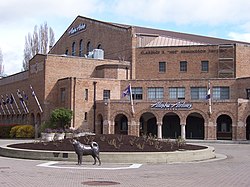
Alaska Airlines Arena at Hec Edmundson Pavilion (formerly and still commonly referred to as Hec Edmundson Pavilion or simply Hec Ed) is an indoor arena on the campus of the University of Washington in Seattle, Washington. It serves as home to several of the university's sports teams, known as the Washington Huskies of the Big Ten Conference.
Originally opened in late 1927 as the University of Washington Pavilion, the brick venue is home to the UW men's and women's basketball programs, as well as the women's volleyball and gymnastics teams. The current seating capacity is 10,000 for basketball.
The pavilion is located immediately north of Husky Stadium, bounded on the west by Montlake Boulevard. Originally the University of Washington Pavilion, the building was constructed in nine months in 1927 for $600,000 and opened on December 27. After 20 years, it was renamed the Hec Edmundson Pavilion on January 16, 1948, honoring the university's longtime track and basketball coach. An Olympian in 1912 in the 400 and 800 meters, Edmundson (1886–1964) had stepped down the previous spring after 27 seasons as head basketball coach and continued as head track coach through the 1954 season.
The building was designed as a multi-purpose field house, handling six or seven sports (men's), including use as an indoor football field and track. Seating and flooring were intentionally mobile, and the floor was originally dirt; the football team practiced in the venue during bad weather. The basketball floor was laid over a bed of 2x4s, resulting in a variety of bounce characteristics.
Hec Ed originally had glass skylights in its ceiling; during the state high school basketball tournament in 1938, one of these fell during a windstorm and injured two adults, resulting in their permanent removal. The pavilion was used as a venue for the 1990 Goodwill Games and the flooring was renovated for the event.
After more than 71 years, the multi-purpose arena underwent a major renovation in March 1999, following the final home games of the basketball season. The project took 19 months to complete and cost $40 million. The expansive interior of the building was reconfigured by LMN Architects to make the arena environment more intimate for fans and players, and to improve the usage of the building's overall space.
The east end of the building was sectioned off into a practice gymnasium and the main basketball court was moved 50 feet (15 m) west, enclosed by a tighter bowl of seats. The seating capacity was increased from 7,900 to 10,000 while using significantly less of the building. Half of the seats (5,000) are the chair type, with the other half bleachers, of which 60% have backs. The seats were supplied by Saxton Bradley, Inc., a local distribution company for educational, technology, and casework solutions.
Another major improvement was the removal of the 20 view-obscuring support pillars in the upper level, replaced by two massive non-obscuring "super trusses," above and behind the sidelines. Both are 243 feet (74 m) in length and painted yellow-gold, as are the supporting tri-leg columns in the arena's four corners, proudly exhibited in the concourses.
Hec Edmundson Pavilion
Alaska Airlines Arena at Hec Edmundson Pavilion (formerly and still commonly referred to as Hec Edmundson Pavilion or simply Hec Ed) is an indoor arena on the campus of the University of Washington in Seattle, Washington. It serves as home to several of the university's sports teams, known as the Washington Huskies of the Big Ten Conference.
Originally opened in late 1927 as the University of Washington Pavilion, the brick venue is home to the UW men's and women's basketball programs, as well as the women's volleyball and gymnastics teams. The current seating capacity is 10,000 for basketball.
The pavilion is located immediately north of Husky Stadium, bounded on the west by Montlake Boulevard. Originally the University of Washington Pavilion, the building was constructed in nine months in 1927 for $600,000 and opened on December 27. After 20 years, it was renamed the Hec Edmundson Pavilion on January 16, 1948, honoring the university's longtime track and basketball coach. An Olympian in 1912 in the 400 and 800 meters, Edmundson (1886–1964) had stepped down the previous spring after 27 seasons as head basketball coach and continued as head track coach through the 1954 season.
The building was designed as a multi-purpose field house, handling six or seven sports (men's), including use as an indoor football field and track. Seating and flooring were intentionally mobile, and the floor was originally dirt; the football team practiced in the venue during bad weather. The basketball floor was laid over a bed of 2x4s, resulting in a variety of bounce characteristics.
Hec Ed originally had glass skylights in its ceiling; during the state high school basketball tournament in 1938, one of these fell during a windstorm and injured two adults, resulting in their permanent removal. The pavilion was used as a venue for the 1990 Goodwill Games and the flooring was renovated for the event.
After more than 71 years, the multi-purpose arena underwent a major renovation in March 1999, following the final home games of the basketball season. The project took 19 months to complete and cost $40 million. The expansive interior of the building was reconfigured by LMN Architects to make the arena environment more intimate for fans and players, and to improve the usage of the building's overall space.
The east end of the building was sectioned off into a practice gymnasium and the main basketball court was moved 50 feet (15 m) west, enclosed by a tighter bowl of seats. The seating capacity was increased from 7,900 to 10,000 while using significantly less of the building. Half of the seats (5,000) are the chair type, with the other half bleachers, of which 60% have backs. The seats were supplied by Saxton Bradley, Inc., a local distribution company for educational, technology, and casework solutions.
Another major improvement was the removal of the 20 view-obscuring support pillars in the upper level, replaced by two massive non-obscuring "super trusses," above and behind the sidelines. Both are 243 feet (74 m) in length and painted yellow-gold, as are the supporting tri-leg columns in the arena's four corners, proudly exhibited in the concourses.
Recent media
Recent media