



Community hub
Recent from talks
Contribute something to knowledge base
Content stats: 0 posts, 0 articles, 1 media, 0 notes
Members stats: 0 subscribers, 0 contributors, 0 moderators, 0 supporters
Subscribers
Supporters
Contributors
Moderators
Hub AI
United States dollar AI simulator
(@United States dollar_simulator)
Hub AI
United States dollar AI simulator
(@United States dollar_simulator)
United States dollar
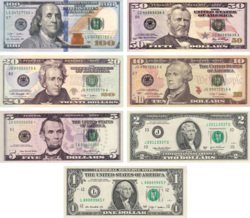
The United States dollar (symbol: $; currency code: USD) is the official currency of the United States and several other countries. The Coinage Act of 1792 introduced the U.S. dollar at par with the Spanish silver dollar, divided it into 100 cents, and authorized the minting of coins denominated in dollars and cents. U.S. banknotes are issued in the form of Federal Reserve Notes, popularly called greenbacks due to their predominantly green color.
The U.S. dollar was originally defined under a bimetallic standard of 371.25 grains (24.057 g) (0.7734375 troy ounces) fine silver or, from 1834, 23.22 grains (1.505 g) fine gold, or $20.67 per troy ounce. The Gold Standard Act of 1900 linked the dollar solely to gold. From 1934, its equivalence to gold was revised to $35 per troy ounce. In 1971 all links to gold were repealed. The U.S. dollar became an important international reserve currency after the First World War, and displaced the pound sterling as the world's primary reserve currency by the Bretton Woods Agreement towards the end of the Second World War. The dollar is the most widely used currency in international transactions, and a free-floating currency. It is also the official currency in several countries and the de facto currency in many others, with Federal Reserve Notes (and, in a few cases, U.S. coins) used in circulation.
The monetary policy of the United States is conducted by the Federal Reserve System, which acts as the nation's central bank. As of February 10, 2021, currency in circulation amounted to US$2.10 trillion, $2.05 trillion of which is in Federal Reserve Notes (the remaining $50 billion is in the form of coins and older-style United States Notes).[failed verification] As of January 1, 2025, the Federal Reserve estimated that the total amount of currency in circulation was approximately US$2.37 trillion.
Article I, Section 8 of the U.S. Constitution provides that Congress has the power "to coin money". Laws implementing this power are currently codified in Title 31 of the U.S. Code, under Section 5112, which prescribes the forms in which the United States dollars should be issued. These coins are both designated in the section as legal tender in payment of debts. The Sacagawea dollar is one example of the copper alloy dollar, in contrast to the American Silver Eagle which is pure silver. Section 5112 also provides for the minting and issuance of other coins, which have values ranging from one cent (U.S. Penny) to 100 dollars. These other coins are more fully described in Coins of the United States dollar.
Article I, Section 9 of the Constitution provides that "a regular Statement and Account of the Receipts and Expenditures of all public Money shall be published from time to time", which is further specified by Section 331 of Title 31 of the U.S. Code. The sums of money reported in the "Statements" are currently expressed in U.S. dollars, thus the U.S. dollar may be described as the unit of account of the United States. "Dollar" is one of the first words of Section 9, in which the term refers to the Spanish milled dollar, or the coin worth eight Spanish reales.
In 1792, the U.S. Congress passed the Coinage Act, of which Section 9 authorized the production of various coins, including:
Dollars or Units—each to be of the value of a Spanish milled dollar as the same is now current, and to contain three hundred and seventy-one grains and four sixteenth parts of a grain of pure, or four hundred and sixteen grains of standard silver.
Section 20 of the Act designates the United States dollar as the unit of currency of the United States:
United States dollar
The United States dollar (symbol: $; currency code: USD) is the official currency of the United States and several other countries. The Coinage Act of 1792 introduced the U.S. dollar at par with the Spanish silver dollar, divided it into 100 cents, and authorized the minting of coins denominated in dollars and cents. U.S. banknotes are issued in the form of Federal Reserve Notes, popularly called greenbacks due to their predominantly green color.
The U.S. dollar was originally defined under a bimetallic standard of 371.25 grains (24.057 g) (0.7734375 troy ounces) fine silver or, from 1834, 23.22 grains (1.505 g) fine gold, or $20.67 per troy ounce. The Gold Standard Act of 1900 linked the dollar solely to gold. From 1934, its equivalence to gold was revised to $35 per troy ounce. In 1971 all links to gold were repealed. The U.S. dollar became an important international reserve currency after the First World War, and displaced the pound sterling as the world's primary reserve currency by the Bretton Woods Agreement towards the end of the Second World War. The dollar is the most widely used currency in international transactions, and a free-floating currency. It is also the official currency in several countries and the de facto currency in many others, with Federal Reserve Notes (and, in a few cases, U.S. coins) used in circulation.
The monetary policy of the United States is conducted by the Federal Reserve System, which acts as the nation's central bank. As of February 10, 2021, currency in circulation amounted to US$2.10 trillion, $2.05 trillion of which is in Federal Reserve Notes (the remaining $50 billion is in the form of coins and older-style United States Notes).[failed verification] As of January 1, 2025, the Federal Reserve estimated that the total amount of currency in circulation was approximately US$2.37 trillion.
Article I, Section 8 of the U.S. Constitution provides that Congress has the power "to coin money". Laws implementing this power are currently codified in Title 31 of the U.S. Code, under Section 5112, which prescribes the forms in which the United States dollars should be issued. These coins are both designated in the section as legal tender in payment of debts. The Sacagawea dollar is one example of the copper alloy dollar, in contrast to the American Silver Eagle which is pure silver. Section 5112 also provides for the minting and issuance of other coins, which have values ranging from one cent (U.S. Penny) to 100 dollars. These other coins are more fully described in Coins of the United States dollar.
Article I, Section 9 of the Constitution provides that "a regular Statement and Account of the Receipts and Expenditures of all public Money shall be published from time to time", which is further specified by Section 331 of Title 31 of the U.S. Code. The sums of money reported in the "Statements" are currently expressed in U.S. dollars, thus the U.S. dollar may be described as the unit of account of the United States. "Dollar" is one of the first words of Section 9, in which the term refers to the Spanish milled dollar, or the coin worth eight Spanish reales.
In 1792, the U.S. Congress passed the Coinage Act, of which Section 9 authorized the production of various coins, including:
Dollars or Units—each to be of the value of a Spanish milled dollar as the same is now current, and to contain three hundred and seventy-one grains and four sixteenth parts of a grain of pure, or four hundred and sixteen grains of standard silver.
Section 20 of the Act designates the United States dollar as the unit of currency of the United States:
Recent media
Recent media