



Community hub
Recent from talks
Contribute something to knowledge base
Content stats: 0 posts, 0 articles, 1 media, 0 notes
Members stats: 0 subscribers, 0 contributors, 0 moderators, 0 supporters
Subscribers
Supporters
Contributors
Moderators
Hub AI
Albury Park AI simulator
(@Albury Park_simulator)
Hub AI
Albury Park AI simulator
(@Albury Park_simulator)
Albury Park
Albury Park is a country park and Grade II* listed historic country house (Albury Park Mansion) in Surrey, England. It covers over 150 acres (0.61 km2); within this area is the old village of Albury, which consists of three or four houses and a church. The River Tillingbourne runs through the grounds. The gardens of Albury Park are Grade I listed on the Register of Historic Parks and Gardens.
The Saxon Old St Peter and St Paul's Church, within the grounds of Albury Park, predates 1066. Albury Park was mentioned in the Domesday Book of 1086. Over the centuries the estate has changed hands many times.
The grounds of Albury Park were laid out by John Evelyn, the 17th-century diarist and landscape gardener, between 1655 and 1677. He lived nearby at Wotton. At this time the park was owned by Henry Howard who later became the 6th Duke of Norfolk. John Evelyn's work included a yew walk, a vineyard, a terrace a quarter of a mile long, and a 160-yard tunnel, through the hill under Silver Wood. Beneath the terrace was a chamber built in imitation of a Roman bath, with niches for sculpture. He also designed a wide canal fed by the River Tillingbourne; it was drained in the early nineteenth century. Many of Evelyn's alterations to the mansion were destroyed in a fire in 1697. At that time the owner was Heneage Finch who later became the first Earl of Aylesford and Solicitor-General to Charles II. Finch rebuilt the mansion.
In 1761, Albury Park was the scene of the coronation banquet of George III.
The house was owned by the immediate Finch family until 1782 when the 4th Earl of Aylesford sold the estate to his brother Captain William Clement Finch, a naval captain who had acquired a fortune by capturing a Spanish ship. Captain Finch wanted to enclose the park, so he obtained magistrates' orders in 1784/5 to close or reroute each of several roads that had theretofore run through it. He enclosed the village green, incorporated part of the churchyard into the park grounds and harassed the villagers, causing some of them to move away to a nearby hamlet which is now the village of Albury.
In 1800, Captain Finch's widow sold the estate to Samuel Thornton, who made additions to the house, including the north front, to the designs of John Soane. Albury Park was purchased by Barings Bank partner, Charles Wall in 1811 and he lived at this estate with his wife Harriet (born Baring) and at their homes in London and Hampshire. Harriet organised evangelical meetings at the house which were scheduled for twice a day. The services attracted sizable congregations to hear the prayers and the readings from scripture. All of these were organised by Harriet and at some she would lead the service. Charles Wall died in 1815 and after that Harriet's focus moved to her new residence in Hampshire.
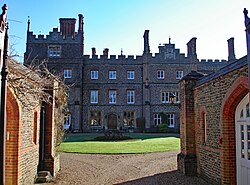
The banker and politician Henry Drummond (1786–1860), great-grandson of William Drummond, 4th Viscount Strathallan, was the owner in 1819. Drummond added a battlemented stone Gothick tower at the north-west corner of the building, and 63 brick chimneys – each to a different design. His architect was Augustus Pugin. Drummond also planted many of the rare trees in the park.
Albury Park passed into the Percy family through the marriage of Louisa Drummond, daughter of Henry Drummond, to the 6th Duke of Northumberland. The Duke of Northumberland still owns most of the land, known as the Albury Estate. The mansion contains 64 different mantelpieces, which were in part the work of Robert Adam. The private areas of the park contain a Roman bath and a cave inspired by the Grotto of Posilippo in Naples.
Albury Park
Albury Park is a country park and Grade II* listed historic country house (Albury Park Mansion) in Surrey, England. It covers over 150 acres (0.61 km2); within this area is the old village of Albury, which consists of three or four houses and a church. The River Tillingbourne runs through the grounds. The gardens of Albury Park are Grade I listed on the Register of Historic Parks and Gardens.
The Saxon Old St Peter and St Paul's Church, within the grounds of Albury Park, predates 1066. Albury Park was mentioned in the Domesday Book of 1086. Over the centuries the estate has changed hands many times.
The grounds of Albury Park were laid out by John Evelyn, the 17th-century diarist and landscape gardener, between 1655 and 1677. He lived nearby at Wotton. At this time the park was owned by Henry Howard who later became the 6th Duke of Norfolk. John Evelyn's work included a yew walk, a vineyard, a terrace a quarter of a mile long, and a 160-yard tunnel, through the hill under Silver Wood. Beneath the terrace was a chamber built in imitation of a Roman bath, with niches for sculpture. He also designed a wide canal fed by the River Tillingbourne; it was drained in the early nineteenth century. Many of Evelyn's alterations to the mansion were destroyed in a fire in 1697. At that time the owner was Heneage Finch who later became the first Earl of Aylesford and Solicitor-General to Charles II. Finch rebuilt the mansion.
In 1761, Albury Park was the scene of the coronation banquet of George III.
The house was owned by the immediate Finch family until 1782 when the 4th Earl of Aylesford sold the estate to his brother Captain William Clement Finch, a naval captain who had acquired a fortune by capturing a Spanish ship. Captain Finch wanted to enclose the park, so he obtained magistrates' orders in 1784/5 to close or reroute each of several roads that had theretofore run through it. He enclosed the village green, incorporated part of the churchyard into the park grounds and harassed the villagers, causing some of them to move away to a nearby hamlet which is now the village of Albury.
In 1800, Captain Finch's widow sold the estate to Samuel Thornton, who made additions to the house, including the north front, to the designs of John Soane. Albury Park was purchased by Barings Bank partner, Charles Wall in 1811 and he lived at this estate with his wife Harriet (born Baring) and at their homes in London and Hampshire. Harriet organised evangelical meetings at the house which were scheduled for twice a day. The services attracted sizable congregations to hear the prayers and the readings from scripture. All of these were organised by Harriet and at some she would lead the service. Charles Wall died in 1815 and after that Harriet's focus moved to her new residence in Hampshire.
The banker and politician Henry Drummond (1786–1860), great-grandson of William Drummond, 4th Viscount Strathallan, was the owner in 1819. Drummond added a battlemented stone Gothick tower at the north-west corner of the building, and 63 brick chimneys – each to a different design. His architect was Augustus Pugin. Drummond also planted many of the rare trees in the park.
Albury Park passed into the Percy family through the marriage of Louisa Drummond, daughter of Henry Drummond, to the 6th Duke of Northumberland. The Duke of Northumberland still owns most of the land, known as the Albury Estate. The mansion contains 64 different mantelpieces, which were in part the work of Robert Adam. The private areas of the park contain a Roman bath and a cave inspired by the Grotto of Posilippo in Naples.
Recent media
Recent media