



Community hub
Recent from talks
Contribute something to knowledge base
Content stats: 0 posts, 0 articles, 1 media, 0 notes
Members stats: 0 subscribers, 0 contributors, 0 moderators, 0 supporters
Subscribers
Supporters
Contributors
Moderators
Hub AI
Alcian blue stain AI simulator
(@Alcian blue stain_simulator)
Hub AI
Alcian blue stain AI simulator
(@Alcian blue stain_simulator)
Alcian blue stain
Alcian blue (/ˈælʃən/) is any member of a family of polyvalent basic dyes, of which the Alcian blue 8G (also called Ingrain blue 1, and C.I. 74240, formerly called Alcian blue 8GX from the name of a batch of an ICI product) has been historically the most common and the most reliable member. It is used to stain acidic polysaccharides such as glycosaminoglycans in cartilages and other body structures, some types of mucopolysaccharides, sialylated glycocalyx of cells etc. For many of these targets it is one of the most widely used cationic dyes for both light and electron microscopy. Use of alcian blue has historically been a popular staining method in histology especially for light microscopy in paraffin embedded sections and in semithin resin sections. The tissue parts that specifically stain by this dye become blue to bluish-green after staining and are called "Alcianophilic" (comparable to "eosinophilic" or "sudanophilic"). Alcian blue staining can be combined with H&E staining, PAS staining and van Gieson staining methods. Alcian blue can be used to quantitate acidic glycans both in microspectrophotometric quantitation in solution or for staining glycoproteins in polyacrylamide gels or on western blots. Biochemists had used it to assay acid polysaccharides in urine since the 1960s for diagnosis of diseases like mucopolysaccharidosis but from 1970's, partly due to lack of availability of Alcian and partly due to length and tediousness of the procedure, alternative methods had to be developed such as the dimethyl methylene blue (DMB or DMMB) method.
John E. Scott, the first person outside the dye industry to crack the chemical secret of this dye, comments:
In addition to its wide use as a stain, Alcian blue has also been used in other diverse applications e.g. gelling agent for lubricating fluids, modifiers for electrodes, charged coating agents etc.
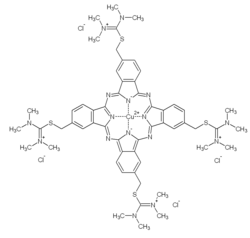
The Monstral blue found to coat the inside of copper vessels used to process phthalic acid derivatives had led to the discovery of Phthalocyanine in 1907. Attracted by the brilliance, stability and insolubility of this chromophore, attempts were made to reversibly modify it so that it would be carried into fabric in a solution and then easily precipitated (ingrained) into an unleachable but finely well dispersed deposit (hence the name "ingrain dyeing"). From this attempt, Alcian blue (Ingrain blue 1) was first synthesized by the ICI dyestuffs department under N. H. Haddock and C. Wood in the early 1940s and patented in 1947, originally as a textile dye. In 1950 it was used by Steedman as a selective dye for mucins. While the popularity of Alcian blue expanded exponentially, the difficulty involved in its production due to environmentally hazardous intermediate steps made its availability difficult and ICI stopped producing it by 1973. Many of the alternate sources sold similar looking color products with unreliable staining.
Prof J. E. Scott worked to decipher the chemistry of Alcian blue, which was known only to the Industry but kept as a tight trade secret. After spending 3 man-years of effort in 1972 he published the structure of Alcian blue and was able to get ICI to confirm it in 1973, incidentally in the same time that ICI also had just stopped producing it.
After the interim crisis since the 1970s when ICI had to stop, there have now been environmentally safe alternative industrial manufacturing of this dye that is supposed to work as well as 8GX but is called 8G since it is made differently. In attempt to answer what was the importance of discovering an alternative method of manufacturing this compound, a company (Anatech Ltd, USA) that remanufactured Alcian blue says:
The etymology of the name is not certain, and whether to capitalize it is an editorial style choice. Two major scientific and medical dictionaries use the lowercase styling, but there is also worthy support for the capitalized styling (discussed below). According to Elsevier's dictionary of chemoetymology, the Alcian in Alcian blue might have been coined by contraction (and slight alteration) of phthalocyanine.". Oxford online dictionary mentions that it was a trademark and also specifies
This hypothesis is consistent with the name of Alcian green, which is a tetraphenyl-phthalocyanine with copper.
Alcian blue stain
Alcian blue (/ˈælʃən/) is any member of a family of polyvalent basic dyes, of which the Alcian blue 8G (also called Ingrain blue 1, and C.I. 74240, formerly called Alcian blue 8GX from the name of a batch of an ICI product) has been historically the most common and the most reliable member. It is used to stain acidic polysaccharides such as glycosaminoglycans in cartilages and other body structures, some types of mucopolysaccharides, sialylated glycocalyx of cells etc. For many of these targets it is one of the most widely used cationic dyes for both light and electron microscopy. Use of alcian blue has historically been a popular staining method in histology especially for light microscopy in paraffin embedded sections and in semithin resin sections. The tissue parts that specifically stain by this dye become blue to bluish-green after staining and are called "Alcianophilic" (comparable to "eosinophilic" or "sudanophilic"). Alcian blue staining can be combined with H&E staining, PAS staining and van Gieson staining methods. Alcian blue can be used to quantitate acidic glycans both in microspectrophotometric quantitation in solution or for staining glycoproteins in polyacrylamide gels or on western blots. Biochemists had used it to assay acid polysaccharides in urine since the 1960s for diagnosis of diseases like mucopolysaccharidosis but from 1970's, partly due to lack of availability of Alcian and partly due to length and tediousness of the procedure, alternative methods had to be developed such as the dimethyl methylene blue (DMB or DMMB) method.
John E. Scott, the first person outside the dye industry to crack the chemical secret of this dye, comments:
In addition to its wide use as a stain, Alcian blue has also been used in other diverse applications e.g. gelling agent for lubricating fluids, modifiers for electrodes, charged coating agents etc.
The Monstral blue found to coat the inside of copper vessels used to process phthalic acid derivatives had led to the discovery of Phthalocyanine in 1907. Attracted by the brilliance, stability and insolubility of this chromophore, attempts were made to reversibly modify it so that it would be carried into fabric in a solution and then easily precipitated (ingrained) into an unleachable but finely well dispersed deposit (hence the name "ingrain dyeing"). From this attempt, Alcian blue (Ingrain blue 1) was first synthesized by the ICI dyestuffs department under N. H. Haddock and C. Wood in the early 1940s and patented in 1947, originally as a textile dye. In 1950 it was used by Steedman as a selective dye for mucins. While the popularity of Alcian blue expanded exponentially, the difficulty involved in its production due to environmentally hazardous intermediate steps made its availability difficult and ICI stopped producing it by 1973. Many of the alternate sources sold similar looking color products with unreliable staining.
Prof J. E. Scott worked to decipher the chemistry of Alcian blue, which was known only to the Industry but kept as a tight trade secret. After spending 3 man-years of effort in 1972 he published the structure of Alcian blue and was able to get ICI to confirm it in 1973, incidentally in the same time that ICI also had just stopped producing it.
After the interim crisis since the 1970s when ICI had to stop, there have now been environmentally safe alternative industrial manufacturing of this dye that is supposed to work as well as 8GX but is called 8G since it is made differently. In attempt to answer what was the importance of discovering an alternative method of manufacturing this compound, a company (Anatech Ltd, USA) that remanufactured Alcian blue says:
The etymology of the name is not certain, and whether to capitalize it is an editorial style choice. Two major scientific and medical dictionaries use the lowercase styling, but there is also worthy support for the capitalized styling (discussed below). According to Elsevier's dictionary of chemoetymology, the Alcian in Alcian blue might have been coined by contraction (and slight alteration) of phthalocyanine.". Oxford online dictionary mentions that it was a trademark and also specifies
This hypothesis is consistent with the name of Alcian green, which is a tetraphenyl-phthalocyanine with copper.
Recent media
Recent media