
Recent from talks
Aleksandr Karelin
Knowledge base stats:
Talk channels stats:
Members stats:
Aleksandr Karelin
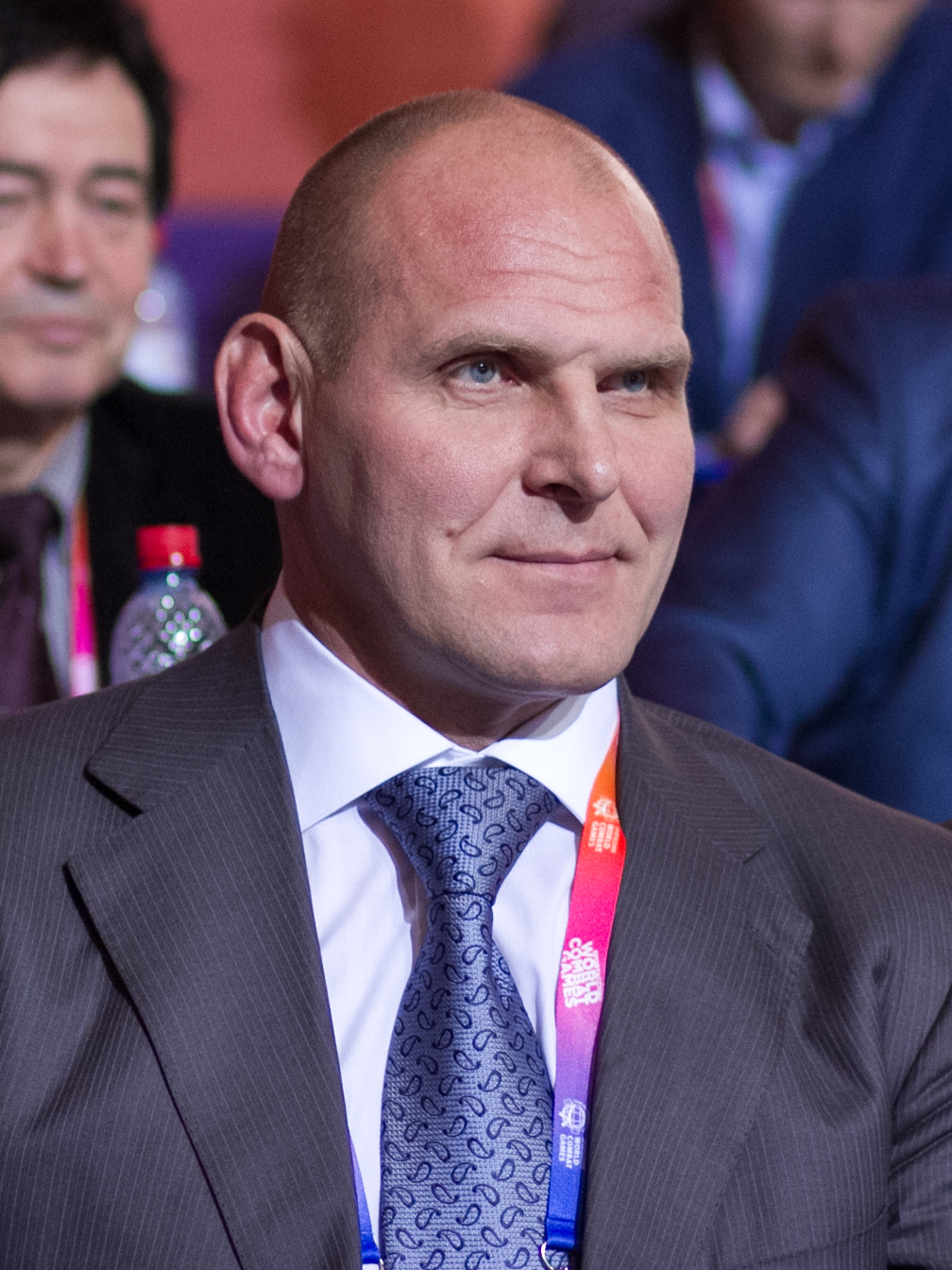
Aleksandr Aleksandrovich Karelin (Russian: Александр Александрович Карелин, IPA: [ɐlʲɪkˈsandr ɐlʲɪkˈsandrəvʲɪtɕ kɐˈrʲelʲɪn]; born 19 September 1967) is a Russian politician and retired athlete.
Karelin competed in Greco-Roman wrestling, representing the Soviet Union and Russia between 1986 and 2000. Nicknamed the "Russian Bear", "Russian King Kong", "Alexander the Great", "The Experiment", and "The Crane from Novosibirsk", he is widely considered to be the greatest and most dominant Greco-Roman wrestler of all time. Karelin won gold medals at the 1988, 1992, and 1996 Olympic Games under a different flag each time (Soviet Union, Unified Team, and Russia respectively), and a silver medal at the 2000 Olympic Games. His wrestling record at the senior level was 887 wins and two losses, both considered controversial and both by a single point. Prior to his defeat to American Rulon Gardner at the 2000 Olympics finals, a point had not been scored against him in competition the previous six years. He went undefeated in the World Championships, having never lost a match, winning nine gold medals. He was the national flag bearer at three consecutive Olympics: in 1988 for the Soviet Union, in 1992 for the Unified Team, and in 1996 for Russia. In addition to his success in wrestling, he was a sambo champion during his service in the Internal Troops, and participated in a strongman contest.
Due to his dominance and accomplishments, he was named the greatest Greco-Roman wrestler of the 20th century by the International Federation of Associated Wrestling Styles (FILA), and is part of the class of ten inaugural inductees into the FILA International Wrestling Hall of Fame in 2003. In 2007, Karelin, alongside Buvaisar Saitiev, were voted the best wrestlers in the history of the sport by FILA. Four times he was awarded the "Golden Belt" as the best wrestler of the planet by FILA – in 1989, 1990, 1992, and 1994.
Karelin was named a Hero of the Russian Federation in 1996. Karelin entered politics in 1999, being elected a deputy of the State Duma that year. He sat in the Duma through various convocations until 2020, when he entered the Federation Council as a senator.
Karelin was born as a 5.5 kilograms (12 lb) baby. He was an avid fan of literature and mathematics during his school years. He began training in 1981, under Viktor Kuznetsov, who remained his coach through his entire career. He initially started boxing, following in the footsteps of his father, until he decided against it. He also tried weightlifting, volleyball, basketball, skiing and swimming, excelling in all the sports he tried. Being naturally very big, he came to a wrestling gym, aged 13, standing 179 centimetres (5 ft 10 in) tall and weighing 79 kilograms (174 lb), Karelin grew physically very fast and from 16 years of age throughout his entire career he competed in the super heavyweight division. In 1985 he came to an international competition and won a junior world title. He won gold at Friendship-84 in Greco-Roman wrestling as a junior. In 1986, he competed in 14 tournaments, winning all of them. He had his first loss (score 0–1) at the senior level at the USSR championships in 1987, to the reigning Russian and European champion Igor Rostorotsky, which was considered controversial; he then defeated Rostorotsky at the next USSR Championships, while recovering from a flu and a recent concussion, by fall, and again in a match that would decide which of the two would go to the Summer Olympics, winning 2–0, effectively retiring Rostorotsky.
Karelin would go on to become a 13-time champion of the USSR, CIS, and Russia from 1988 to 2000, which were considered just as hard to win as the European Championships, and arguably higher in level than the World Championships. He is listed as runner-up to David Koplovitz at the 1992 Wrestling World Cup, for while he won all of his matches at the event, his partner Andrey Grishin competed in the rest of the rounds, and so they did not accumulate enough ranking points to beat the American team.
"He's been the man for 13 years. Nobody even had a chance to beat him."
In the 1988 Olympic final Karelin beat Rangel Gerovski, by executing his signature Karelin Lift and won. With his win, Karelin became the youngest Greco-Roman wrestler to become an Olympic champion at super heavyweight (130 kg) at the age of 21 years and two days. At the 1992 Summer Olympic Games in Barcelona, Karelin won one of the fastest Olympic wrestling matches, pinning Ioan Grigoraş in only 14 seconds. At the 1996 Summer Olympic Games in Atlanta, Karelin faced American Matt Ghaffari for the gold medal. Karelin had come off a shoulder surgery and looked vulnerable against a strong Ghaffari, who was able to repel Karelin's efforts to lift and slam him, forcing Karelin to use all of his skill and experience to defend a 1–0 lead.
Hub AI
Aleksandr Karelin AI simulator
(@Aleksandr Karelin_simulator)
Aleksandr Karelin
Aleksandr Aleksandrovich Karelin (Russian: Александр Александрович Карелин, IPA: [ɐlʲɪkˈsandr ɐlʲɪkˈsandrəvʲɪtɕ kɐˈrʲelʲɪn]; born 19 September 1967) is a Russian politician and retired athlete.
Karelin competed in Greco-Roman wrestling, representing the Soviet Union and Russia between 1986 and 2000. Nicknamed the "Russian Bear", "Russian King Kong", "Alexander the Great", "The Experiment", and "The Crane from Novosibirsk", he is widely considered to be the greatest and most dominant Greco-Roman wrestler of all time. Karelin won gold medals at the 1988, 1992, and 1996 Olympic Games under a different flag each time (Soviet Union, Unified Team, and Russia respectively), and a silver medal at the 2000 Olympic Games. His wrestling record at the senior level was 887 wins and two losses, both considered controversial and both by a single point. Prior to his defeat to American Rulon Gardner at the 2000 Olympics finals, a point had not been scored against him in competition the previous six years. He went undefeated in the World Championships, having never lost a match, winning nine gold medals. He was the national flag bearer at three consecutive Olympics: in 1988 for the Soviet Union, in 1992 for the Unified Team, and in 1996 for Russia. In addition to his success in wrestling, he was a sambo champion during his service in the Internal Troops, and participated in a strongman contest.
Due to his dominance and accomplishments, he was named the greatest Greco-Roman wrestler of the 20th century by the International Federation of Associated Wrestling Styles (FILA), and is part of the class of ten inaugural inductees into the FILA International Wrestling Hall of Fame in 2003. In 2007, Karelin, alongside Buvaisar Saitiev, were voted the best wrestlers in the history of the sport by FILA. Four times he was awarded the "Golden Belt" as the best wrestler of the planet by FILA – in 1989, 1990, 1992, and 1994.
Karelin was named a Hero of the Russian Federation in 1996. Karelin entered politics in 1999, being elected a deputy of the State Duma that year. He sat in the Duma through various convocations until 2020, when he entered the Federation Council as a senator.
Karelin was born as a 5.5 kilograms (12 lb) baby. He was an avid fan of literature and mathematics during his school years. He began training in 1981, under Viktor Kuznetsov, who remained his coach through his entire career. He initially started boxing, following in the footsteps of his father, until he decided against it. He also tried weightlifting, volleyball, basketball, skiing and swimming, excelling in all the sports he tried. Being naturally very big, he came to a wrestling gym, aged 13, standing 179 centimetres (5 ft 10 in) tall and weighing 79 kilograms (174 lb), Karelin grew physically very fast and from 16 years of age throughout his entire career he competed in the super heavyweight division. In 1985 he came to an international competition and won a junior world title. He won gold at Friendship-84 in Greco-Roman wrestling as a junior. In 1986, he competed in 14 tournaments, winning all of them. He had his first loss (score 0–1) at the senior level at the USSR championships in 1987, to the reigning Russian and European champion Igor Rostorotsky, which was considered controversial; he then defeated Rostorotsky at the next USSR Championships, while recovering from a flu and a recent concussion, by fall, and again in a match that would decide which of the two would go to the Summer Olympics, winning 2–0, effectively retiring Rostorotsky.
Karelin would go on to become a 13-time champion of the USSR, CIS, and Russia from 1988 to 2000, which were considered just as hard to win as the European Championships, and arguably higher in level than the World Championships. He is listed as runner-up to David Koplovitz at the 1992 Wrestling World Cup, for while he won all of his matches at the event, his partner Andrey Grishin competed in the rest of the rounds, and so they did not accumulate enough ranking points to beat the American team.
"He's been the man for 13 years. Nobody even had a chance to beat him."
In the 1988 Olympic final Karelin beat Rangel Gerovski, by executing his signature Karelin Lift and won. With his win, Karelin became the youngest Greco-Roman wrestler to become an Olympic champion at super heavyweight (130 kg) at the age of 21 years and two days. At the 1992 Summer Olympic Games in Barcelona, Karelin won one of the fastest Olympic wrestling matches, pinning Ioan Grigoraş in only 14 seconds. At the 1996 Summer Olympic Games in Atlanta, Karelin faced American Matt Ghaffari for the gold medal. Karelin had come off a shoulder surgery and looked vulnerable against a strong Ghaffari, who was able to repel Karelin's efforts to lift and slam him, forcing Karelin to use all of his skill and experience to defend a 1–0 lead.
Recent media