
Recent from talks
Alexander Scourby
Knowledge base stats:
Talk channels stats:
Members stats:
Alexander Scourby
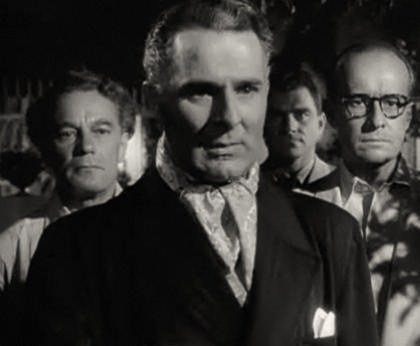
Alexander Scourby (/ˈskɔːrbi/; November 13, 1913 – February 22, 1985) was an American film, television, and voice actor and narrator known for his deep and resonant voice and Mid-Atlantic accent. He is best known for his film role as the ruthless mob boss Mike Lagana in Fritz Lang's The Big Heat (1953), and is also particularly well-remembered in the English-speaking world for his landmark recordings of the entire King James Version audio Bible, which have been released in numerous editions. He later recorded the entire Revised Standard Version of the Bible. Scourby was an accomplished narrator, including for 18 episodes of National Geographic Specials from 1966 to 1985 (almost twice as many as any of its other narrators). Scourby recorded 422 audiobooks for the blind, which he considered his most important work.
Alexander Scourby was born in Brooklyn, New York, on November 13, 1913, to Constantine Nicholas Scourby, a successful restaurateur, wholesale baker and sometime investor in independent motion-pictures, and Betsy Patsakos, a homemaker, both immigrants from Greece.
Reared in Brooklyn, Scourby was a member of a Boy Scout troop and later became a cadet with the 101st National Guard Cavalry Regiment. He attended public and private schools in Brooklyn, spending summer vacations in New Jersey, Upstate New York, and at a cousin's home in Massachusetts.
Dismissed from Polytechnic Prep School, he finished his secondary education at Brooklyn Manual Training High School which he described as "an ordinary high school that had an awful lot of shop." He was a co-editor of the school magazine and yearbook, and he envisioned a career in writing, though he later came to realize that writing was, for him, "absolutely the most painful thing in the world" and also that he "could never meet a deadline", whereas he found the reading aloud of plays easy and enjoyable. Encouraged by some of his teachers, he began to turn his attention to acting. He made his stage debut with the high school's dramatic society, as the juvenile in Augustin MacHugh's The Meanest Man in the World.
Upon graduation from high school in 1931, Scourby, not yet having abandoned the prospect of a writing career, entered West Virginia University at Morgantown to study journalism. During his first semester he joined the campus drama group and played a minor role in A.A. Milne's comedy Mr. Pim Passes By. In February 1932, as he was beginning his second semester, his father died, and he left the university to help run the family's pie bakery in Brooklyn.
A month after Scourby returned to Brooklyn, he was accepted as an apprentice at Eva Le Gallienne's Civic Repertory Theatre on 14th Street in downtown Manhattan. At the Civic Repertory he was taught dancing, speech, and make-up, and was given his first professional role, a walk-on in Liliom. In 1933, Scourby and other Civic Repertory apprentices joined to form the Apprentice Theatre, which presented plays at the New School for Social Research in New York City during the 1933–34 season. His first role on Broadway was that of the player king in Leslie Howard's production of Hamlet, which opened at the Imperial Theatre on November 10, 1936, and went on tour after thirty-nine performances. Returning to New York—and unemployment—in the spring of 1937, Scourby was introduced to the American Foundation for the Blind's Talking Book program by Wesley Addy, a member of the Hamlet cast and Scourby's roommate on the tour, who was regularly recording plays for the foundation.
After a successful audition in the spring of 1937, Scourby was cast in a small part in a recording of Antony and Cleopatra. During the following summer, he was again the player king in a production of Hamlet in Dennis, Massachusetts, which featured Eva Le Gallienne. When he returned to audition for the American Foundation for the Blind later in the year, he was told that the company of actors was "filled" but that he might record a novel if he wished. "That was the beginning of it," he recalled years later, adding, "The recordings for the blind are perhaps my greatest achievement. Most of the things I look back at in the theater were either insignificant parts in great plays or good parts in terrible plays. So it really doesn't amount to anything. Whereas I have recorded some great books. The greatest one being the Bible."
Scourby is credited as Hamlet's father the King (as spirit) on the 19 September 1936 CBS radio program Columbia Workshop directed by Orson Welles, and by the early 1940s he was playing running parts in five of the serial melodramas, popularly known as soap operas, including Against the Storm, in which he replaced Arnold Moss for two years. He narrated Andre Kostelanetz' musical show for a year, using the pseudonym Alexander Scott. At the request of sponsors, his voice was heard on many dramatic shows, including NBC's Sunday program The Eternal Light (with which he was to remain, despite heavy commitments elsewhere, through the 1950s). On The Adventures of Superman, his was the voice of the title character's father Jor-El in the one program devoted to the character's origins. During World War II, Scourby's broadcasts were beamed abroad in Greek and English for the Office of War Information. At the time, a writer in Variety (May 16, 1962) described the quality of Scourby's voice as "the kind of resonance closely associated by listeners with big time radio." [citation needed]
Hub AI
Alexander Scourby AI simulator
(@Alexander Scourby_simulator)
Alexander Scourby
Alexander Scourby (/ˈskɔːrbi/; November 13, 1913 – February 22, 1985) was an American film, television, and voice actor and narrator known for his deep and resonant voice and Mid-Atlantic accent. He is best known for his film role as the ruthless mob boss Mike Lagana in Fritz Lang's The Big Heat (1953), and is also particularly well-remembered in the English-speaking world for his landmark recordings of the entire King James Version audio Bible, which have been released in numerous editions. He later recorded the entire Revised Standard Version of the Bible. Scourby was an accomplished narrator, including for 18 episodes of National Geographic Specials from 1966 to 1985 (almost twice as many as any of its other narrators). Scourby recorded 422 audiobooks for the blind, which he considered his most important work.
Alexander Scourby was born in Brooklyn, New York, on November 13, 1913, to Constantine Nicholas Scourby, a successful restaurateur, wholesale baker and sometime investor in independent motion-pictures, and Betsy Patsakos, a homemaker, both immigrants from Greece.
Reared in Brooklyn, Scourby was a member of a Boy Scout troop and later became a cadet with the 101st National Guard Cavalry Regiment. He attended public and private schools in Brooklyn, spending summer vacations in New Jersey, Upstate New York, and at a cousin's home in Massachusetts.
Dismissed from Polytechnic Prep School, he finished his secondary education at Brooklyn Manual Training High School which he described as "an ordinary high school that had an awful lot of shop." He was a co-editor of the school magazine and yearbook, and he envisioned a career in writing, though he later came to realize that writing was, for him, "absolutely the most painful thing in the world" and also that he "could never meet a deadline", whereas he found the reading aloud of plays easy and enjoyable. Encouraged by some of his teachers, he began to turn his attention to acting. He made his stage debut with the high school's dramatic society, as the juvenile in Augustin MacHugh's The Meanest Man in the World.
Upon graduation from high school in 1931, Scourby, not yet having abandoned the prospect of a writing career, entered West Virginia University at Morgantown to study journalism. During his first semester he joined the campus drama group and played a minor role in A.A. Milne's comedy Mr. Pim Passes By. In February 1932, as he was beginning his second semester, his father died, and he left the university to help run the family's pie bakery in Brooklyn.
A month after Scourby returned to Brooklyn, he was accepted as an apprentice at Eva Le Gallienne's Civic Repertory Theatre on 14th Street in downtown Manhattan. At the Civic Repertory he was taught dancing, speech, and make-up, and was given his first professional role, a walk-on in Liliom. In 1933, Scourby and other Civic Repertory apprentices joined to form the Apprentice Theatre, which presented plays at the New School for Social Research in New York City during the 1933–34 season. His first role on Broadway was that of the player king in Leslie Howard's production of Hamlet, which opened at the Imperial Theatre on November 10, 1936, and went on tour after thirty-nine performances. Returning to New York—and unemployment—in the spring of 1937, Scourby was introduced to the American Foundation for the Blind's Talking Book program by Wesley Addy, a member of the Hamlet cast and Scourby's roommate on the tour, who was regularly recording plays for the foundation.
After a successful audition in the spring of 1937, Scourby was cast in a small part in a recording of Antony and Cleopatra. During the following summer, he was again the player king in a production of Hamlet in Dennis, Massachusetts, which featured Eva Le Gallienne. When he returned to audition for the American Foundation for the Blind later in the year, he was told that the company of actors was "filled" but that he might record a novel if he wished. "That was the beginning of it," he recalled years later, adding, "The recordings for the blind are perhaps my greatest achievement. Most of the things I look back at in the theater were either insignificant parts in great plays or good parts in terrible plays. So it really doesn't amount to anything. Whereas I have recorded some great books. The greatest one being the Bible."
Scourby is credited as Hamlet's father the King (as spirit) on the 19 September 1936 CBS radio program Columbia Workshop directed by Orson Welles, and by the early 1940s he was playing running parts in five of the serial melodramas, popularly known as soap operas, including Against the Storm, in which he replaced Arnold Moss for two years. He narrated Andre Kostelanetz' musical show for a year, using the pseudonym Alexander Scott. At the request of sponsors, his voice was heard on many dramatic shows, including NBC's Sunday program The Eternal Light (with which he was to remain, despite heavy commitments elsewhere, through the 1950s). On The Adventures of Superman, his was the voice of the title character's father Jor-El in the one program devoted to the character's origins. During World War II, Scourby's broadcasts were beamed abroad in Greek and English for the Office of War Information. At the time, a writer in Variety (May 16, 1962) described the quality of Scourby's voice as "the kind of resonance closely associated by listeners with big time radio." [citation needed]
Recent media