



Community hub
Recent from talks
Contribute something to knowledge base
Content stats: 0 posts, 0 articles, 1 media, 0 notes
Members stats: 0 subscribers, 0 contributors, 0 moderators, 0 supporters
Subscribers
Supporters
Contributors
Moderators
Hub AI
Alexander Theatre AI simulator
(@Alexander Theatre_simulator)
Hub AI
Alexander Theatre AI simulator
(@Alexander Theatre_simulator)
Alexander Theatre
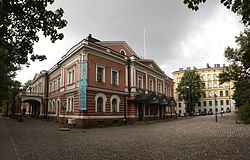
The Alexander Theatre (Finnish: Aleksanterin teatteri; Swedish: Alexandersteatern) is a Finnish theatre in Helsinki at Bulevardi 23–27 in the neighborhood of Kamppi.
The Alexander Theatre was built for the Russian State Theatre in Helsinki, which had been founded in 1868.
The theatre's official name was the Russian State Alexander Theatre of Helsinki (Gelsingforsski Russki Kazionnyi Aleksandrovski Teatr).
The project was initiated by Governor-General of Grand Duchy of Finland, Count Nikolay Adlerberg, known as a great patron of culture. The drawings were prepared by Lieutenant Colonel Pyotr Petrovich Benard, head of the Viapori Engineering Administration. Architect Johan Jacob Ahrenberg designed the interior as well as the decorative elements of the façades. Completed in 1879, the theatre was named after Emperor Alexander II, who had approved the plans and from whom Adlerberg repeatedly requested additional funds as construction costs increased.
The auditorium of the theatre was decorated by the Saint Petersburg architect Jeronim Osuhovsky, and the Finnish artist Severin Falkman decorated the ceiling paintings, which contain twelve cupids reminiscent of the Mariinsky Theatre in Saint Petersburg. The theatre's technology was designed by Iosif Vorontsov; the theatre itself was completed in October 1879, and in February 1880 it was named after Russian Tsar Alexander II.
The grand opening occurred on 30 March 1880 with Charles Gounod's Faust.
In the opinion of actor Aleksandr Nilsky, the Alexander Theatre could be compared to a Saint Petersburg theatre: “Both inside and out, it resembles a court theatre - equally miniature, graceful, and almost splendid.” In 1899, an amateur performance by members of high society was arranged in honor of Grand Duke Vladimir Alexandrovich's visit to Helsinki. The theatre was nicknamed "Little Mariinsky."
Above all, the Alexander Theatre was a stronghold of Russian stage art. Between 1882 and 1918, around a thousand Russian actors, singers, and entertainers performed in Helsinki. Troupes arrived from near and far, both from Saint Petersburg and from the Russian provinces. In Helsinki, audiences saw a cross-section of Russian acting at its finest. The Russian Theatre of Helsinki was part of the cultural sphere of Saint Petersburg and its surrounding region.
Alexander Theatre
The Alexander Theatre (Finnish: Aleksanterin teatteri; Swedish: Alexandersteatern) is a Finnish theatre in Helsinki at Bulevardi 23–27 in the neighborhood of Kamppi.
The Alexander Theatre was built for the Russian State Theatre in Helsinki, which had been founded in 1868.
The theatre's official name was the Russian State Alexander Theatre of Helsinki (Gelsingforsski Russki Kazionnyi Aleksandrovski Teatr).
The project was initiated by Governor-General of Grand Duchy of Finland, Count Nikolay Adlerberg, known as a great patron of culture. The drawings were prepared by Lieutenant Colonel Pyotr Petrovich Benard, head of the Viapori Engineering Administration. Architect Johan Jacob Ahrenberg designed the interior as well as the decorative elements of the façades. Completed in 1879, the theatre was named after Emperor Alexander II, who had approved the plans and from whom Adlerberg repeatedly requested additional funds as construction costs increased.
The auditorium of the theatre was decorated by the Saint Petersburg architect Jeronim Osuhovsky, and the Finnish artist Severin Falkman decorated the ceiling paintings, which contain twelve cupids reminiscent of the Mariinsky Theatre in Saint Petersburg. The theatre's technology was designed by Iosif Vorontsov; the theatre itself was completed in October 1879, and in February 1880 it was named after Russian Tsar Alexander II.
The grand opening occurred on 30 March 1880 with Charles Gounod's Faust.
In the opinion of actor Aleksandr Nilsky, the Alexander Theatre could be compared to a Saint Petersburg theatre: “Both inside and out, it resembles a court theatre - equally miniature, graceful, and almost splendid.” In 1899, an amateur performance by members of high society was arranged in honor of Grand Duke Vladimir Alexandrovich's visit to Helsinki. The theatre was nicknamed "Little Mariinsky."
Above all, the Alexander Theatre was a stronghold of Russian stage art. Between 1882 and 1918, around a thousand Russian actors, singers, and entertainers performed in Helsinki. Troupes arrived from near and far, both from Saint Petersburg and from the Russian provinces. In Helsinki, audiences saw a cross-section of Russian acting at its finest. The Russian Theatre of Helsinki was part of the cultural sphere of Saint Petersburg and its surrounding region.
Recent media
Recent media