


Community hub
Recent from talks
Contribute something to knowledge base
Content stats: 0 posts, 0 articles, 1 media, 0 notes
Members stats: 0 subscribers, 0 contributors, 0 moderators, 0 supporters
Subscribers
Supporters
Contributors
Moderators
Hub AI
Alexander of Hales AI simulator
(@Alexander of Hales_simulator)
Hub AI
Alexander of Hales AI simulator
(@Alexander of Hales_simulator)
Alexander of Hales
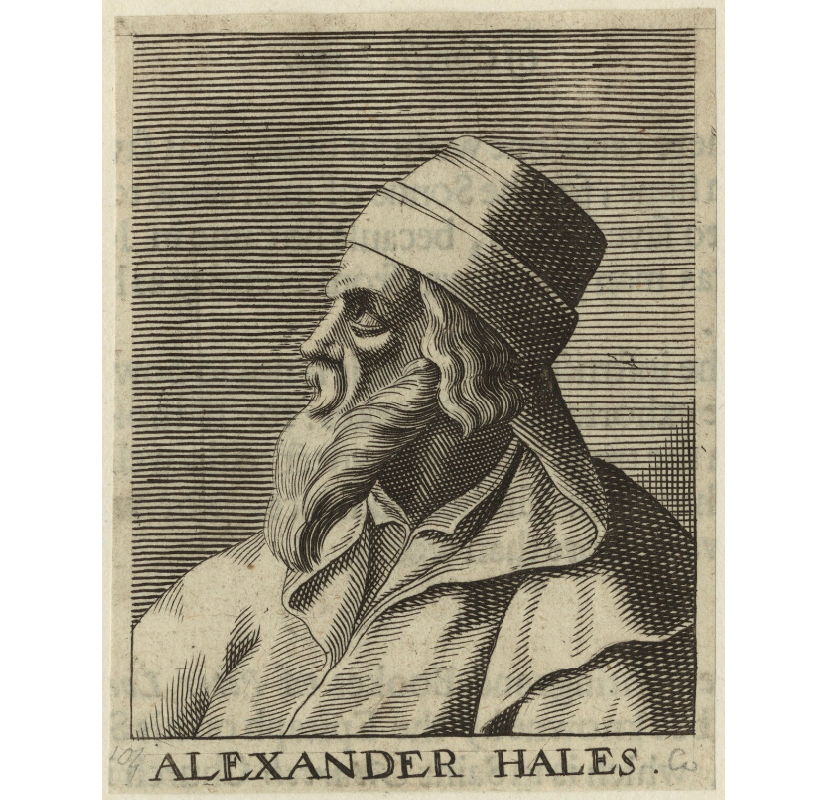
Alexander of Hales (also Halensis, Alensis, Halesius, Alesius /əˈliːsiəs/; c. 1185 – 21 August 1245)—known also as Doctor Irrefragibilis, or "Irrefutable Teacher" (so-called by Pope Alexander IV in the bull De Fontibus Paradisi), and as Theologorum Monarcha (or "King of Theologians")—was a Franciscan friar, theologian, and philosopher instrumental to the development of scholasticism.
Alexander was born at Hales, Shropshire (today Halesowen, West Midlands), England, between 1180 and 1186. He came from a rather wealthy country family, studied at the University of Paris, and became a master of arts sometime before 1210. He began to read theology in 1212 or 1213, and became a regent master in 1220 or 1221. He introduced the Sentences of Peter Lombard as the basic textbook for the study of theology. During the University strike of 1229, Alexander participated in an embassy to Rome to discuss the place of Aristotle in the curriculum. Having held a prebend at Holborn (prior to 1229) and a canonry of St. Paul's in London (1226–1229), he visited England in 1230 and received a canonry and an archdeaconry in Coventry and Lichfield, his native diocese. He taught at Paris in the academic year 1232–33, but was appointed to a delegation by Henry III of England in 1235, along with Simon Langton and Fulk Basset, to negotiate the renewal of the peace between England and France.
In 1236 or 1237, aged about 50, Alexander entered the Franciscan Order after considering both the Cistercians and the Dominicans. He thus became the first Franciscan friar to hold a university chair. His doctrinal positions became the starting point of the Franciscan school of theology. He continued to teach and to represent the university, and participated in the First Council of Lyon in the winter of 1245.
After returning to Paris, Alexander fell ill, possibly due to an epidemic then sweeping the city. He passed his chair on to John of La Rochelle, setting the precedent for that chair to be held by a Franciscan, and soon after died in Paris on 21 August 1245.
As the first Franciscan to hold a chair at the University of Paris, Alexander had many significant disciples. He was called Doctor Irrefragibilis (Irrefutable Teacher) and Doctor Doctorum (Teacher of Teachers). The latter title is especially suggestive of his role in educating several Franciscans who later became influential thinkers in the faculty, among them Bonaventure, John of La Rochelle, Odo Rigaldus, William of Middleton, and Richard Rufus of Cornwall. Bonaventure, who may not have studied under Alexander directly, nevertheless referred to him as his "father and master" and wished to "follow in his footsteps."
Alexander is known for reflecting the works of several other Middle Age thinkers, especially those of Anselm of Canterbury and Augustine of Hippo. He was also known to quote thinkers such as Bernard of Clairvaux and Richard of Saint-Victor. He differs from those in his genre as he is known to reflect his own interests and those of his generation. When using the works of his authorities, Alexander does not only review their reasoning but also gives conclusions, expands on them, and offers his agreements and disagreement with them. He also differed in that he appealed to pre-Lombardian figures, and by referencing Anselm of Canterbury and Bernard of Clairvaux, whose works were not cited as frequently by other 12th-century scholastics. Aristotle is also quite frequently quoted in Alexander's works. Alexander was fascinated by the Pseudo-Dionysian hierarchy of angels and in how their nature can be understood, given Aristotelian metaphysics.
Among the doctrines which were specially developed and, so to speak, fixed by Alexander of Hales, are the thesaurus supererogationis perfectorum (treasury of supererogatory merits) and the character indelibilis (sacramental character) of baptism, confirmation, and ordination. That doctrine had been written about much earlier by Augustine and was eventually defined a dogma by the Council of Trent. He also posed an important question about the cause of the Incarnation: would Christ have been incarnated if humanity had never sinned? The question eventually became the focal point for a philosophical issue (the theory of possible worlds) and a theological topic on the distinction between God's absolute power (potentia absoluta) and His ordained power (potentia ordinata).
Alexander wrote a summary and commentary of Peter Lombard's four books of the Sentences. It had exposed the trinitarian theology of the Greeks. This had been the most important writing that Alexander had claimed, and it had been the earliest in the genre. While it is common for scholars to state that Alexander was the first to write a commentary on the Sentences of Peter Lombard, it is not quite accurate. Authorship is more contentious for this work; although he started this work, he died before it could be finished, and it most likely was more a product of people other than Alexander. There were a number of "commentaries" on the Sentences, but Alexander's appears to have been the first magisterial commentary. Although it was Alexander's most significant writing, it had not been completed, therefore leaving historians with many questions on the reliability and quality of the writing. This was taken into consideration when the Summa had been examined by Victorin Doucet for different editions of them. The sources has seem to be the resulting problem of the Summa, "counted there were 4814 explicit quotations and 1372 implicit quotations from Augustine, more than one quarter of texts were cited in the body of the Summa.[incomprehensible]
Alexander of Hales
Alexander of Hales (also Halensis, Alensis, Halesius, Alesius /əˈliːsiəs/; c. 1185 – 21 August 1245)—known also as Doctor Irrefragibilis, or "Irrefutable Teacher" (so-called by Pope Alexander IV in the bull De Fontibus Paradisi), and as Theologorum Monarcha (or "King of Theologians")—was a Franciscan friar, theologian, and philosopher instrumental to the development of scholasticism.
Alexander was born at Hales, Shropshire (today Halesowen, West Midlands), England, between 1180 and 1186. He came from a rather wealthy country family, studied at the University of Paris, and became a master of arts sometime before 1210. He began to read theology in 1212 or 1213, and became a regent master in 1220 or 1221. He introduced the Sentences of Peter Lombard as the basic textbook for the study of theology. During the University strike of 1229, Alexander participated in an embassy to Rome to discuss the place of Aristotle in the curriculum. Having held a prebend at Holborn (prior to 1229) and a canonry of St. Paul's in London (1226–1229), he visited England in 1230 and received a canonry and an archdeaconry in Coventry and Lichfield, his native diocese. He taught at Paris in the academic year 1232–33, but was appointed to a delegation by Henry III of England in 1235, along with Simon Langton and Fulk Basset, to negotiate the renewal of the peace between England and France.
In 1236 or 1237, aged about 50, Alexander entered the Franciscan Order after considering both the Cistercians and the Dominicans. He thus became the first Franciscan friar to hold a university chair. His doctrinal positions became the starting point of the Franciscan school of theology. He continued to teach and to represent the university, and participated in the First Council of Lyon in the winter of 1245.
After returning to Paris, Alexander fell ill, possibly due to an epidemic then sweeping the city. He passed his chair on to John of La Rochelle, setting the precedent for that chair to be held by a Franciscan, and soon after died in Paris on 21 August 1245.
As the first Franciscan to hold a chair at the University of Paris, Alexander had many significant disciples. He was called Doctor Irrefragibilis (Irrefutable Teacher) and Doctor Doctorum (Teacher of Teachers). The latter title is especially suggestive of his role in educating several Franciscans who later became influential thinkers in the faculty, among them Bonaventure, John of La Rochelle, Odo Rigaldus, William of Middleton, and Richard Rufus of Cornwall. Bonaventure, who may not have studied under Alexander directly, nevertheless referred to him as his "father and master" and wished to "follow in his footsteps."
Alexander is known for reflecting the works of several other Middle Age thinkers, especially those of Anselm of Canterbury and Augustine of Hippo. He was also known to quote thinkers such as Bernard of Clairvaux and Richard of Saint-Victor. He differs from those in his genre as he is known to reflect his own interests and those of his generation. When using the works of his authorities, Alexander does not only review their reasoning but also gives conclusions, expands on them, and offers his agreements and disagreement with them. He also differed in that he appealed to pre-Lombardian figures, and by referencing Anselm of Canterbury and Bernard of Clairvaux, whose works were not cited as frequently by other 12th-century scholastics. Aristotle is also quite frequently quoted in Alexander's works. Alexander was fascinated by the Pseudo-Dionysian hierarchy of angels and in how their nature can be understood, given Aristotelian metaphysics.
Among the doctrines which were specially developed and, so to speak, fixed by Alexander of Hales, are the thesaurus supererogationis perfectorum (treasury of supererogatory merits) and the character indelibilis (sacramental character) of baptism, confirmation, and ordination. That doctrine had been written about much earlier by Augustine and was eventually defined a dogma by the Council of Trent. He also posed an important question about the cause of the Incarnation: would Christ have been incarnated if humanity had never sinned? The question eventually became the focal point for a philosophical issue (the theory of possible worlds) and a theological topic on the distinction between God's absolute power (potentia absoluta) and His ordained power (potentia ordinata).
Alexander wrote a summary and commentary of Peter Lombard's four books of the Sentences. It had exposed the trinitarian theology of the Greeks. This had been the most important writing that Alexander had claimed, and it had been the earliest in the genre. While it is common for scholars to state that Alexander was the first to write a commentary on the Sentences of Peter Lombard, it is not quite accurate. Authorship is more contentious for this work; although he started this work, he died before it could be finished, and it most likely was more a product of people other than Alexander. There were a number of "commentaries" on the Sentences, but Alexander's appears to have been the first magisterial commentary. Although it was Alexander's most significant writing, it had not been completed, therefore leaving historians with many questions on the reliability and quality of the writing. This was taken into consideration when the Summa had been examined by Victorin Doucet for different editions of them. The sources has seem to be the resulting problem of the Summa, "counted there were 4814 explicit quotations and 1372 implicit quotations from Augustine, more than one quarter of texts were cited in the body of the Summa.[incomprehensible]
Recent media
Recent media