
Recent from talks
Whitefly
Knowledge base stats:
Talk channels stats:
Members stats:
Whitefly
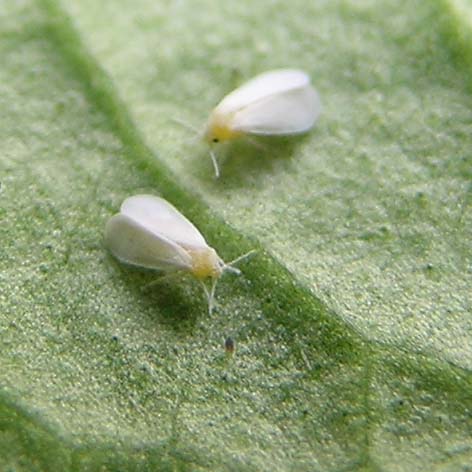
Whiteflies are Hemipterans that typically feed on the undersides of plant leaves. They comprise the family Aleyrodidae, the only family in the superfamily Aleyrodoidea. More than 1550 species have been described.
The Aleyrodidae are a family in the suborder Sternorrhyncha and at present comprise the entire superfamily Aleyrodoidea, related to the superfamily Psylloidea. The family often occurs in older literature as "Aleurodidae", but that is a junior synonym and accordingly incorrect in terms of the international standards for zoological nomenclature.
Aleyrodidae are small insects, most species with a wingspan of less than 3 mm and a body length of 1 mm to 2 mm. Many are so small that their size complicates their control in greenhouses because they can only be excluded by screening with very fine mesh; in fact they can enter mesh so fine that many of their natural enemies cannot come in after them, so that unchecked whitefly populations in greenhouses rapidly become overwhelming. Some "giant whitefly" species exist, some of which may exceed 5 mm in size. This sometimes is associated with sexual dimorphism in which one sex is markedly larger than the other. Such dimorphism is common in the Sternorrhyncha, in which the males of most scale insects for example are tiny compared to the female. Remarkably however, in some giant tropical species the males are much larger than the females.
Like most of the mobile Sternorrhyncha, adult Aleyrodidae have well-developed antennae, which in most species in this family are seven-segmented.
As in many Hemiptera, there are two ocelli, which generally in the Aleyrodidae are placed at the anterior margins of the compound eyes. The compound eyes themselves are rather remarkable: many have a distinct constriction between the upper and lower halves, and in some species there is a complete separation. Many insects' compound eyes are divided into functionally and anatomically distinct upper and lower regions, but the adaptation's purpose or origin in Aleyrodidae is unclear. The degree of separation is useful in recognising the species; for instance, one way to tell adult Bemisia from Trialeurodes is that the upper and lower parts of the compound eyes are connected by a single ommatidium in Bemisia, while in Trialeurodes they are completely separate.
Both sexes have functional mouthparts and two pairs of membranous, functional wings; the rear wings are neither much reduced, nor modified into any such hooked or haltere-like structures as occur in some other Hemiptera such as many of the Coccoidea. The wing venation is reduced, like that of the Psyllidae, only generally much more so. In many genera there is only one conspicuous and unbranched vein in each wing; however, wings of larger species such as Udamoselis have less reduced venation, though their veins still are simple and few.
The insects and their wings are variously marked or mottled according to species, and many species are covered with fine wax powder, giving most species a floury, dusted appearance, hence names such as Aleyrodidae, Aleurodidae and Aleuroduplidens; the root refers to the Ancient Greek: αλευρώδης (aleurodes) meaning "floury". However, not all species are white; for example, Aleurocanthus woglumi is slaty black.
The legs of Aleyrodidae are well developed and fairly long, but gracile, and in contrast to Psyllidae, not adapted to leaping. The tarsi have two segments of roughly equal length. The pretarsus has paired claws, with an empodium between—in some species the empodium is a bristle, but in others it is a pad.
Hub AI
Whitefly AI simulator
(@Whitefly_simulator)
Whitefly
Whiteflies are Hemipterans that typically feed on the undersides of plant leaves. They comprise the family Aleyrodidae, the only family in the superfamily Aleyrodoidea. More than 1550 species have been described.
The Aleyrodidae are a family in the suborder Sternorrhyncha and at present comprise the entire superfamily Aleyrodoidea, related to the superfamily Psylloidea. The family often occurs in older literature as "Aleurodidae", but that is a junior synonym and accordingly incorrect in terms of the international standards for zoological nomenclature.
Aleyrodidae are small insects, most species with a wingspan of less than 3 mm and a body length of 1 mm to 2 mm. Many are so small that their size complicates their control in greenhouses because they can only be excluded by screening with very fine mesh; in fact they can enter mesh so fine that many of their natural enemies cannot come in after them, so that unchecked whitefly populations in greenhouses rapidly become overwhelming. Some "giant whitefly" species exist, some of which may exceed 5 mm in size. This sometimes is associated with sexual dimorphism in which one sex is markedly larger than the other. Such dimorphism is common in the Sternorrhyncha, in which the males of most scale insects for example are tiny compared to the female. Remarkably however, in some giant tropical species the males are much larger than the females.
Like most of the mobile Sternorrhyncha, adult Aleyrodidae have well-developed antennae, which in most species in this family are seven-segmented.
As in many Hemiptera, there are two ocelli, which generally in the Aleyrodidae are placed at the anterior margins of the compound eyes. The compound eyes themselves are rather remarkable: many have a distinct constriction between the upper and lower halves, and in some species there is a complete separation. Many insects' compound eyes are divided into functionally and anatomically distinct upper and lower regions, but the adaptation's purpose or origin in Aleyrodidae is unclear. The degree of separation is useful in recognising the species; for instance, one way to tell adult Bemisia from Trialeurodes is that the upper and lower parts of the compound eyes are connected by a single ommatidium in Bemisia, while in Trialeurodes they are completely separate.
Both sexes have functional mouthparts and two pairs of membranous, functional wings; the rear wings are neither much reduced, nor modified into any such hooked or haltere-like structures as occur in some other Hemiptera such as many of the Coccoidea. The wing venation is reduced, like that of the Psyllidae, only generally much more so. In many genera there is only one conspicuous and unbranched vein in each wing; however, wings of larger species such as Udamoselis have less reduced venation, though their veins still are simple and few.
The insects and their wings are variously marked or mottled according to species, and many species are covered with fine wax powder, giving most species a floury, dusted appearance, hence names such as Aleyrodidae, Aleurodidae and Aleuroduplidens; the root refers to the Ancient Greek: αλευρώδης (aleurodes) meaning "floury". However, not all species are white; for example, Aleurocanthus woglumi is slaty black.
The legs of Aleyrodidae are well developed and fairly long, but gracile, and in contrast to Psyllidae, not adapted to leaping. The tarsi have two segments of roughly equal length. The pretarsus has paired claws, with an empodium between—in some species the empodium is a bristle, but in others it is a pad.
Recent media